QUESTION IMAGE
Question
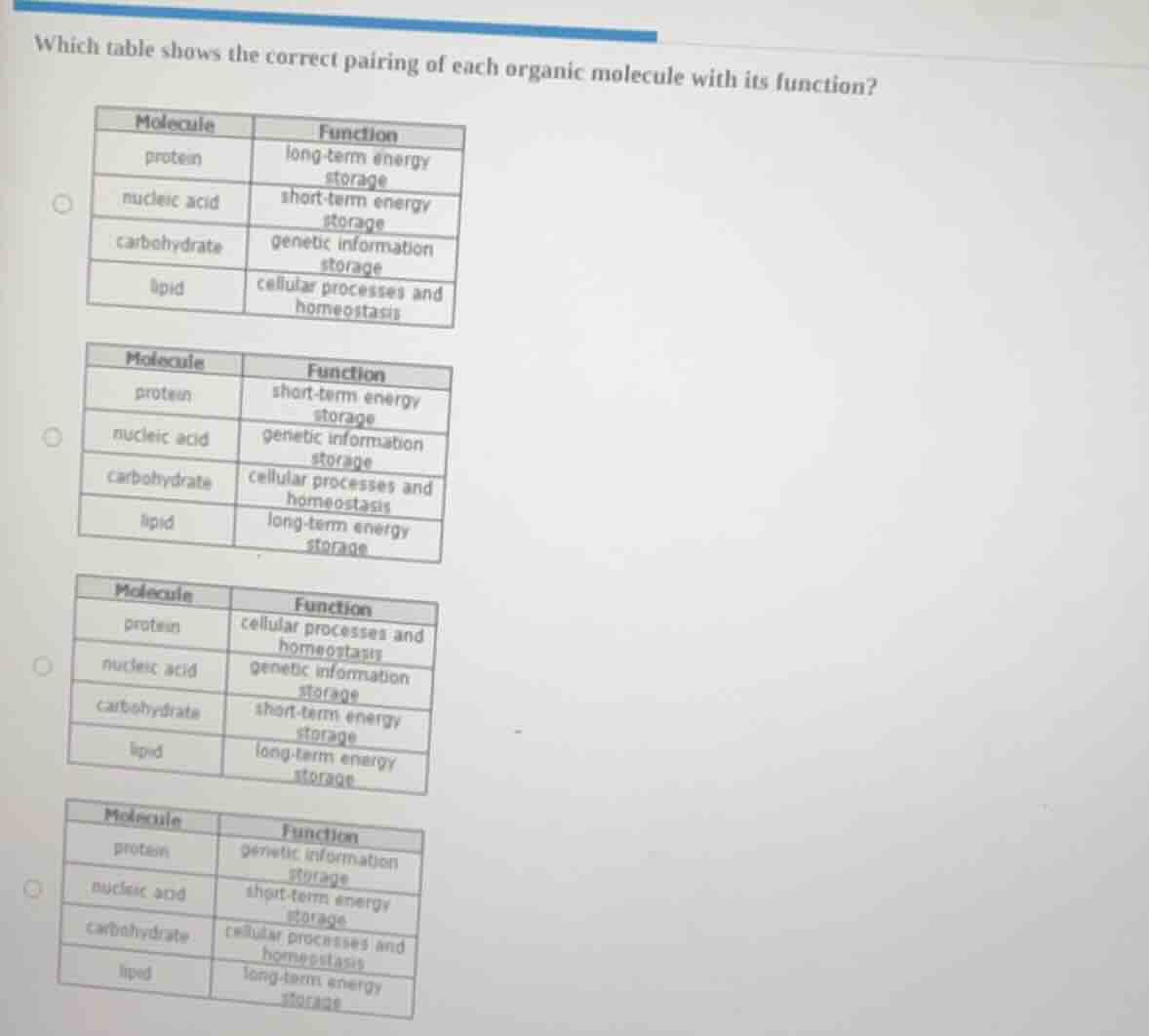
which table shows the correct pairing of each organic molecule with its function?
| molecule | function |
|---|---|
| nucleic acid | short - term energy storage |
| carbohydrate | genetic information storage |
| lipid | cellular processes and homeostasis |
| molecule | function |
|---|---|
| nucleic acid | genetic information storage |
| carbohydrate | cellular processes and homeostasis |
| lipid | long - term energy storage |
| molecule | function |
|---|---|
| nucleic acid | genetic information storage |
| carbohydrate | short - term energy storage |
| lipid | long - term energy storage |
| molecule | function |
|---|---|
| nucleic acid | short - term energy storage |
| carbohydrate | cellular processes and homeostasis |
| lipid | long - term energy storage |
Brief Explanations
- Proteins carry out cellular processes and maintain homeostasis (e.g., enzymes, structural proteins).
- Nucleic acids (DNA/RNA) store and transmit genetic information.
- Carbohydrates provide short-term energy storage (e.g., glucose, glycogen).
- Lipids are used for long-term energy storage (e.g., fat cells) and cell structure.
By matching each molecule to its core function, we identify the correct table.

Snap & solve any problem in the app
Get step-by-step solutions on Sovi AI
Photo-based solutions with guided steps
Explore more problems and detailed explanations
The third table (with the following pairings):
protein - cellular processes and homeostasis
nucleic acid - genetic information storage
carbohydrate - short-term energy storage
lipid - long-term energy storage