QUESTION IMAGE
Question
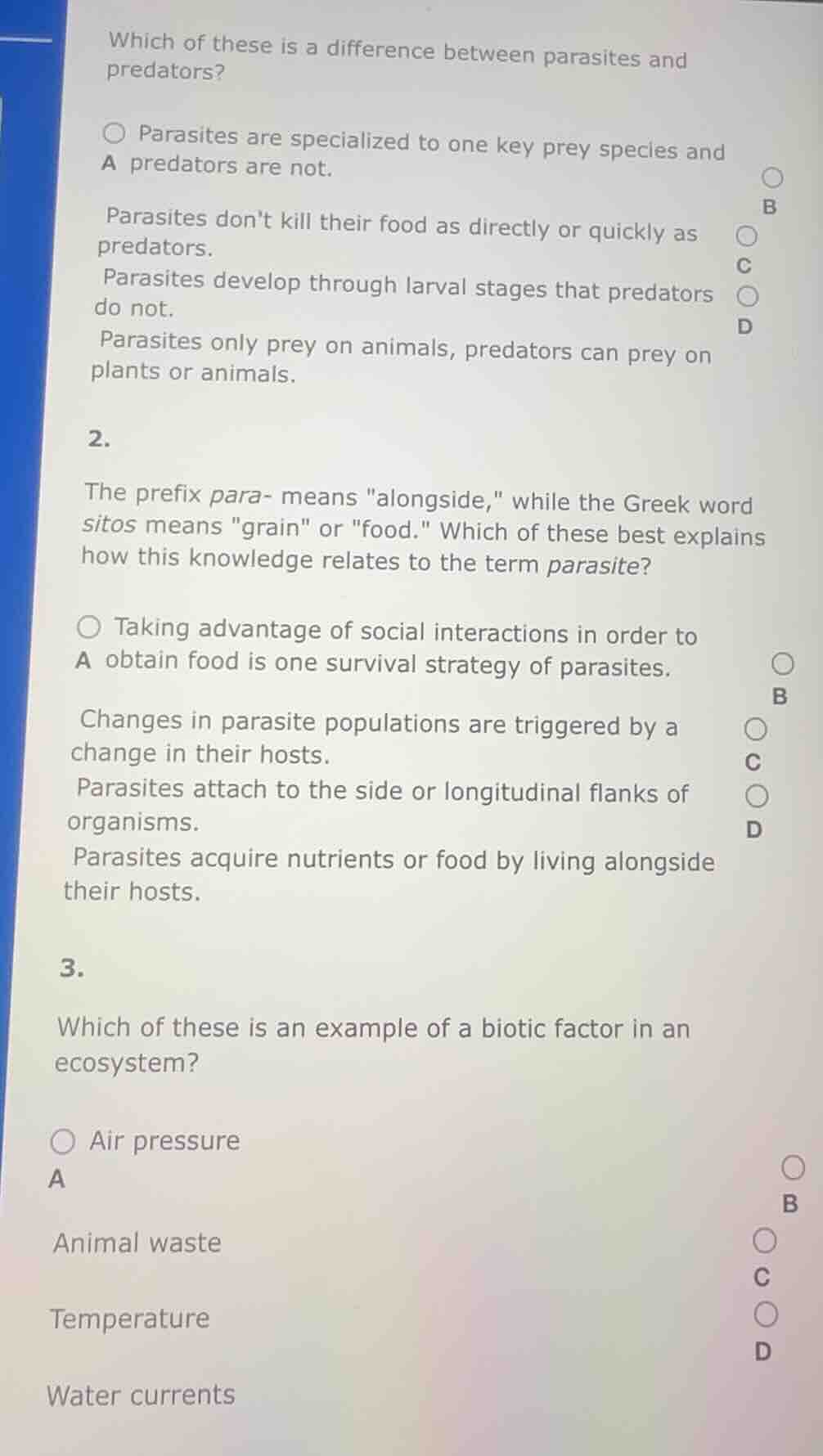
which of these is a difference between parasites and predators?
a parasites are specialized to one key prey species and predators are not.
parasites dont kill their food as directly or quickly as predators.
parasites develop through larval stages that predators do not.
parasites only prey on animals, predators can prey on plants or animals.
2.
the prefix para- means \alongside,\ while the greek word sitos means \grain\ or \food.\ which of these best explains how this knowledge relates to the term parasite?
a taking advantage of social interactions in order to obtain food is one survival strategy of parasites.
changes in parasite populations are triggered by a change in their hosts.
parasites attach to the side or longitudinal flanks of organisms.
parasites acquire nutrients or food by living alongside their hosts.
3.
which of these is an example of a biotic factor in an ecosystem?
a air pressure
animal waste
temperature
water currents
- For the first question: Parasites typically rely on a living host for nutrients over time, not killing them quickly, while predators directly and quickly kill their prey. Other options are incorrect—some predators are specialized, some parasites have no unique larval stages, and some predators only hunt animals.
- For the second question: The prefix "para-" (alongside) and "sitos" (food) directly align with parasites living alongside their hosts to obtain nutrients. The other options do not connect to the word's etymology.
- For the third question: Biotic factors are living or once-living components of an ecosystem. Animal waste is organic/once-living, while air pressure, temperature, and water currents are abiotic (non-living) factors.

Snap & solve any problem in the app
Get step-by-step solutions on Sovi AI
Photo-based solutions with guided steps
Explore more problems and detailed explanations
- B. Parasites don't kill their food as directly or quickly as predators.
- D. Parasites acquire nutrients or food by living alongside their hosts.
- B. Animal waste