QUESTION IMAGE
Question
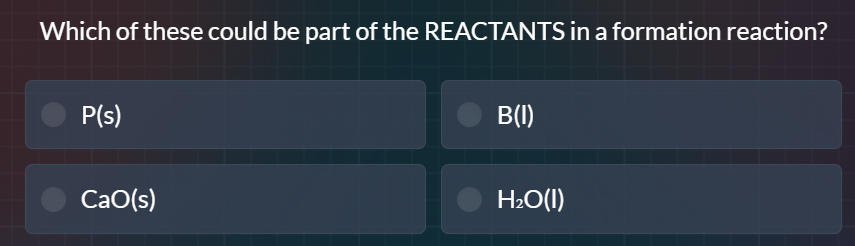
which of these could be part of the reactants in a formation reaction? p(s) b(l) cao(s) h₂o(l)
Response
To solve this, we first recall what a formation reaction is: a reaction where one mole of a compound is formed from its constituent elements in their standard states.
Step 1: Analyze each option
- \( P(s) \): Phosphorus (P) is an element in its standard state (solid for phosphorus). In a formation reaction, elements in their standard states are reactants to form a compound. So \( P(s) \) could be a reactant.
- \( B(l) \): Boron (B) is an element, but its standard state is solid (not liquid). So \( B(l) \) is not in its standard state and is less likely to be a reactant in a formation reaction.
- \( CaO(s) \): Calcium oxide (CaO) is a compound, not an element. Formation reactions form compounds from elements, so \( CaO(s) \) would be a product (or a reactant in a decomposition, not formation).
- \( H_2O(l) \): Water (\( H_2O \)) is a compound. Formation reactions form compounds from elements, so \( H_2O(l) \) would be a product (or a reactant in a reaction like hydrolysis, not formation).

Snap & solve any problem in the app
Get step-by-step solutions on Sovi AI
Photo-based solutions with guided steps
Explore more problems and detailed explanations
\( \boldsymbol{P(s)} \) (since it is an element in its standard state, suitable as a reactant in a formation reaction)