QUESTION IMAGE
Question
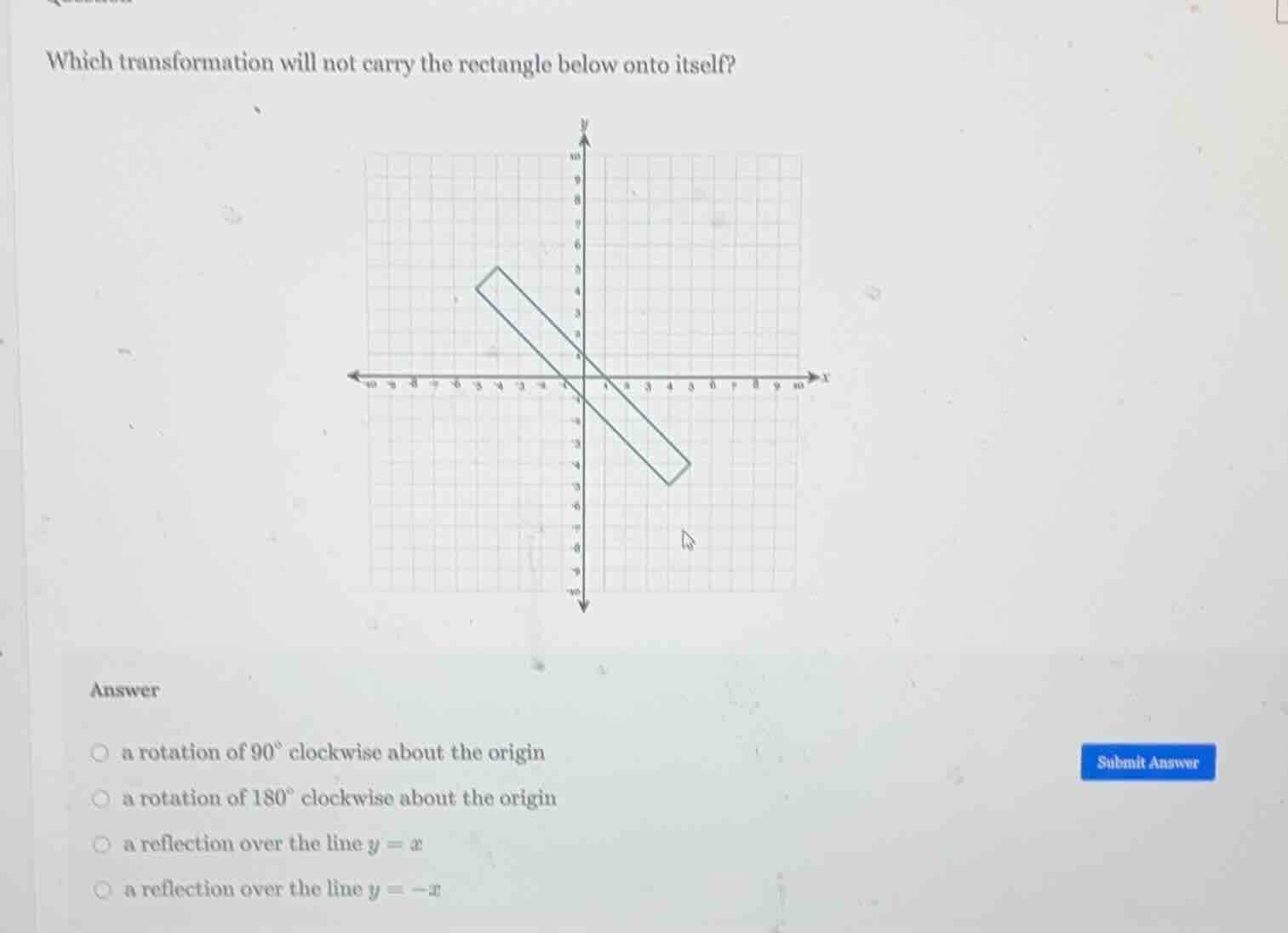
which transformation will not carry the rectangle below onto itself?
answer
\\(\circ\\) a rotation of \\(90^\circ\\) clockwise about the origin
\\(\circ\\) a rotation of \\(180^\circ\\) clockwise about the origin
\\(\circ\\) a reflection over the line \\(y = x\\)
\\(\circ\\) a reflection over the line \\(y = -x\\)
Step 1: Recall Rectangle Symmetry
A rectangle has rotational symmetry of order 2 (180° rotation) and reflection symmetry over lines through midpoints of opposite sides or diagonals (if it's a square, but here it's a non - square rectangle, but still has 180° rotational symmetry). Also, for a rectangle with vertices that are symmetric with respect to \(y = x\) or \(y=-x\) (from the graph, the rectangle is symmetric about the origin for 180° rotation and about \(y = x\), \(y=-x\) if its vertices satisfy the reflection properties).
Step 2: Analyze 90° Clockwise Rotation
A rectangle (non - square) does not have 90° rotational symmetry. When we rotate a rectangle 90° clockwise about the origin, the length and width will be swapped in a way that the image will not coincide with the original rectangle. For example, if we consider the coordinates of the rectangle's vertices, a 90° clockwise rotation \((x,y)\to(y, - x)\) will change the shape's orientation in a way that it won't map onto itself.
Step 3: Analyze 180° Clockwise Rotation
A 180° clockwise rotation \((x,y)\to(-x,-y)\) will map the rectangle onto itself because a rectangle is symmetric about the origin for 180° rotation. The opposite vertices will be mapped to each other, and the sides will align.
Step 4: Analyze Reflection over \(y = x\)
For a reflection over \(y=x\), the transformation is \((x,y)\to(y,x)\). From the graph, the rectangle's vertices are symmetric with respect to the line \(y = x\), so this reflection will carry the rectangle onto itself.
Step 5: Analyze Reflection over \(y=-x\)
The reflection over \(y = - x\) is \((x,y)\to(-y,-x)\). The rectangle's vertices are symmetric with respect to the line \(y=-x\) (since it's symmetric about the origin and the line \(y = - x\) is also a line of symmetry for this rectangle's orientation), so this reflection will carry the rectangle onto itself.

Snap & solve any problem in the app
Get step-by-step solutions on Sovi AI
Photo-based solutions with guided steps
Explore more problems and detailed explanations
a rotation of \(90^{\circ}\) clockwise about the origin