QUESTION IMAGE
Question
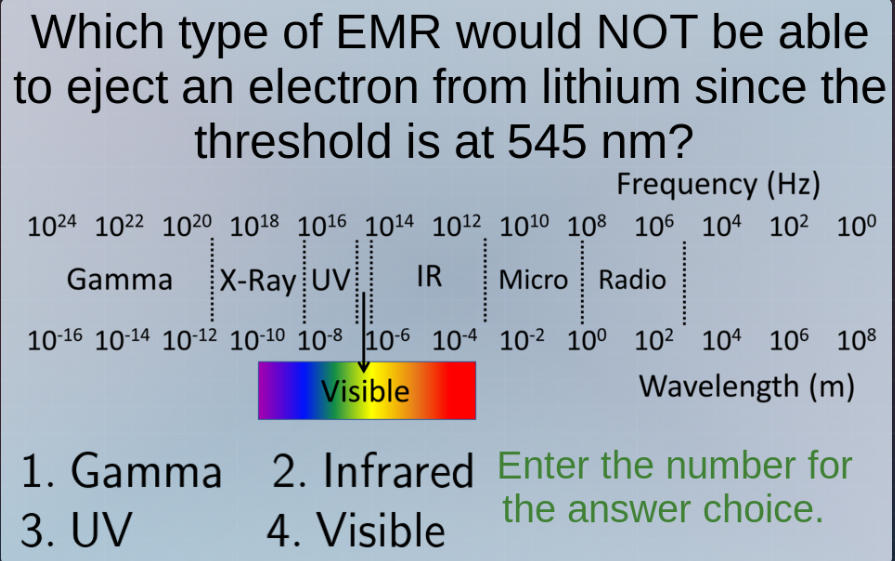
which type of emr would not be able to eject an electron from lithium since the threshold is at 545 nm?
frequency (hz)
$10^{24}$ $10^{22}$ $10^{20}$ $10^{18}$ $10^{16}$ $10^{14}$ $10^{12}$ $10^{10}$ $10^{8}$ $10^{6}$ $10^{4}$ $10^{2}$ $10^{0}$
gamma x-ray uv ir micro radio
$10^{-16}$ $10^{-14}$ $10^{-12}$ $10^{-10}$ $10^{-8}$ $10^{-6}$ $10^{-4}$ $10^{-2}$ $10^{0}$ $10^{2}$ $10^{4}$ $10^{6}$ $10^{8}$
wavelength (m)
visible
- gamma 2. infrared enter the number for
the answer choice.
- uv 4. visible
Step1: Relate wavelength to energy
Electromagnetic radiation (EMR) with longer wavelength has lower energy. To not eject an electron from lithium, the EMR must have energy below the threshold (545 nm, meaning wavelength > 545 nm).
Step2: Match options to wavelength scale
From the spectrum: Gamma, UV, and Visible have shorter wavelengths than 545 nm. Infrared (IR) has longer wavelengths than visible light (and thus longer than 545 nm), so its energy is too low to eject an electron.

Snap & solve any problem in the app
Get step-by-step solutions on Sovi AI
Photo-based solutions with guided steps
Explore more problems and detailed explanations
- Infrared