QUESTION IMAGE
Question
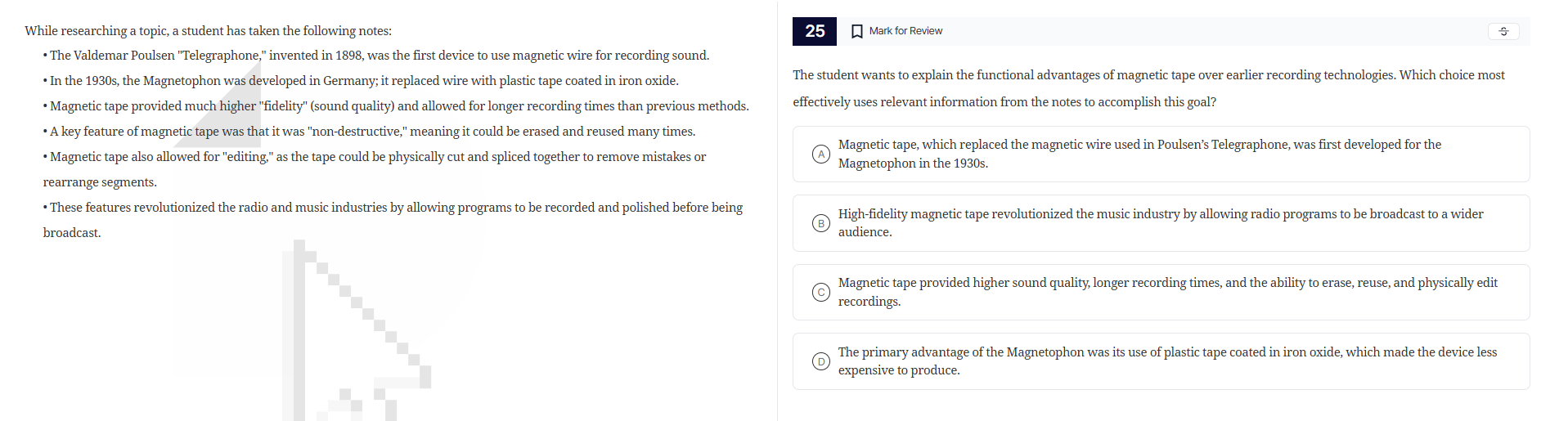
while researching a topic, a student has taken the following notes: • the valdemar poulsen \telegraphone,\ invented in 1898, was the first device to use magnetic wire for recording sound. • in the 1930s, the magnetophon was developed in germany; it replaced wire with plastic tape coated in iron oxide. • magnetic tape provided much higher \fidelity\ (sound quality) and allowed for longer recording times than previous methods. • a key feature of magnetic tape was that it was
on - destructive,\ meaning it could be erased and reused many times. • magnetic tape also allowed for \editing,\ as the tape could be physically cut and spliced together to remove mistakes or rearrange segments. • these features revolutionized the radio and music industries by allowing programs to be recorded and polished before being broadcast. 25 mark for review the student wants to explain the functional advantages of magnetic tape over earlier recording technologies. which choice most effectively uses relevant information from the notes to accomplish this goal? a magnetic tape, which replaced the magnetic wire used in poulsen’s telegraphone, was first developed for the magnetophon in the 1930s. b high - fidelity magnetic tape revolutionized the music industry by allowing radio programs to be broadcast to a wider audience. c magnetic tape provided higher sound quality, longer recording times, and the ability to erase, reuse, and physically edit recordings. d the primary advantage of the magnetophon was its use of plastic tape coated in iron oxide, which made the device less expensive to produce.
To determine the correct answer, we analyze each option:
- Option A: Focuses on the development history (Magnetophon in 1930s) rather than the functional advantages of magnetic tape over earlier technologies. Eliminate.
- Option B: Mentions "broadcast to a wider audience," which is not a functional advantage of magnetic tape over earlier recording methods (the notes don't mention audience reach as an advantage of the tape itself). Eliminate.
- Option C: Directly lists the functional advantages from the notes: higher sound quality (fidelity), longer recording times, non - destructive (erase/reuse), and editing (cut/splice). This matches the goal of explaining the functional advantages of magnetic tape over earlier technologies.
- Option D: Talks about the Magnetophon's production cost, which is not related to the functional advantages of magnetic tape over earlier recording technologies. Eliminate.

Snap & solve any problem in the app
Get step-by-step solutions on Sovi AI
Photo-based solutions with guided steps
Explore more problems and detailed explanations
C. Magnetic tape provided higher sound quality, longer recording times, and the ability to erase, reuse, and physically edit recordings.