QUESTION IMAGE
Question
who is in charge?
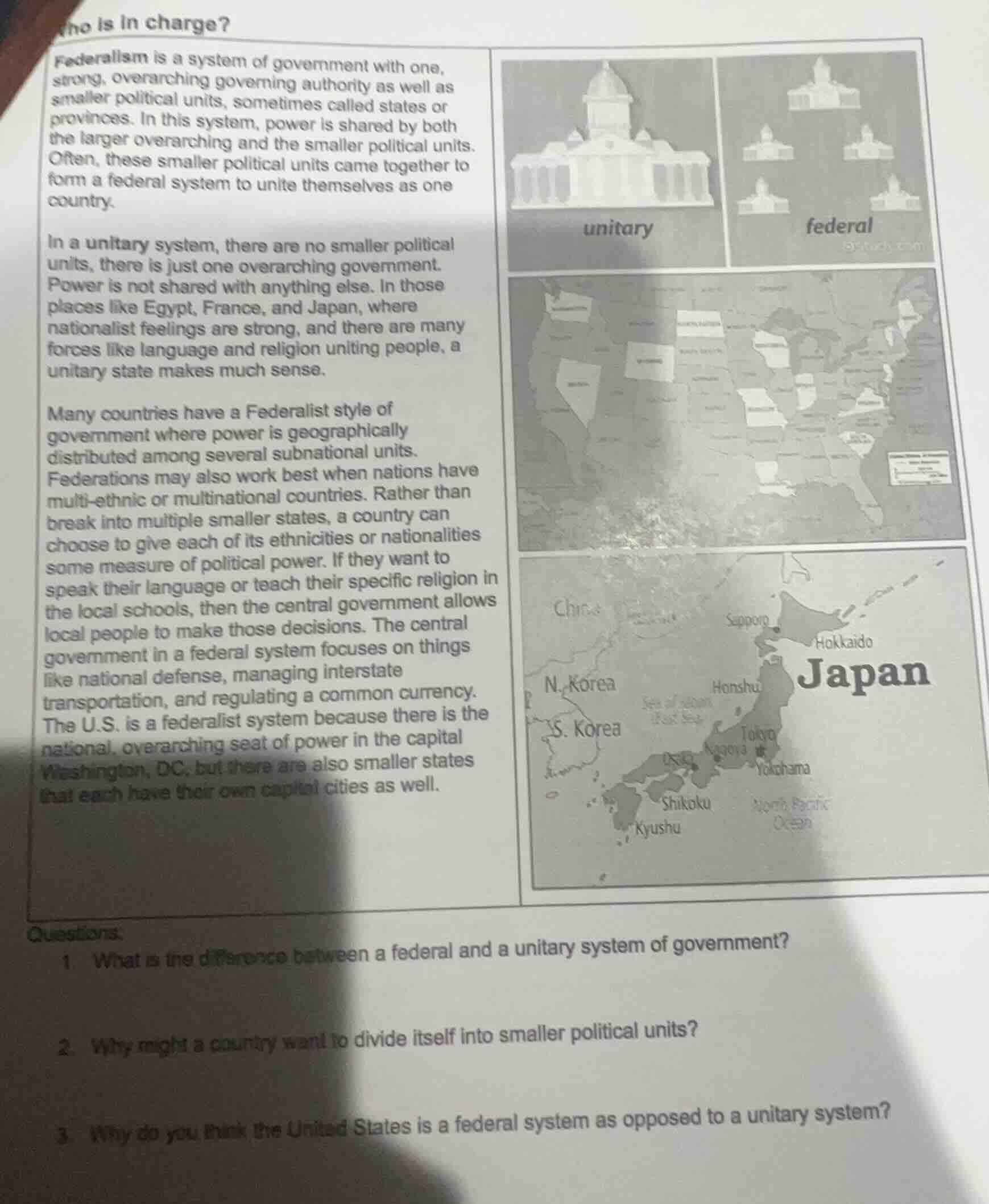
federalism is a system of government with one, strong, overarching governing authority as well as smaller political units, sometimes called states or provinces. in this system, power is shared by both the larger overarching and the smaller political units. often, these smaller political units came together to form a federal system to unite themselves as one country.
in a unitary system, there are no smaller political units, there is just one overarching government. power is not shared with anything else. in those places like egypt, france, and japan, where nationalist feelings are strong, and there are many forces like language and religion uniting people, a unitary state makes much sense.
many countries have a federalist style of government where power is geographically distributed among several subnational units. federations may also work best when nations have multi - ethnic or multinational countries. rather than break into multiple smaller states, a country can choose to give each of its ethnicities or nationalities some measure of political power. if they want to speak their language or teach their specific religion in the local schools, then the central government allows local people to make those decisions. the central government in a federal system focuses on things like national defense, managing interstate transportation, and regulating a common currency. the u.s. is a federalist system because there is the national, overarching seat of power in the capital washington, dc, but there are also smaller states that each have their own capital cities as well.
questions:
- what is the difference between a federal and a unitary system of government?
- why might a country want to divide itself into smaller political units?
- why do you think the united states is a federal system as opposed to a unitary system?
- For the first question: The core difference lies in power distribution and the existence of subnational political units. A federal system splits power between a central authority and smaller subnational units, while a unitary system concentrates all power in a single central government with no independent smaller political units.
- For the second question: Countries may split into smaller units to grant political power to distinct ethnic/national groups, allowing local control over cultural matters like language or religion, which helps unify diverse populations instead of splitting into separate nations.
- For the third question: The U.S. uses a federal system because it has a central national government (based in Washington, D.C.) alongside individual states with their own local governing bodies; this structure allows power to be shared, with the federal government handling national-level issues (like defense, interstate transport) and states managing local affairs.

Snap & solve any problem in the app
Get step-by-step solutions on Sovi AI
Photo-based solutions with guided steps
Explore more problems and detailed explanations
- A federal system shares power between a strong central governing authority and smaller, independent subnational political units (states/provinces). A unitary system has only one central governing authority, with no smaller political units, and all power is held by this single central body.
- A country might divide into smaller political units to give distinct ethnic or national groups a measure of local political power, allowing them to make decisions about cultural matters (like local language or religious education) while remaining unified as one nation, rather than splitting into separate countries.
- The United States is a federal system because it has an overarching national government (based in Washington, D.C.) focused on national issues (like defense, interstate transportation, currency regulation), while also having individual states that each have their own governing bodies and control over local affairs, meaning power is shared between the central authority and subnational units instead of being concentrated in a single unitary government.