QUESTION IMAGE
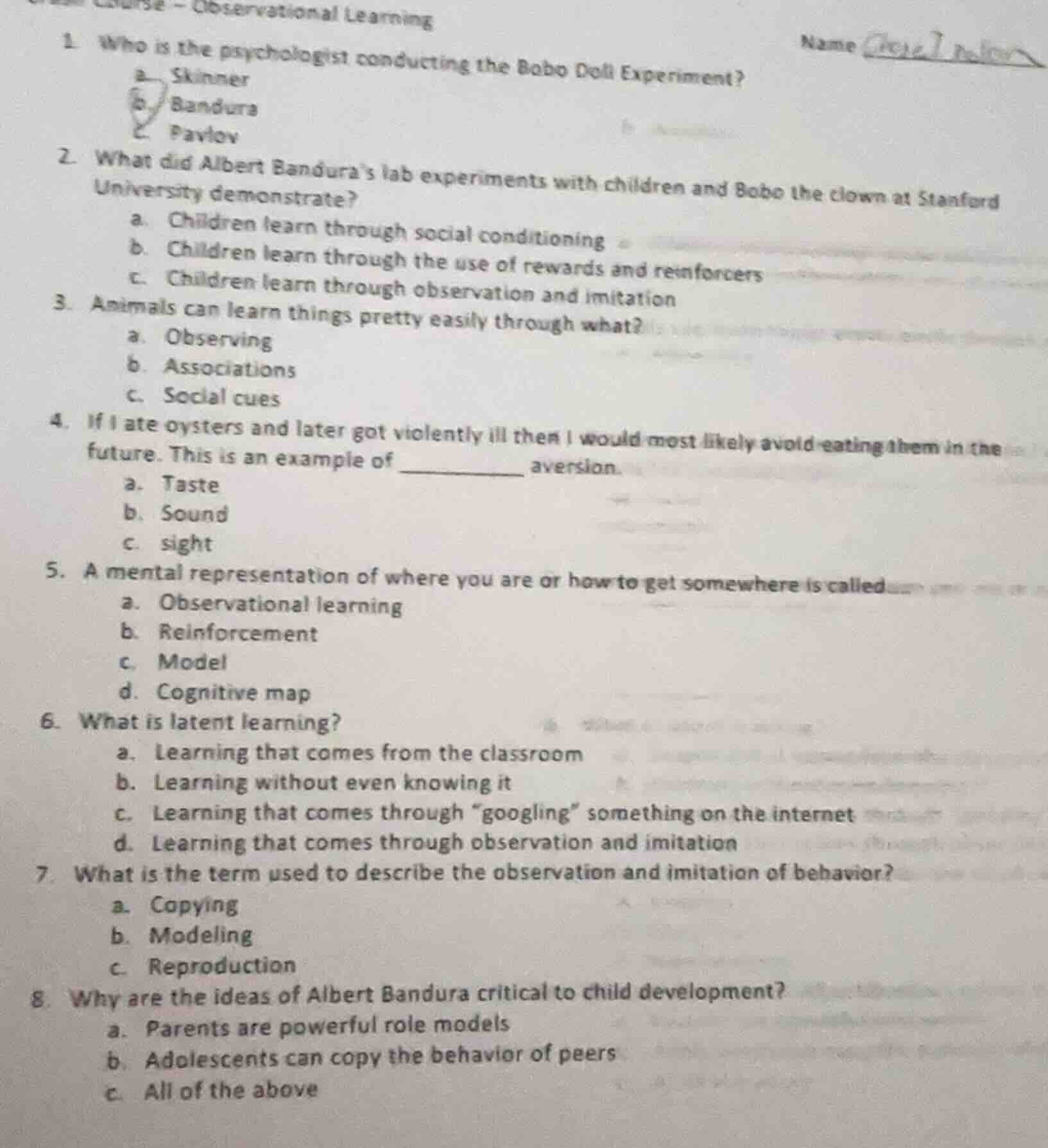
Question
1 who is the psychologist conducting the bobo doll experiment?
a skinner
b bandura
c pavlov
2 what did albert bandura’s lab experiments with children and bobo the clown at stanford university demonstrate?
a children learn through social conditioning
b children learn through the use of rewards and reinforcers
c children learn through observation and imitation
3 animals can learn things pretty easily through what?
a observing
b associations
c social cues
4 if i ate oysters and later got violently ill then i would most likely avoid eating them in the future. this is an example of _______ aversion.
a taste
b sound
c sight
5 a mental representation of where you are or how to get somewhere is called
a observational learning
b reinforcement
c model
d cognitive map
6 what is latent learning?
a learning that comes from the classroom
b learning without even knowing it
c learning that comes through “googling” something on the internet
d learning that comes through observation and imitation
7 what is the term used to describe the observation and imitation of behavior?
a copying
b modeling
c reproduction
8 why are the ideas of albert bandura critical to child development?
a parents are powerful role models
b adolescents can copy the behavior of peers
c all of the above
Question 1
The Bobo Doll Experiment was conducted by Albert Bandura to study observational learning. Skinner is known for operant conditioning, and Pavlov for classical conditioning.
Bandura's Bobo Doll Experiment showed that children learn aggressive behavior through observing and imitating adults. Social conditioning (a) is broader, and rewards/reinforcers (b) relate to operant conditioning, not this experiment.
Animals often learn through associations (classical or operant conditioning, e.g., Pavlov's dogs). Observing (a) is more for social learning (common in humans), and social cues (c) are more complex social interactions.

Snap & solve any problem in the app
Get step-by-step solutions on Sovi AI
Photo-based solutions with guided steps
Explore more problems and detailed explanations
b. Bandura