QUESTION IMAGE
Question
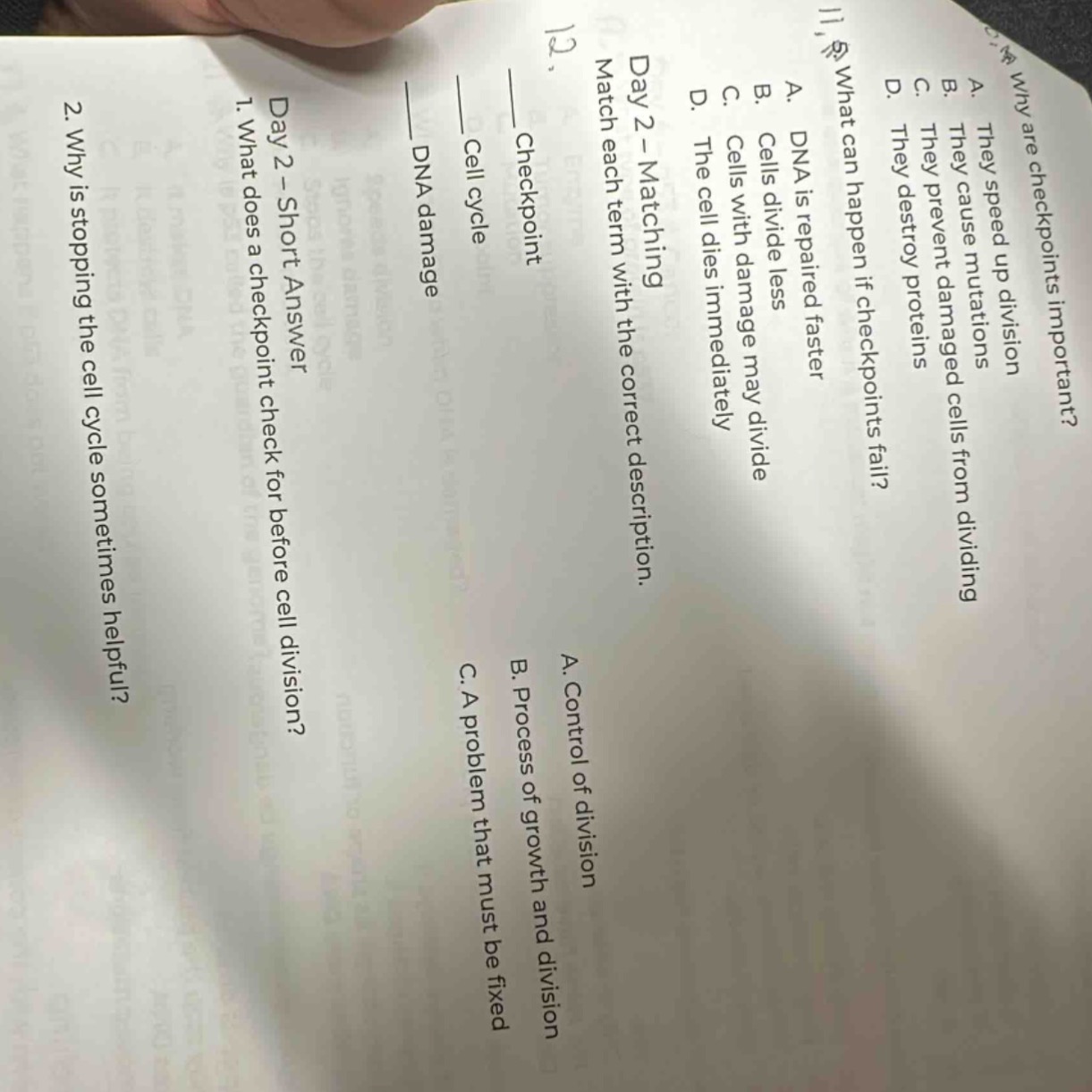
why are checkpoints important?
a. they speed up division
b. they cause mutations
c. they prevent damaged cells from dividing
d. they destroy proteins
- what can happen if checkpoints fail?
a. dna is repaired faster
b. cells divide less
c. cells with damage may divide
d. the cell dies immediately
- day 2 – matching
match each term with the correct description.
____ checkpoint
____ cell cycle
____ dna damage
a. control of division
b. process of growth and division
c. a problem that must be fixed
day 2 – short answer
- what does a checkpoint check for before cell division?
- why is stopping the cell cycle sometimes helpful?
Step1: Answer checkpoint importance
Checkpoints monitor cell health pre-division.
Step2: Answer checkpoint failure outcome
Failed checkpoints let damaged cells divide.
Step3: Match checkpoint to description
Checkpoints are division controls.
Step4: Match cell cycle to description
Cell cycle is growth/division process.
Step5: Match DNA damage to description
DNA damage is a fixable problem.
Step6: Answer checkpoint check purpose
Checkpoints verify cell readiness for division.
Step7: Answer cell cycle stop benefit
Stopping lets cells repair damage.

Snap & solve any problem in the app
Get step-by-step solutions on Sovi AI
Photo-based solutions with guided steps
Explore more problems and detailed explanations
11.
- Why are checkpoints important?
C. They prevent damaged cells from dividing
- What can happen if checkpoints fail?
C. Cells with damage may divide
12.
- Checkpoint: A. Control of division
- Cell cycle: B. Process of growth and division
- DNA damage: C. A problem that must be fixed
Day 2 - Short Answer
- A checkpoint checks for DNA damage, proper cell growth, and readiness (like sufficient resources) to ensure the cell is fit to divide.
- Stopping the cell cycle gives the cell time to repair DNA damage or correct errors, preventing the passing of mutations to daughter cells and avoiding the formation of abnormal or cancerous cells.