QUESTION IMAGE
Question
- why are fungi and bacteria important in a food web?
a. they are an important food source for primary consumers.
b. they are producers.
c. they help to recycle nutrients back into the soil.
d. they are an important food source for secondary consumers.
- which of the following will be at the top of an energy pyramid?
a. decomposer
b. producer
c. herbivore
d. carnivore
- in general, which types of organisms survive at the lowest energy level?
a. producers
b. primary consumers
c. tertiary consumers
d. decomposers
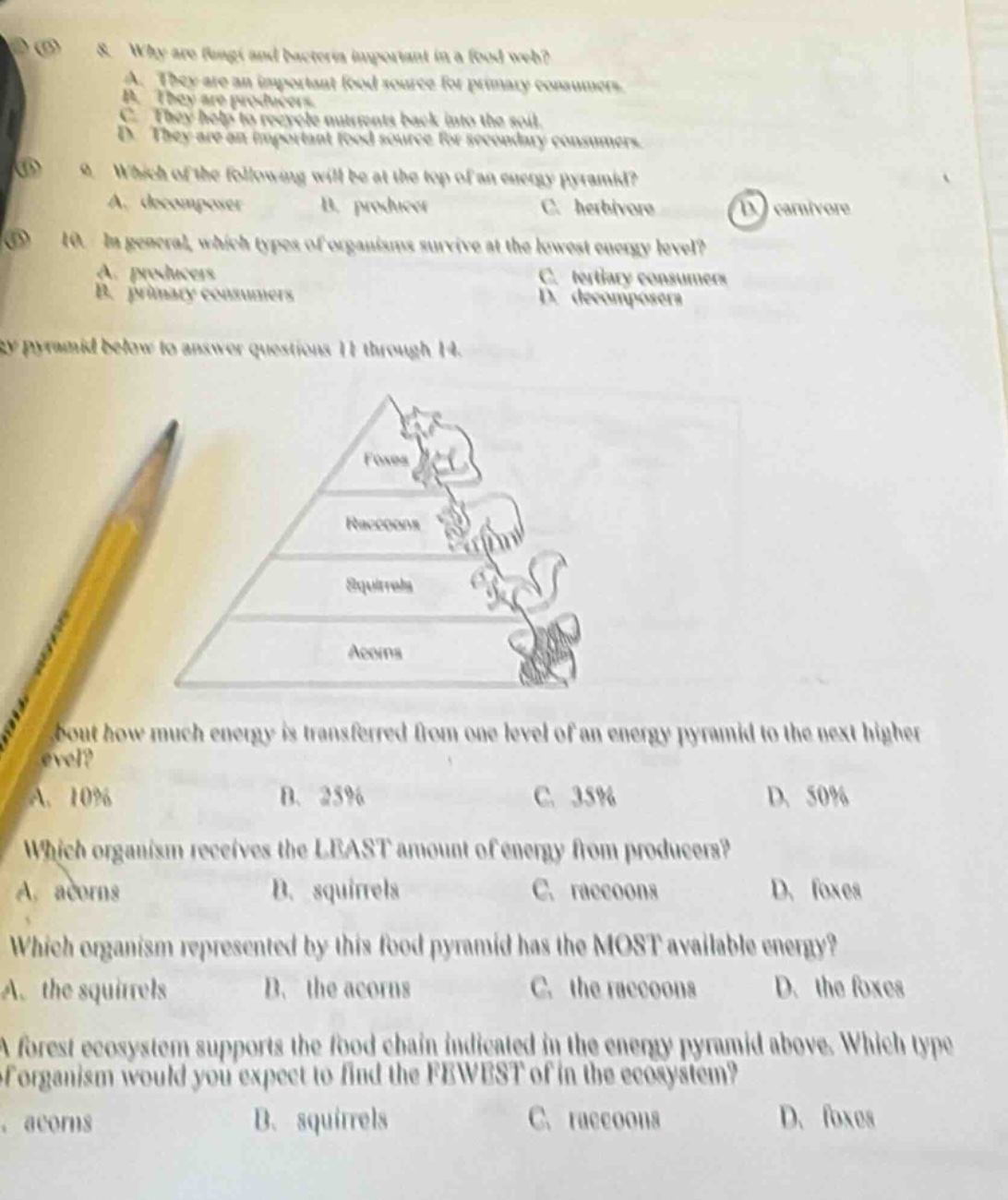
use the pyramid below to answer questions 11 through 14.
image of an energy pyramid with levels: acorns (bottom), squirrels, raccoons, foxes (top)
- about how much energy is transferred from one level of an energy pyramid to the next higher level?
a. 10%
b. 25%
c. 35%
d. 50%
- which organism receives the least amount of energy from producers?
a. acorns
b. squirrels
c. raccoons
d. foxes
- which organism represented by this food pyramid has the most available energy?
a. the squirrels
b. the acorns
c. the raccoons
d. the foxes
- a forest ecosystem supports the food chain indicated in the energy pyramid above. which type of organism would you expect to find the fewest of in the ecosystem?
a. acorns
b. squirrels
c. raccoons
d. foxes
Question 8
Fungi and bacteria are decomposers. Decomposers break down dead organic matter and recycle nutrients (like nitrogen, phosphorus) back into the soil, making them available for producers. Option A is wrong as primary consumers eat producers, not decomposers. Option B is wrong as producers are autotrophs (like plants), not fungi/bacteria. Option D is wrong as secondary consumers eat primary consumers, not decomposers. So the correct reason is they recycle nutrients.
An energy pyramid has producers at the bottom (most energy), then primary consumers (herbivores), secondary consumers, and top carnivores (tertiary or apex) at the top. Decomposers are not part of the energy pyramid's trophic levels (they recycle across levels). Producers are bottom, herbivores are primary consumers (second level), carnivores (like apex predators) are at the top. So the top of the energy pyramid is a carnivore.
In an energy pyramid, energy decreases as we move up trophic levels (10% transfer rule). Producers (autotrophs, like plants) are at the lowest energy level (first trophic level) and have the most energy available (since they capture energy from the sun). Primary consumers eat producers, tertiary consumers eat secondary, and decomposers recycle. So producers survive at the lowest energy level (first level) with the most energy (but the question is "survive at the lowest energy level" – the lowest trophic level is producers, which have the most energy available for their level).

Snap & solve any problem in the app
Get step-by-step solutions on Sovi AI
Photo-based solutions with guided steps
Explore more problems and detailed explanations
C. They help to recycle nutrients back into the soil.