QUESTION IMAGE
Question
why government?
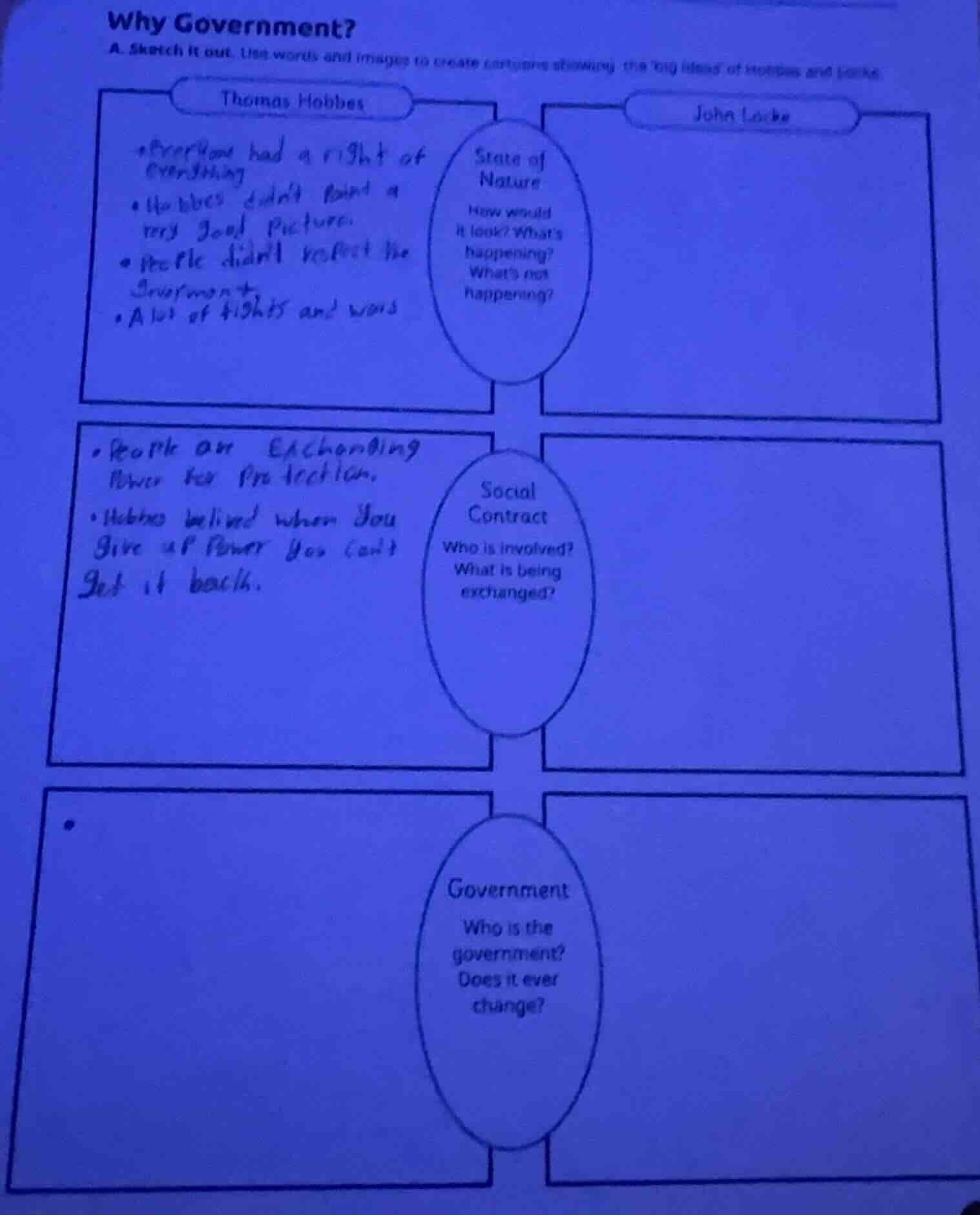
a. sketch it out. use words and images to create cartoons showing the big ideas of hobbes and locke.
thomas hobbes
- everyone had a right of everything
- hobbes didnt paint a very good picture.
- people didnt respect the government
- a lot of fights and wars
john locke
state of nature
how would it look? whats happening? whats not happening?
- people are exchanging power for protection.
- hobbes believed when you give up power you cant get it back.
john locke (empty box)
social contract
who is involved? what is being exchanged?
thomas hobbes (text in box)
john locke (empty box)
government
who is the government? does it ever change?
thomas hobbes (empty box with a dot)
john locke (empty box)
To complete the chart for John Locke, we analyze his views on the State of Nature, Social Contract, and Government:
State of Nature (John Locke)
- How it looks: People are rational and moral, have natural rights (life, liberty, property).
- What’s happening: Individuals act within moral bounds, respect others’ rights.
- What’s not happening: No chaos/war (unlike Hobbes); disputes are rare, resolved informally.
Social Contract (John Locke)
- Who is involved: Individuals (people) and the government.
- What is exchanged: People give up some natural freedom to the government in exchange for protection of their natural rights (life, liberty, property). The government’s power is limited; if it fails to protect rights, people can revoke consent.
Government (John Locke)
- Who is the government? A body formed by the people, with limited power (e.g., legislative, executive).
- Does it ever change? Yes—if the government violates the social contract (e.g., infringes on natural rights), the people have the right to overthrow it and establish a new government.
Filling the chart:
| Thomas Hobbes | State of Nature | John Locke |
|---|
| Thomas Hobbes | Social Contract | John Locke |
|---|
| Thomas Hobbes | Government | John Locke |
|---|
This aligns with Locke’s political philosophy, emphasizing natural rights, limited government, and popular sovereignty.

Snap & solve any problem in the app
Get step-by-step solutions on Sovi AI
Photo-based solutions with guided steps
Explore more problems and detailed explanations
To complete the chart for John Locke, we analyze his views on the State of Nature, Social Contract, and Government:
State of Nature (John Locke)
- How it looks: People are rational and moral, have natural rights (life, liberty, property).
- What’s happening: Individuals act within moral bounds, respect others’ rights.
- What’s not happening: No chaos/war (unlike Hobbes); disputes are rare, resolved informally.
Social Contract (John Locke)
- Who is involved: Individuals (people) and the government.
- What is exchanged: People give up some natural freedom to the government in exchange for protection of their natural rights (life, liberty, property). The government’s power is limited; if it fails to protect rights, people can revoke consent.
Government (John Locke)
- Who is the government? A body formed by the people, with limited power (e.g., legislative, executive).
- Does it ever change? Yes—if the government violates the social contract (e.g., infringes on natural rights), the people have the right to overthrow it and establish a new government.
Filling the chart:
| Thomas Hobbes | State of Nature | John Locke |
|---|
| Thomas Hobbes | Social Contract | John Locke |
|---|
| Thomas Hobbes | Government | John Locke |
|---|
This aligns with Locke’s political philosophy, emphasizing natural rights, limited government, and popular sovereignty.