QUESTION IMAGE
Question
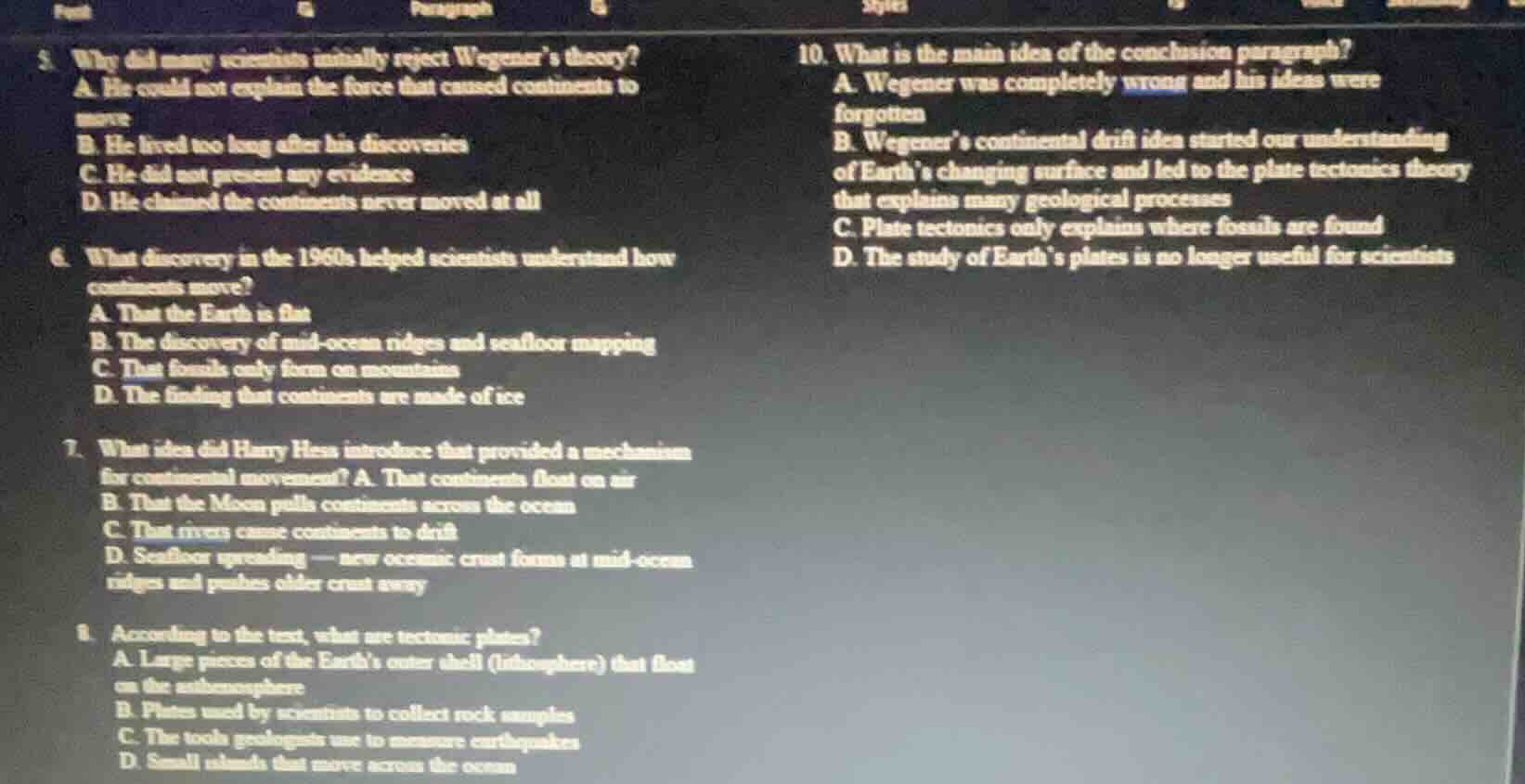
- why did many scientists initially reject wegeners theory?
a. he could not explain the force that caused continents to move
b. he lived too long after his discoveries
c. he did not present any evidence
d. he claimed the continents never moved at all
- what discovery in the 1960s helped scientists understand how continents move?
a. that the earth is flat
b. the discovery of mid-ocean ridges and seafloor mapping
c. that fossils only form on mountains
d. the finding that continents are made of ice
- what idea did harry hess introduce that provided a mechanism for continental movement?
a. that continents float on air
b. that the moon pulls continents across the ocean
c. that rivers cause continents to drift
d. seafloor spreading — new oceanic crust forms at mid-ocean ridges and pushes older crust away
- according to the text, what are tectonic plates?
a. large pieces of the earths outer shell (lithosphere) that float on the asthenosphere
b. plates used by scientists to collect rock samples
c. the tools geologists use to measure earthquakes
d. small islands that move across the ocean
- what is the main idea of the conclusion paragraph?
a. wegener was completely wrong and his ideas were forgotten
b. wegeners continental drift idea started our understanding of earths changing surface and led to the plate tectonics theory that explains many geological processes
c. plate tectonics only explains where fossils are found
d. the study of earths plates is no longer useful for scientists
- Wegener's continental drift theory was rejected initially because he could not identify the force that caused continental movement, even though he had evidence like fossil and rock matches across continents.
- In the 1960s, the discovery of mid-ocean ridges and seafloor mapping provided key data to explain continental movement, supporting seafloor spreading ideas.
- Harry Hess proposed seafloor spreading: new ocean crust forms at mid-ocean ridges, pushing older crust aside, which provided a mechanism for continental movement.
- Tectonic plates are large segments of the Earth's lithosphere (outer rigid shell) that float and move on the semi-fluid asthenosphere beneath them.
- Wegener's continental drift theory laid the foundational framework for later understanding of Earth's dynamic surface, which developed into the comprehensive plate tectonics theory that explains most geological processes.

Snap & solve any problem in the app
Get step-by-step solutions on Sovi AI
Photo-based solutions with guided steps
Explore more problems and detailed explanations
- A. He could not explain the force that caused continents to move
- B. The discovery of mid-ocean ridges and seafloor mapping
- D. Seafloor spreading — new oceanic crust forms at mid-ocean ridges and pushes older crust away
- A. Large pieces of the Earth's outer shell (lithosphere) that float on the asthenosphere
- B. Wegener's continental drift idea started our understanding of Earth's changing surface and led to the plate tectonics theory that explains many geological processes