QUESTION IMAGE
Question
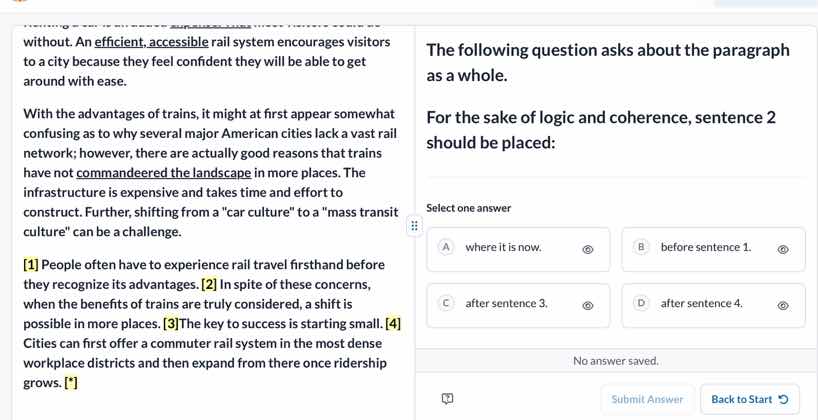
without. an efficient, accessible rail system encourages visitors to a city because they feel confident they will be able to get around with ease.
with the advantages of trains, it might at first appear somewhat confusing as to why several major american cities lack a vast rail network; however, there are actually good reasons that trains have not commandeered the landscape in more places. the infrastructure is expensive and takes time and effort to construct. further, shifting from a \car culture\ to a \mass transit culture\ can be a challenge.
1 people often have to experience rail travel firsthand before they recognize its advantages. 2 in spite of these concerns, when the benefits of trains are truly considered, a shift is possible in more places. 3 the key to success is starting small. 4 cities can first offer a commuter rail system in the most dense workplace districts and then expand from there once ridership grows.
the following question asks about the paragraph as a whole.
for the sake of logic and coherence, sentence 2 should be placed:
select one answer
a where it is now.
b before sentence 1.
c after sentence 3.
d after sentence 4.
no answer saved.
submit answer back to start
To determine the correct placement of sentence 2, we analyze the logical flow. Sentence 1 talks about people needing to experience rail travel to recognize its advantages. Sentence 2 ("In spite of these concerns, when the benefits of trains are truly considered, a shift is possible in more places") introduces a contrast and a positive note about the shift. Sentence 3 ("The key to success is starting small") and sentence 4 ("Cities can first offer a commuter rail system...") then discuss how to make the shift possible.
If we place sentence 2 after sentence 4: Sentence 4 ends with "once ridership grows", and sentence 2's idea of "a shift is possible in more places" would logically follow the explanation of how cities can start small and expand (sentences 3 - 4). Let's check other options:
- Option A (where it is now): Sentence 2 is between sentence 1 and 3. But sentence 1 is about experiencing rail, sentence 2 introduces the shift, and then sentence 3 talks about starting small. The flow is less logical here because sentence 3 and 4 are about implementing the shift, so sentence 2 (talking about the possibility of the shift) should come after the implementation details? No, wait, actually, the correct flow should be: first, people need to experience rail (sentence 1), then the possibility of shift (sentence 2), then how to do it (sentences 3 - 4). Wait, no, let's re - evaluate.
Wait, the original placement of sentence 2 is between 1 and 3. But let's look at the context. The first part of the paragraph (before the numbered sentences) talks about why trains aren't more common, then the numbered sentences are about the possibility and how to do it.
Wait, sentence 1: People need to experience rail to see its advantages.
Sentence 2: In spite of concerns, shift is possible.
Sentence 3: Key is starting small.
Sentence 4: Cities can start with commuter rail.
If we place sentence 2 after sentence 4: Sentence 4 is about cities starting small, then sentence 2 says shift is possible in more places. That makes sense because after explaining how cities can start small (sentences 3 - 4), we can then say that because of this approach, the shift is possible in more places.
Wait, no, let's check the logical coherence. The idea is: first, people need to experience rail (sentence 1). Then, despite concerns, the shift is possible (sentence 2). Then, how to make the shift possible (start small, cities start with commuter rail - sentences 3 - 4). But if sentence 2 is after sentence 4, then after explaining how to start small, we say the shift is possible. That also makes sense. Wait, maybe I made a mistake earlier.
Wait, let's re - examine the options:
Option A: where it is now (between 1 and 3). Let's see the flow:
- People need to experience rail.
- In spite of concerns, shift is possible.
- Key is starting small.
- Cities start with commuter rail.
This flow is: people need to experience, then shift is possible, then how to do it. This is a logical flow. But wait, the other part of the paragraph (before the numbered sentences) talks about why trains aren't more common, then the numbered sentences are about the solution.
Wait, maybe the correct answer is D (after sentence 4). Let's think again.
The first part of the paragraph (non - numbered) says that trains have advantages but aren't more common, then the numbered sentences are about the possibility and how to achieve it.
Sentence 1: People need to experience rail to see its benefits.
Sentence 3: Key is starting small.
Sentence 4: Cities can start with commuter rail.
Then sentence…

Snap & solve any problem in the app
Get step-by-step solutions on Sovi AI
Photo-based solutions with guided steps
Explore more problems and detailed explanations
D. after sentence 4