QUESTION IMAGE
Question
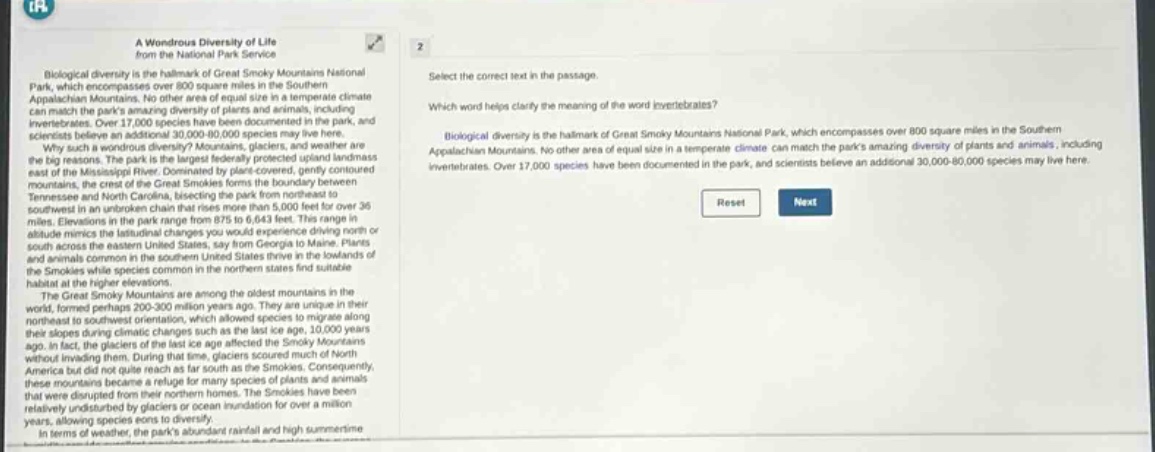
a wondrous diversity of life from the national park service biological diversity is the hallmark of great smoky mountains national park, which encompasses over 800 square miles in the southern appalachian mountains. no other area of equal size in a temperate climate can match the parks amazing diversity of plants and animals, including invertebrates. over 17,000 species have been documented in the park, and scientists believe an additional 30,000 - 80,000 species may live here. why such a wondrous diversity? mountains, glaciers, and weather are the big reasons. the park is the largest federally protected woodland east of the mississippi river. dominated by plane - covered, gently contoured mountains, the park straddles the border between tennessee and north carolina, bisecting the park from northeast to southwest in an unbroken chain that rises more than 5,000 feet for over 36 miles. elevations in the park range from 875 to 6,643 feet. this range in altitude mimics the latitudinal changes you would experience driving north or south across the eastern united states, say from georgia to maine. plants and animals common in the southern united states thrive in the lowlands of the smokies while species common in the northern states and subarctic habitats are found at higher elevations. the mountains of the smoky mountains are among the oldest mountains in the world, formed perhaps 200 - 300 million years ago. they are unique in their northeast to southwest orientation, which allowed species to migrate along their slopes during climatic changes such as the last ice age, 10,000 years ago. in fact, the glaciers of the last ice age affected the smoky mountains without invading them. during that time, glaciers scoured much of north america but did not quite reach as far south as the smokies. cool, moist air from the gulf of mexico and the atlantic ocean allowed these mountains to become a refuge for many species. equally important is the fact that the smokies have been relatively undisturbed by glaciers or ocean inundation for over a million years, allowing species to diversify. in terms of weather, the parks abundant rainfall and high summertime 2 select the correct text in the passage. which word helps clarify the meaning of the word invertebrates? biological diversity is the hallmark of great smoky mountains national park, which encompasses over 800 square miles in the southern appalachian mountains. no other area of equal size in a temperate climate can match the parks amazing diversity of plants and animals, including invertebrates. over 17,000 species have been documented in the park, and scientists believe an additional 30,000 - 80,000 species may live here. reset next
To solve this, we analyze the context of "invertebrates" (a type of animal) and look for a word that clarifies it. The phrase "plants and animals" includes "animals", and "invertebrates" are a type of animal. So the word "animals" (from "diversity of plants and animals") helps clarify "invertebrates" as invertebrates are animals.
Looking at the passage, the relevant text is "diversity of plants and animals, including invertebrates". The word "animals" (within "plants and animals") clarifies that invertebrates are a type of animal. So we select the part that includes the context connecting to invertebrates, which is the text about the park's diversity of plants and animals including invertebrates.
To clarify "invertebrates", we find the word/phrase that relates it to its category (animals). The text "diversity of plants and animals, including invertebrates" uses "animals" (via "plants and animals") to show invertebrates are animals. So we select this text.

Snap & solve any problem in the app
Get step-by-step solutions on Sovi AI
Photo-based solutions with guided steps
Explore more problems and detailed explanations
The correct text is: "No other area of equal size in a temperate climate can match the park's amazing diversity of plants and animals, including invertebrates."