QUESTION IMAGE
Question
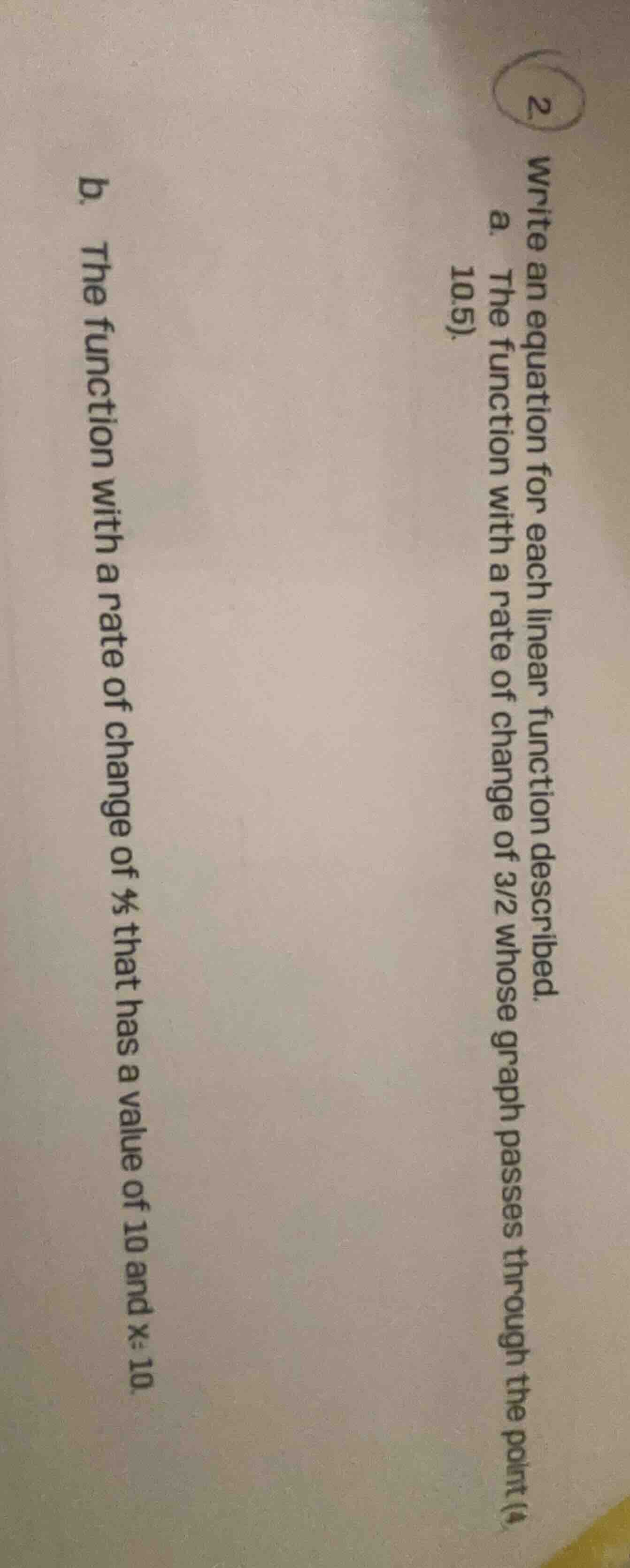
2 write an equation for each linear function described. a. the function with a rate of change of 3/2 whose graph passes through the point (4, 10.5). b. the function with a rate of change of 4/5 that has a value of 10 and x: 10.
Part a
Step1: Recall linear function form
The slope - intercept form of a linear function is $y = mx + b$, where $m$ is the slope (rate of change) and $b$ is the y - intercept. We know that the rate of change $m=\frac{3}{2}$, and the line passes through the point $(4,10.5)$.
Step2: Substitute values into the equation
Substitute $x = 4$, $y=10.5$ and $m=\frac{3}{2}$ into $y=mx + b$:
\[10.5=\frac{3}{2}\times4 + b\]
First, calculate $\frac{3}{2}\times4=6$. So the equation becomes $10.5 = 6 + b$.
Step3: Solve for b
Subtract 6 from both sides of the equation:
\[b=10.5 - 6=4.5=\frac{9}{2}\]
Step4: Write the linear function
Now that we know $m = \frac{3}{2}$ and $b=\frac{9}{2}$, the linear function is $y=\frac{3}{2}x+\frac{9}{2}$ (or we can also write it in decimal form as $y = 1.5x+4.5$).
Part b
(Assuming the "rate of 4/5" is the slope and the point is $(x = 10,y = 10)$)
Step1: Recall linear function form
The slope - intercept form of a linear function is $y=mx + b$, where $m$ is the slope (rate of change) and $b$ is the y - intercept. We know that $m=\frac{4}{5}$, $x = 10$ and $y = 10$.
Step2: Substitute values into the equation
Substitute $x = 10$, $y = 10$ and $m=\frac{4}{5}$ into $y=mx + b$:
\[10=\frac{4}{5}\times10 + b\]
First, calculate $\frac{4}{5}\times10 = 8$. So the equation becomes $10=8 + b$.
Step3: Solve for b
Subtract 8 from both sides of the equation:
\[b=10 - 8 = 2\]
Step4: Write the linear function
Now that we know $m=\frac{4}{5}$ and $b = 2$, the linear function is $y=\frac{4}{5}x+2$ (or in decimal form $y = 0.8x + 2$).

Snap & solve any problem in the app
Get step-by-step solutions on Sovi AI
Photo-based solutions with guided steps
Explore more problems and detailed explanations
s:
a. $y=\frac{3}{2}x+\frac{9}{2}$ (or $y = 1.5x + 4.5$)
b. $y=\frac{4}{5}x + 2$ (or $y=0.8x + 2$)