QUESTION IMAGE
Question
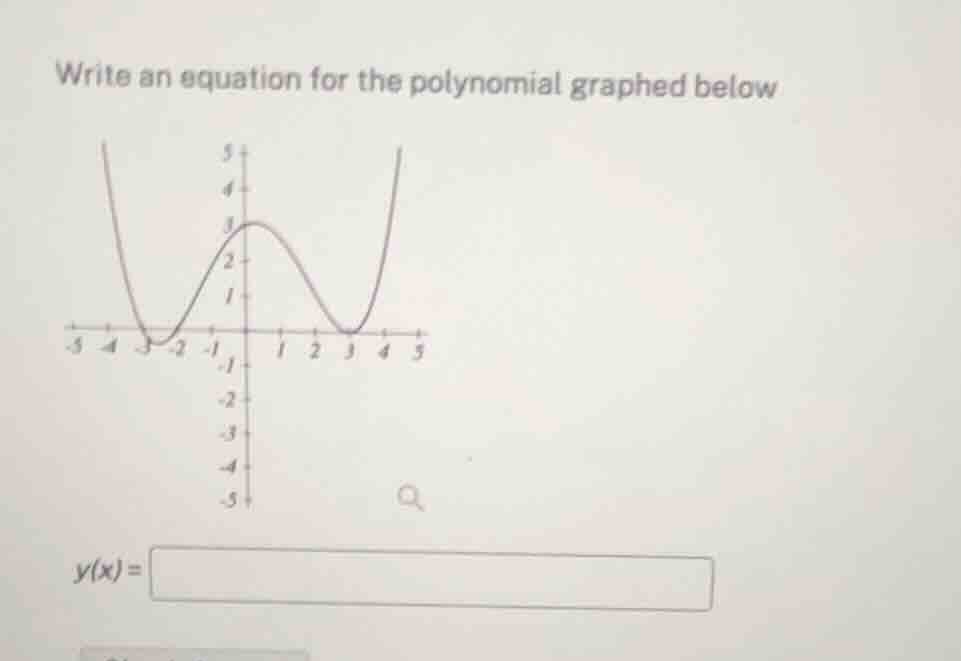
write an equation for the polynomial graphed below
y(x)=
Step1: Identify roots and multiplicities
The graph touches the x - axis at \(x=-3\) and \(x = 3\) (so these are roots with even multiplicities, likely multiplicity 2) and crosses the x - axis? Wait, no, at \(x=-3\) and \(x = 3\) the graph touches the axis (so multiplicity 2), and let's check the y - intercept. The general form of a polynomial with roots \(r_1,r_2,\cdots,r_n\) is \(y(x)=a(x - r_1)^{m_1}(x - r_2)^{m_2}\cdots(x - r_n)^{m_n}\). From the graph, roots are \(x=-3\) (multiplicity 2), \(x = 3\) (multiplicity 2)? Wait, no, wait the graph: when \(x=-3\), the graph touches the x - axis (so multiplicity 2), when \(x = 3\), the graph touches the x - axis (multiplicity 2), and is there another root? Wait, no, the graph has two "touching" points at \(x=-3\) and \(x = 3\), and let's check the y - intercept. The y - intercept is at \((0,3)\). Let's assume the polynomial is \(y(x)=a(x + 3)^{2}(x - 3)^{2}\). Simplify \((x + 3)^{2}(x - 3)^{2}=[(x + 3)(x - 3)]^{2}=(x^{2}-9)^{2}=x^{4}-18x^{2}+81\). Now, use the y - intercept: when \(x = 0\), \(y(0)=a(0 + 3)^{2}(0 - 3)^{2}=a\times9\times9 = 81a\). We know \(y(0)=3\), so \(81a=3\), then \(a=\frac{3}{81}=\frac{1}{27}\)? Wait, no, wait the y - intercept in the graph is at \(y = 3\)? Wait, looking at the graph, when \(x = 0\), the y - value is 3. Wait, maybe I made a mistake in the roots. Wait, maybe the roots are \(x=-3\) (multiplicity 2) and \(x = 3\) (multiplicity 2), but let's re - examine. Wait, the graph: at \(x=-3\), it touches the x - axis (multiplicity 2), at \(x = 3\), it touches the x - axis (multiplicity 2), and let's check the shape. Alternatively, maybe the roots are \(x=-3\) (multiplicity 2) and \(x = 3\) (multiplicity 2), and the polynomial is \(y(x)=a(x + 3)^{2}(x - 3)^{2}\). Let's compute \(y(0)=a(9)(9)=81a\). If \(y(0)=3\), then \(a=\frac{3}{81}=\frac{1}{27}\). But wait, maybe the roots are \(x=-3\) (multiplicity 2) and \(x = 3\) (multiplicity 2), so the polynomial is \(y(x)=\frac{1}{27}(x + 3)^{2}(x - 3)^{2}\)? Wait, no, that seems off. Wait, maybe I misread the y - intercept. Wait, the graph at \(x = 0\) is at \(y = 3\)? Wait, the vertical axis: the marks are 5,4,3,2,1,0,-1,... So at \(x = 0\), the y - value is 3. Let's try another approach. Wait, maybe the polynomial is \(y(x)=a(x + 3)^{2}(x - 3)^{2}\). Let's expand \((x + 3)^{2}(x - 3)^{2}=(x^{2}-9)^{2}=x^{4}-18x^{2}+81\). Then \(y(0)=81a\). If \(y(0)=3\), then \(a=\frac{3}{81}=\frac{1}{27}\). But let's check the graph again. Wait, maybe the roots are \(x=-3\) (multiplicity 2) and \(x = 3\) (multiplicity 2), so the equation is \(y(x)=\frac{1}{27}(x^{2}-9)^{2}\)? Wait, no, that gives \(y(0)=\frac{1}{27}\times81 = 3\), which matches the y - intercept. Wait, but let's check the shape. The polynomial \(y=\frac{1}{27}(x^{2}-9)^{2}=\frac{1}{27}(x^{4}-18x^{2}+81)\) is a quartic function, opening upwards (since the leading coefficient is positive), which matches the graph (both ends go up). At \(x=\pm3\), the graph touches the x - axis (since multiplicity 2), which also matches. So that seems correct.
Step2: Determine the leading coefficient
We found that when \(x = 0\), \(y(0)=3\). For the polynomial \(y(x)=a(x + 3)^{2}(x - 3)^{2}\), substitute \(x = 0\):
\(y(0)=a(0 + 3)^{2}(0 - 3)^{2}=a\times9\times9 = 81a\)
We know \(y(0)=3\), so:
\(81a=3\)
Solve for \(a\):
\(a=\frac{3}{81}=\frac{1}{27}\)
Step3: Write the polynomial
Substitute \(a=\frac{1}{27}\) into the polynomial \(y(x)=a(x + 3)^{2}(x - 3)^{2}\):
\(y(x)=\frac{1}{27}(x + 3)^{2}(x - 3)^{2}\)
We can also expand \((x + 3)^{2}(x - 3)^{2}=(x^{2}-9)^{2}=x^{4}-18x^…

Snap & solve any problem in the app
Get step-by-step solutions on Sovi AI
Photo-based solutions with guided steps
Explore more problems and detailed explanations
\(\frac{1}{27}(x + 3)^{2}(x - 3)^{2}\) (or expanded form \(\frac{1}{27}x^{4}-\frac{2}{3}x^{2}+3\))