QUESTION IMAGE
Question
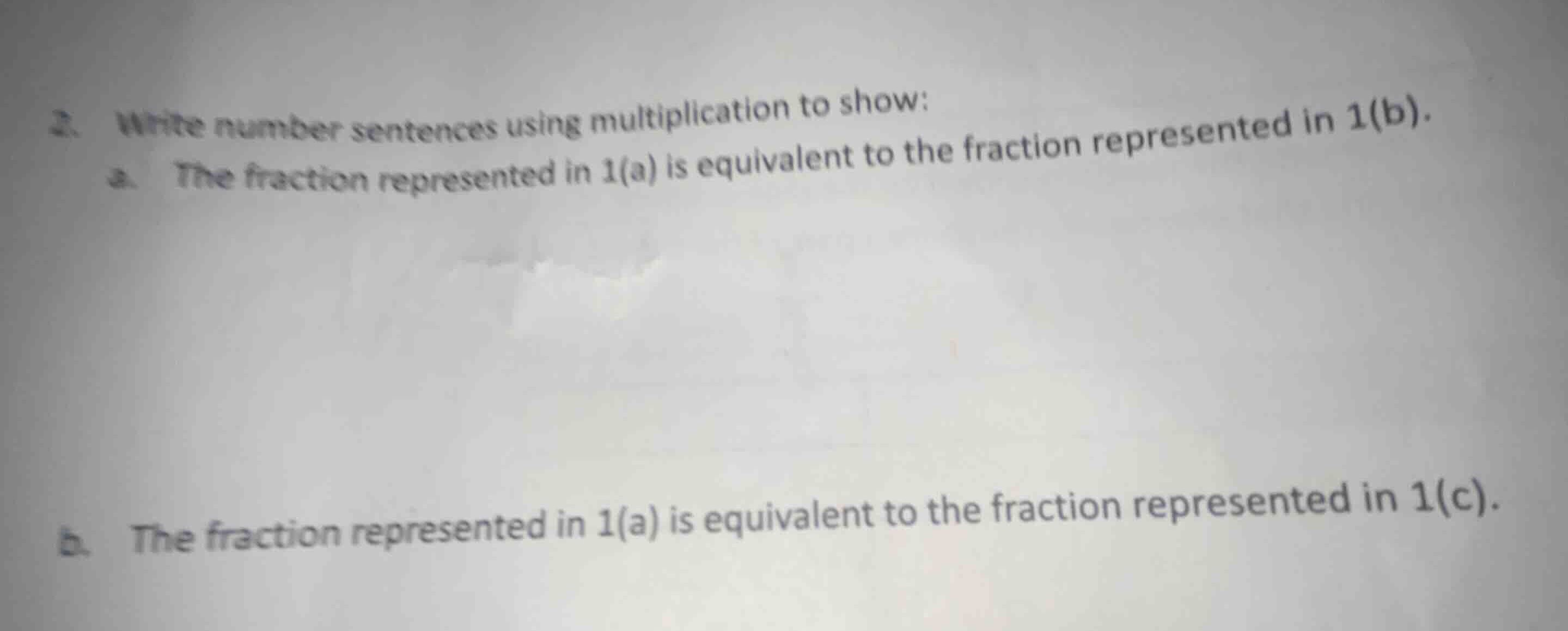
- write number sentences using multiplication to show:
a. the fraction represented in 1(a) is equivalent to the fraction represented in 1(b).
b. the fraction represented in 1(a) is equivalent to the fraction represented in 1(c).
To solve this problem, we need the fractions from questions 1(a), 1(b), and 1(c). Since those fractions are not provided here, we can't write the specific number sentences yet. However, the general method to show equivalent fractions using multiplication is as follows:
General Method for Equivalent Fractions:
To show that two fractions \(\frac{a}{b}\) and \(\frac{c}{d}\) are equivalent using multiplication, we use the property of equivalent fractions: \(\frac{a}{b} = \frac{a \times k}{b \times k}\) (where \(k\) is a non - zero integer) or \(\frac{a}{b}=\frac{a\div k}{b\div k}\) (but for multiplication, we focus on the first form).
For example, if the fraction in 1(a) is \(\frac{1}{2}\) and the fraction in 1(b) is \(\frac{2}{4}\), we can show the equivalence as \(\frac{1}{2}=\frac{1\times2}{2\times2}=\frac{2}{4}\)
If you can provide the fractions from 1(a), 1(b), and 1(c), we can write the specific number sentences.

Snap & solve any problem in the app
Get step-by-step solutions on Sovi AI
Photo-based solutions with guided steps
Explore more problems and detailed explanations
To solve this problem, we need the fractions from questions 1(a), 1(b), and 1(c). Since those fractions are not provided here, we can't write the specific number sentences yet. However, the general method to show equivalent fractions using multiplication is as follows:
General Method for Equivalent Fractions:
To show that two fractions \(\frac{a}{b}\) and \(\frac{c}{d}\) are equivalent using multiplication, we use the property of equivalent fractions: \(\frac{a}{b} = \frac{a \times k}{b \times k}\) (where \(k\) is a non - zero integer) or \(\frac{a}{b}=\frac{a\div k}{b\div k}\) (but for multiplication, we focus on the first form).
For example, if the fraction in 1(a) is \(\frac{1}{2}\) and the fraction in 1(b) is \(\frac{2}{4}\), we can show the equivalence as \(\frac{1}{2}=\frac{1\times2}{2\times2}=\frac{2}{4}\)
If you can provide the fractions from 1(a), 1(b), and 1(c), we can write the specific number sentences.