QUESTION IMAGE
Question
write your own
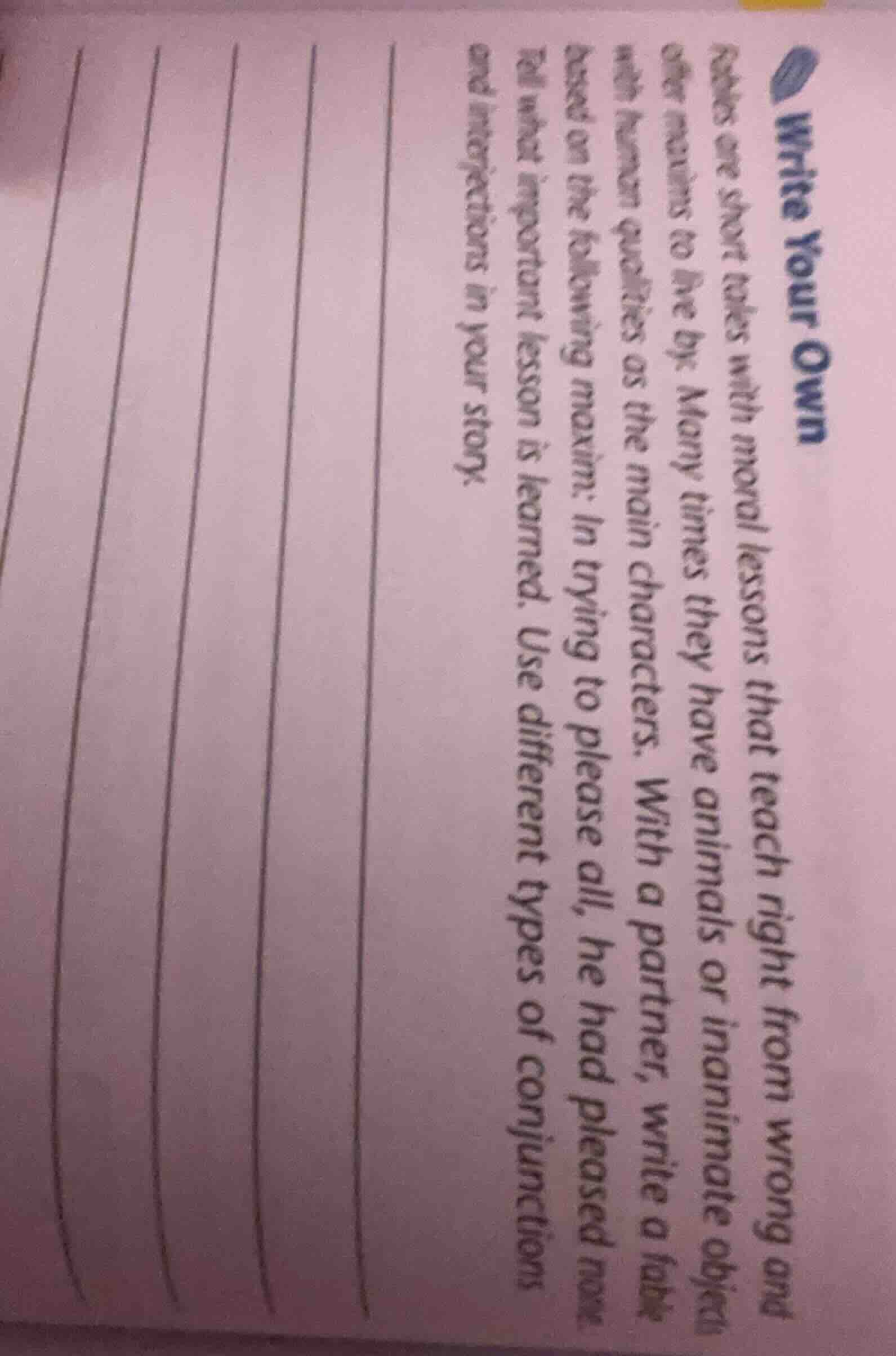
fables are short tales with moral lessons that teach right from wrong and offer maxims to live by. many times they have animals or inanimate objects with human qualities as the main characters. with a partner, write a fable based on the following maxim: in trying to please all, he had pleased none and what important lesson is learned. use different types of conjunctions and interjections in your story.
The task is to write a fable with a moral lesson. Fables often use animals or inanimate objects as characters to teach a lesson. The maxim "In trying to please all, he had pleased none" suggests a story about someone (or a character) attempting to satisfy everyone but failing. We can create a story with a character, say a bird, who tries to adjust its nest to please all its forest friends but ends up with a nest that's uncomfortable for itself and not truly liked by others. Then, the moral is learned that trying to please everyone leads to dissatisfaction for all, including oneself.

Snap & solve any problem in the app
Get step-by-step solutions on Sovi AI
Photo-based solutions with guided steps
Explore more problems and detailed explanations
The Bird and the Nest
Once upon a time, in a lush forest, there lived a little bird named Breeze. Breeze wanted to build the perfect nest that would please every creature in the forest. The squirrels liked cozy, enclosed spaces, so Breeze added thick, bushy walls to the nest. The sparrows preferred open, airy nests, so Breeze tore down some of the walls to make it more open. The rabbits suggested soft, grassy linings, so Breeze filled the nest with tall grass. But the owls thought the nest was too bright, and the deer said it was too flimsy.
As Breeze kept changing the nest to please each friend, the structure became unstable and uncomfortable. When Breeze finally sat in the nest, it wobbled and the grass poked its feathers. Looking around, Breeze realized that while it had tried to make everyone happy, the squirrels still found the nest too open, the sparrows thought it was too closed, and no one was truly satisfied—and Breeze was left with a nest that felt like it belonged to no one, least of all itself.
The moral of the story: In trying to please all, he (or she, in Breeze’s case) had pleased none. It’s better to stay true to one’s own needs and values than to lose oneself in the pursuit of pleasing everyone.