QUESTION IMAGE
Question
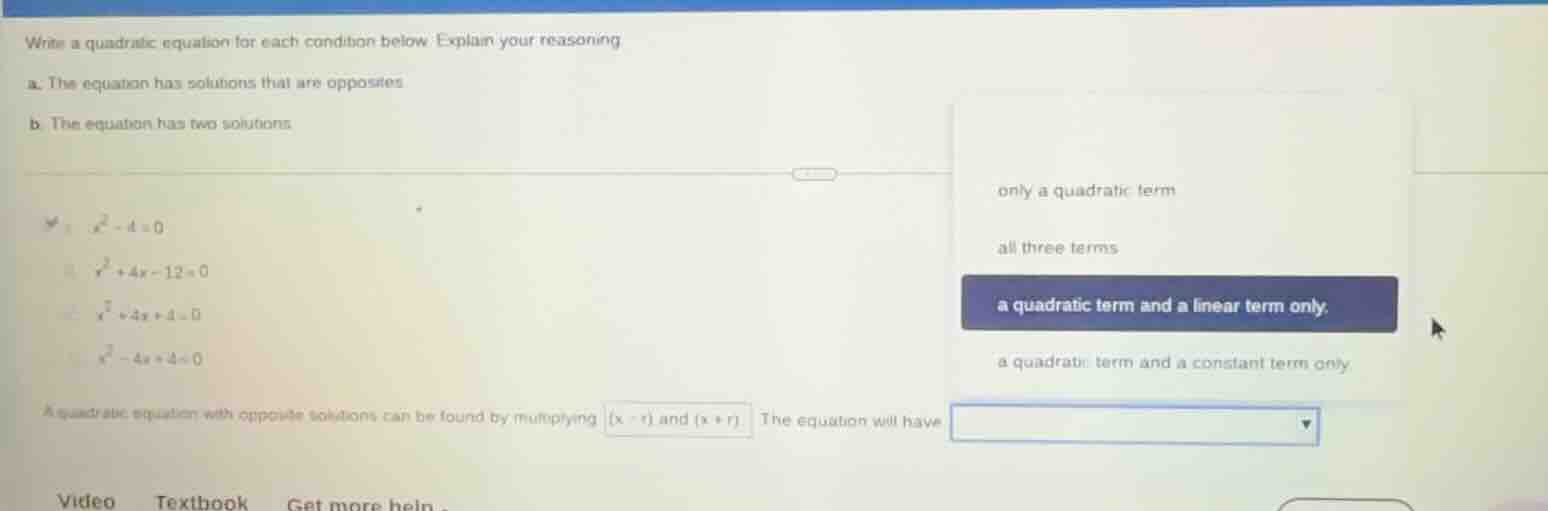
write a quadratic equation for each condition below. explain your reasoning
a. the equation has solutions that are opposites
b. the equation has two solutions
$x^2 - 4 = 0$
$x^2 + 4x - 12 = 0$
$x^2 + 4x + 4 = 0$
$x^2 - 4x + 4 = 0$
a quadratic equation with opposite solutions can be found by multiplying $(x - r)$ and $(x + r)$. the equation will have
only a quadratic term
all three terms
a quadratic term and a linear term only
a quadratic term and a constant term only
Step1: Part a: Use opposite roots
If roots are $r$ and $-r$, factors are $(x-r)$ and $(x+r)$.
Multiply: $(x-r)(x+r) = x^2 - r^2$
Step2: Part a: Identify term type
$x^2 - r^2$ has quadratic ($x^2$) and constant ($-r^2$) terms only. Example: $x^2 - 4 = 0$ (roots 2 and -2)
Step3: Part b: General quadratic
A quadratic with two distinct solutions has the form $ax^2+bx+c=0$ where $b^2-4ac>0$. Example: $x^2 + 4x - 12 = 0$ (roots 2 and -6), which has all three terms.

Snap & solve any problem in the app
Get step-by-step solutions on Sovi AI
Photo-based solutions with guided steps
Explore more problems and detailed explanations
a. $x^2 - 4 = 0$; a quadratic term and a constant term only
b. (Example) $x^2 + 4x - 12 = 0$; all three terms