QUESTION IMAGE
Question
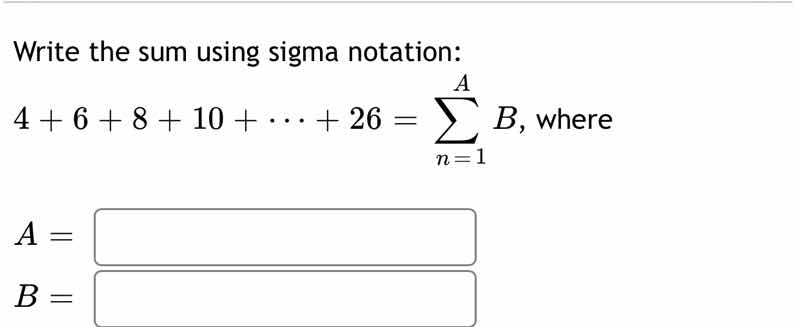
write the sum using sigma notation:
$4 + 6 + 8 + 10 + \cdots + 26 = \sum\limits_{n=1}^{a} b$, where
$a = \square$
$b = \square$
Step1: Identify sequence type
This is an arithmetic sequence with first term $a_1=4$, common difference $d=2$, last term $a_n=26$.
Step2: Find number of terms $A$
Use arithmetic sequence formula $a_n = a_1 + (n-1)d$.
$$26 = 4 + (n-1) \times 2$$
Solve for $n$:
$$26 - 4 = 2(n-1)$$
$$22 = 2(n-1)$$
$$n-1 = 11$$
$$n = 12$$
So $A=12$.
Step3: Find general term $B$
General term for the sequence:
$$B = 4 + (n-1) \times 2 = 2n + 2$$

Snap & solve any problem in the app
Get step-by-step solutions on Sovi AI
Photo-based solutions with guided steps
Explore more problems and detailed explanations
$A = 12$
$B = 2n + 2$