QUESTION IMAGE
Question
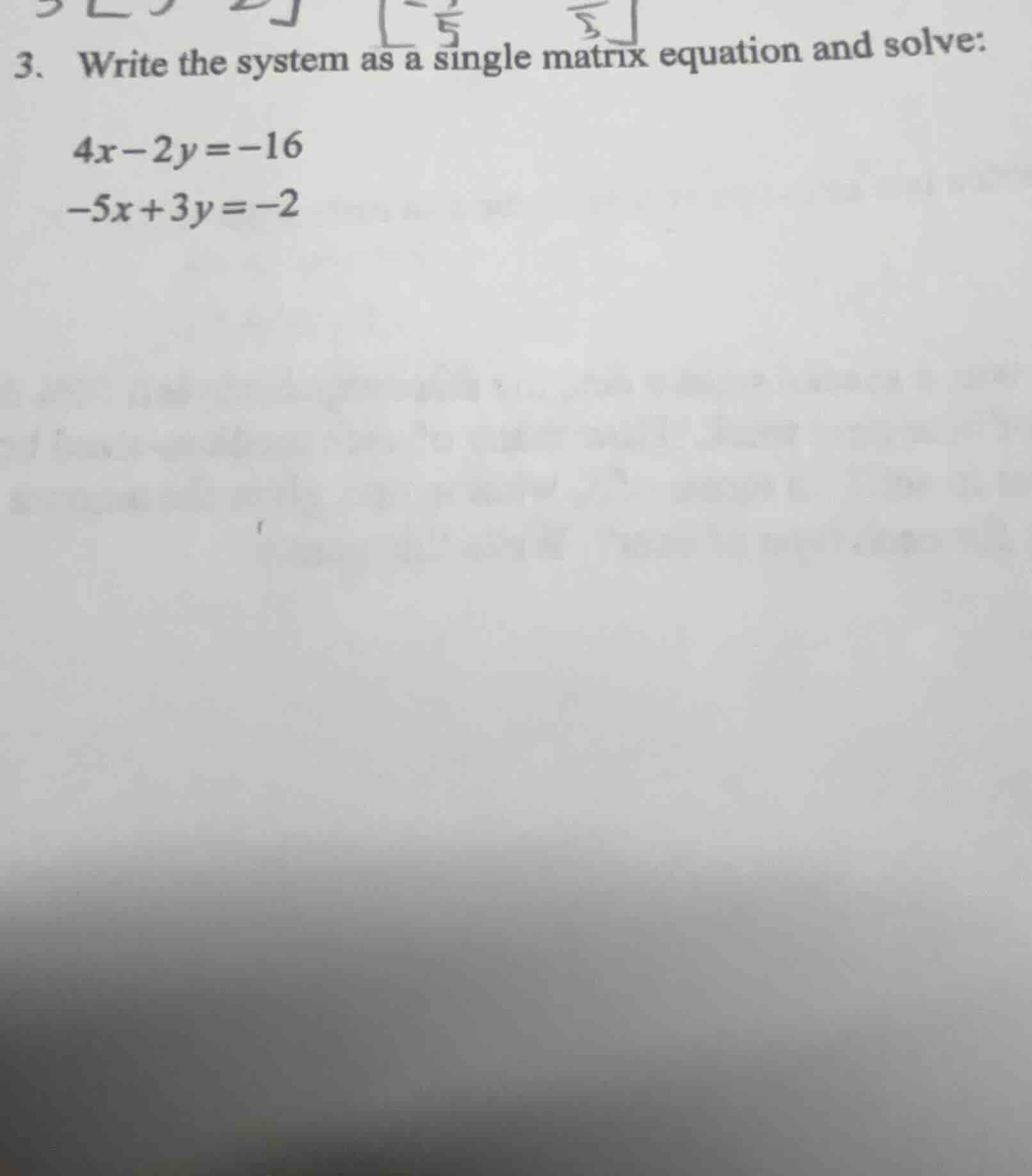
- write the system as a single matrix equation and solve:
4x - 2y = -16
-5x + 3y = -2
Step1: Write matrix equation
A system \( a_1x + b_1y = c_1 \), \( a_2x + b_2y = c_2 \) can be written as \(
=
\). For \( 4x - 2y = -16 \) and \( -5x + 3y = -2 \), the matrix equation is \(
=
\).
Step2: Find inverse of coefficient matrix
The inverse of a \( 2\times2 \) matrix \(
\) is \( \frac{1}{ad - bc}
\). For \(
\), \( ad - bc = 4\times3 - (-2)\times(-5)=12 - 10 = 2 \). So the inverse is \( \frac{1}{2}
=
\).
Step3: Multiply inverse with constant matrix
Multiply the inverse matrix \(
\) with \(
\).
First row: \( \frac{3}{2}\times(-16)+1\times(-2)= -24 - 2 = -26 \)? Wait, no, wait. Wait, let's recalculate. Wait, \(
=
\).
Wait, no, I made a mistake in inverse. Wait, \( ad - bc = 4\times3 - (-2)\times(-5)=12 - 10 = 2 \). So inverse is \( \frac{1}{2}
\). So first element: \( \frac{3}{2}\times(-16)+1\times(-2)=\frac{-48}{2}-2=-24 - 2=-26 \)? No, that can't be. Wait, no, the system is \( 4x - 2y = -16 \) and \( -5x + 3y = -2 \). Wait, maybe I messed up the inverse formula. The inverse of \(
\) is \( \frac{1}{ad - bc}
\). So for \(
\), \( d = 3 \), \( -b = 2 \), \( -c = 5 \), \( a = 4 \). So inverse is \( \frac{1}{2}
\). Now multiply by \(
\):
First component: \( \frac{3}{2}\times(-16) + 1\times(-2) = -24 - 2 = -26 \)? That's wrong. Wait, maybe I made a mistake in setting up the matrix. Wait, the system is \( 4x - 2y = -16 \) and \( -5x + 3y = -2 \). Let's solve using elimination. Multiply first equation by 3: \( 12x - 6y = -48 \). Multiply second equation by 2: \( -10x + 6y = -4 \). Add them: \( 2x = -52 \)? No, that's not right. Wait, no, 12x -6y + (-10x +6y)=2x, and -48 + (-4)= -52. So x = -26? Then plug into first equation: 4*(-26) -2y = -16 → -104 -2y = -16 → -2y = 88 → y = -44. But that seems odd. Wait, no, I must have messed up the inverse. Wait, let's recalculate the determinant. \( 4\times3 - (-2)\times(-5)=12 - 10 = 2 \). Correct. Inverse matrix: \( \frac{1}{2}
\). Now multiply by \(
\):
First row: \( \frac{3}{2} \times (-16) + 1 \times (-2) = -24 - 2 = -26 \). Second row: \( \frac{5}{2} \times (-16) + 2 \times (-2) = -40 - 4 = -44 \). So \( x = -26 \), \( y = -44 \). Wait, but let's check in the original equations. First equation: 4(-26) -2(-44)= -104 +88= -16. Correct. Second equation: -5(-26) +3(-44)=130 -132= -2. Correct. So that's the solution.

Snap & solve any problem in the app
Get step-by-step solutions on Sovi AI
Photo-based solutions with guided steps
Explore more problems and detailed explanations
The matrix equation is \(
=
\), and the solution is \( x = -26 \), \( y = -44 \) (or in matrix form \(
=
\)).