QUESTION IMAGE
Question
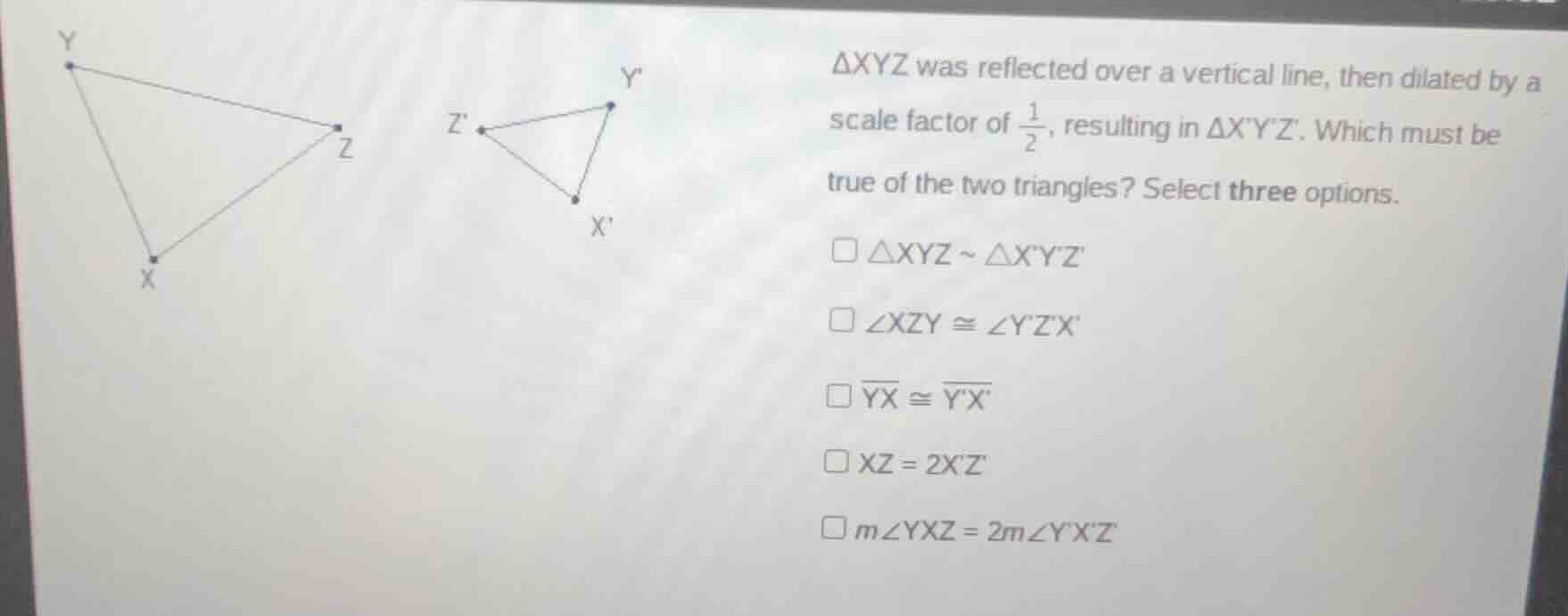
δxyz was reflected over a vertical line, then dilated by a scale factor of \\(\frac{1}{2}\\), resulting in δxyz. which must be true of the two triangles? select three options. \\(\square\\) δxyz ~ δxyz \\(\square\\) ∠xzy ≅ ∠yzx \\(\square\\) \\(\overline{yx} \cong \overline{yx}\\) \\(\square\\) xz = 2xz \\(\square\\) m∠yxz = 2m∠yxz
Step1: Identify similarity
Reflection and dilation are similarity transformations. Similar triangles are denoted by $\sim$, so $\triangle XYZ \sim \triangle X'Y'Z'$.
Step2: Verify angle congruence
Similar triangles have congruent corresponding angles. $\angle XZY$ and $\angle Y'Z'X'$ are corresponding angles, so $\angle XZY \cong \angle Y'Z'X'$.
Step3: Analyze side scale factor
Dilation scale factor is $\frac{1}{2}$, so original side length = $2 \times$ dilated side length. Thus $XZ = 2X'Z'$.
Step4: Eliminate incorrect options
Congruent sides ($\overline{YX} \cong \overline{Y'X'}$) are false because dilation changes side lengths. Angle measure doubling ($m\angle YXZ = 2m\angle Y'X'Z'$) is false because similarity preserves angle measures.

Snap & solve any problem in the app
Get step-by-step solutions on Sovi AI
Photo-based solutions with guided steps
Explore more problems and detailed explanations
$\triangle XYZ \sim \triangle X'Y'Z'$
$\angle XZY \cong \angle Y'Z'X'$
$XZ = 2X'Z'$