QUESTION IMAGE
Question
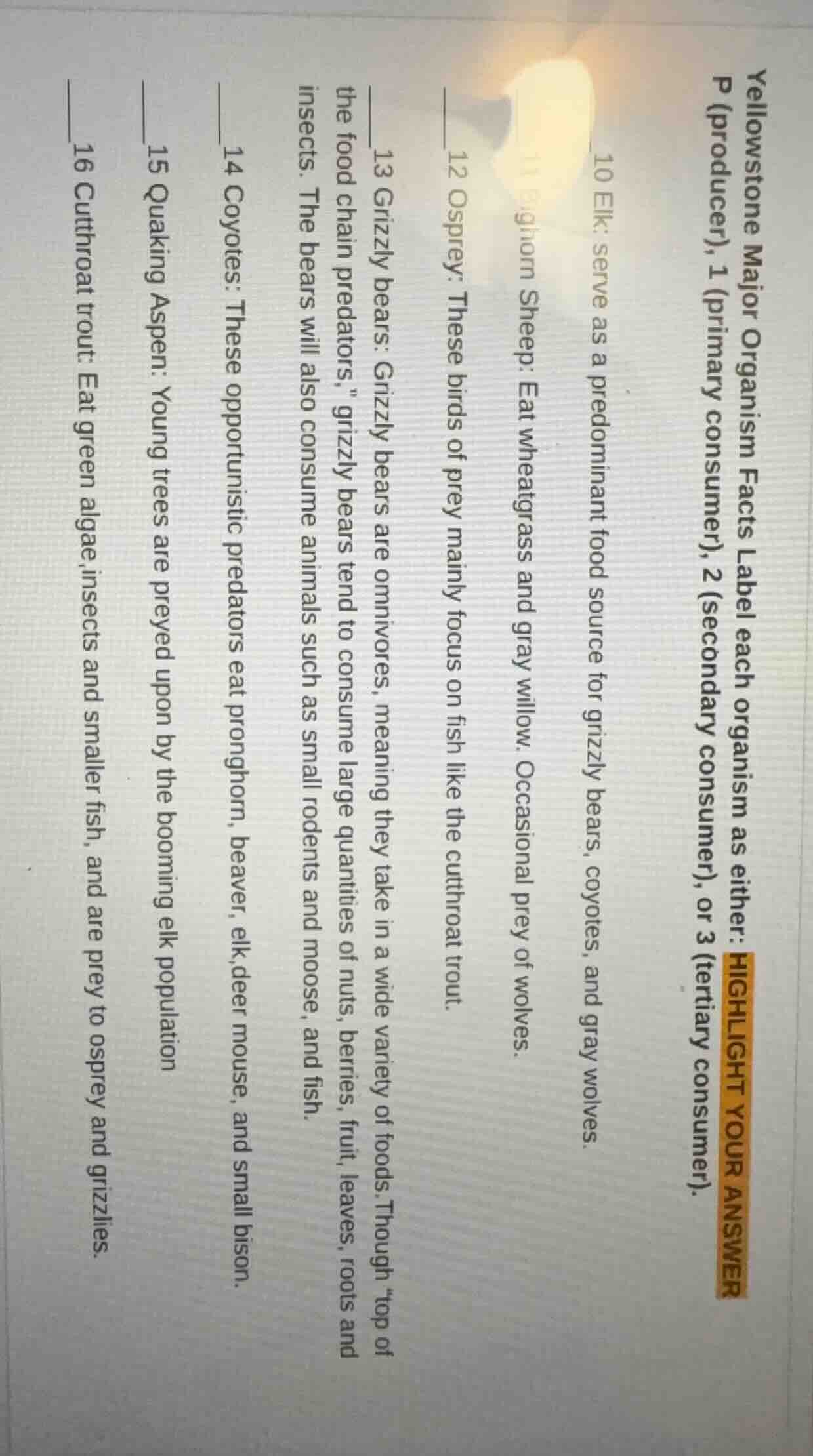
yellowstone major organism facts label each organism as either: p (producer), 1 (primary consumer), 2 (secondary consumer), or 3 (tertiary consumer). 10 elk: serve as a predominant food source for grizzly bears, coyotes, and gray wolves. 11 pronghorn sheep: eat wheatgrass and gray willow. occasional prey of wolves. 12 osprey: these birds of prey mainly focus on fish like the cutthroat trout. 13 grizzly bears: grizzly bears are omnivores, meaning they take in a wide variety of foods. though “top of the food chain predators,” grizzly bears tend to consume large quantities of nuts, berries, fruit, leaves, roots and insects. the bears will also consume animals such as small rodents and moose, and fish. 14 coyotes: these opportunistic predators eat pronghorn, beaver, elk, deer mouse, and small bison. 15 quaking aspen: young trees are preyed upon by the booming elk population 16 cutthroat trout: eat green algae, insects and smaller fish, and are prey to osprey and grizzlies.
Classify each organism by their trophic level:
- Elk eat producers (plants), so they are primary consumers.
- Bighorn Sheep eat producers (plants), so they are primary consumers.
- Osprey eat fish (primary/secondary consumers), so they are tertiary consumers.
- Grizzly bears eat primary consumers (elk, rodents) and secondary consumers (fish), so they are tertiary consumers; they also eat producers, but their predatory role fits tertiary consumer.
- Coyotes eat primary consumers (elk, pronghorn), so they are secondary consumers.
- Quaking Aspen is a plant (producer) that makes its own food.
- Cutthroat trout eat producers (algae) and primary consumers (insects), so they are secondary consumers.

Snap & solve any problem in the app
Get step-by-step solutions on Sovi AI
Photo-based solutions with guided steps
Explore more problems and detailed explanations
- 1 (primary consumer)
- 1 (primary consumer)
- 3 (tertiary consumer)
- 3 (tertiary consumer)
- 2 (secondary consumer)
- P (producer)
- 2 (secondary consumer)