QUESTION IMAGE
Question
can you conclude that \\(overline{jq}\\) and \\(overline{kn}\\) are congruent?\
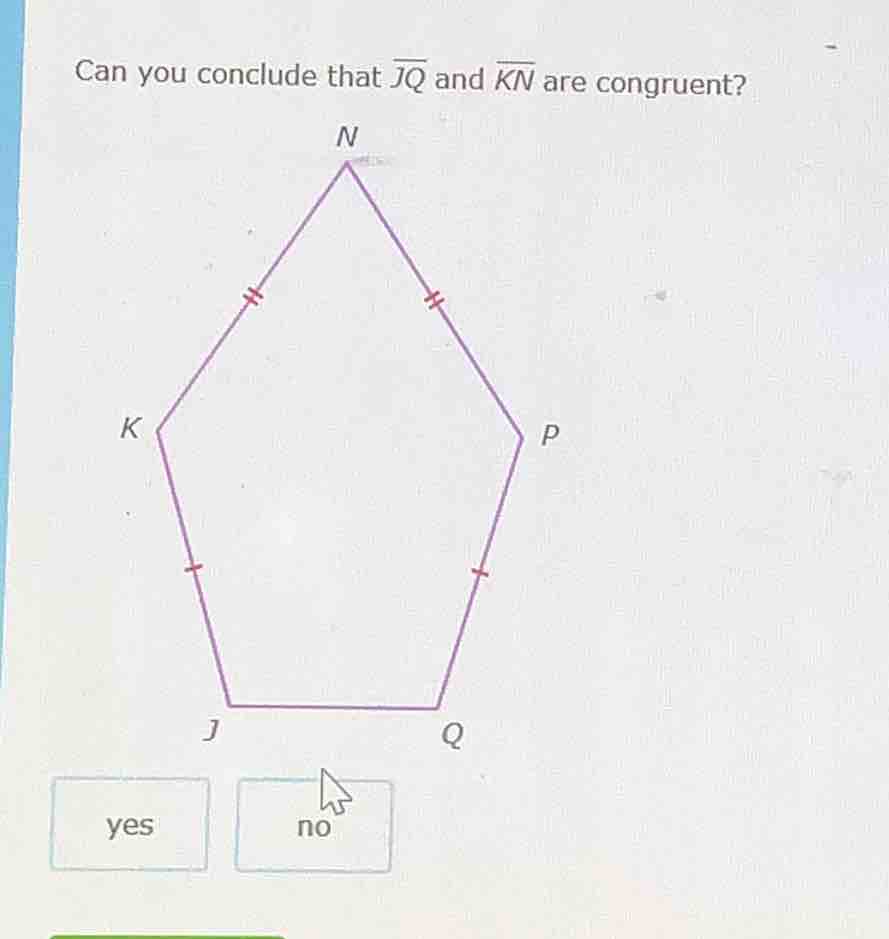
(there is a pentagon figure with vertices n, k, j, q, p, and some sides marked with congruency marks. below the figure are two buttons: yes and no)
Step1: Analyze the figure
The figure appears to be a pentagon with some sides marked as congruent. The markings show that \( \overline{KN} \cong \overline{PN} \) (two marks) and \( \overline{KJ} \cong \overline{PQ} \) (one mark). However, there is no direct marking or information given about the relationship between \( \overline{JQ} \) and \( \overline{KN} \). In a regular pentagon, all sides are congruent, but this figure only has some sides marked as congruent, not all. Without additional information (like it being a regular pentagon or more congruency markings), we can't assume \( \overline{JQ} \) and \( \overline{KN} \) are congruent.
Step2: Conclusion
Since there's no sufficient information (like congruency marks or a statement of the pentagon being regular) to show \( \overline{JQ} \) and \( \overline{KN} \) are congruent, we can't conclude they are congruent.

Snap & solve any problem in the app
Get step-by-step solutions on Sovi AI
Photo-based solutions with guided steps
Explore more problems and detailed explanations
no