QUESTION IMAGE
Question
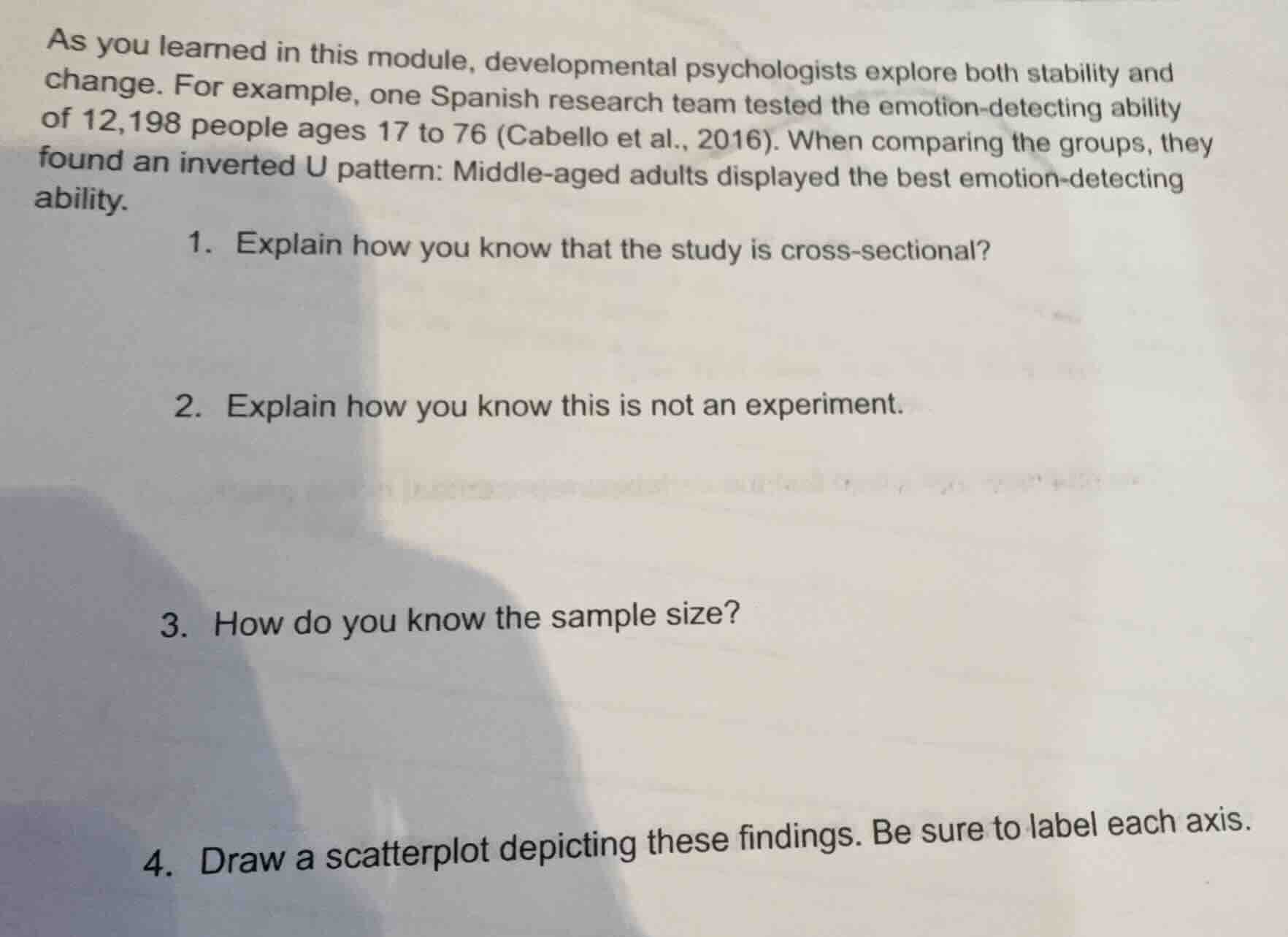
as you learned in this module, developmental psychologists explore both stability and change. for example, one spanish research team tested the emotion - detecting ability of 12,198 people ages 17 to 76 (cabello et al., 2016). when comparing the groups, they found an inverted u pattern: middle - aged adults displayed the best emotion - detecting ability.
- explain how you know that the study is cross - sectional?
- explain how you know this is not an experiment.
- how do you know the sample size?
- draw a scatterplot depicting these findings. be sure to label each axis.
Brief Explanations
- A cross-sectional study compares different age groups at a single point in time. This study tests and compares people across 17 to 76 years old all at once, rather than following groups over time.
- An experiment requires manipulating an independent variable and controlling other factors. This study only measures existing emotion-detecting ability across age groups with no variable manipulation or random assignment to conditions.
- The sample size is directly stated in the provided description of the research.
- The scatterplot has age on the x-axis (ranging 17 to 76) and emotion-detecting ability on the y-axis. Data points form an inverted U: low ability at 17, rising to a peak in middle age (e.g., 40-50), then declining as age approaches 76.

Snap & solve any problem in the app
Get step-by-step solutions on Sovi AI
Photo-based solutions with guided steps
Explore more problems and detailed explanations
- It compares different age groups simultaneously.
- No variable manipulation or random assignment occurs.
- The study explicitly states it tested 12,198 people.
4.
| Axis | Label | Range/Trend |
|---|---|---|
| Y-axis | Emotion-Detecting Ability | Low → Peak (Middle Age) → Low |
The scatterplot points follow an inverted U shape, with the highest points clustered around middle adulthood.