QUESTION IMAGE
Question
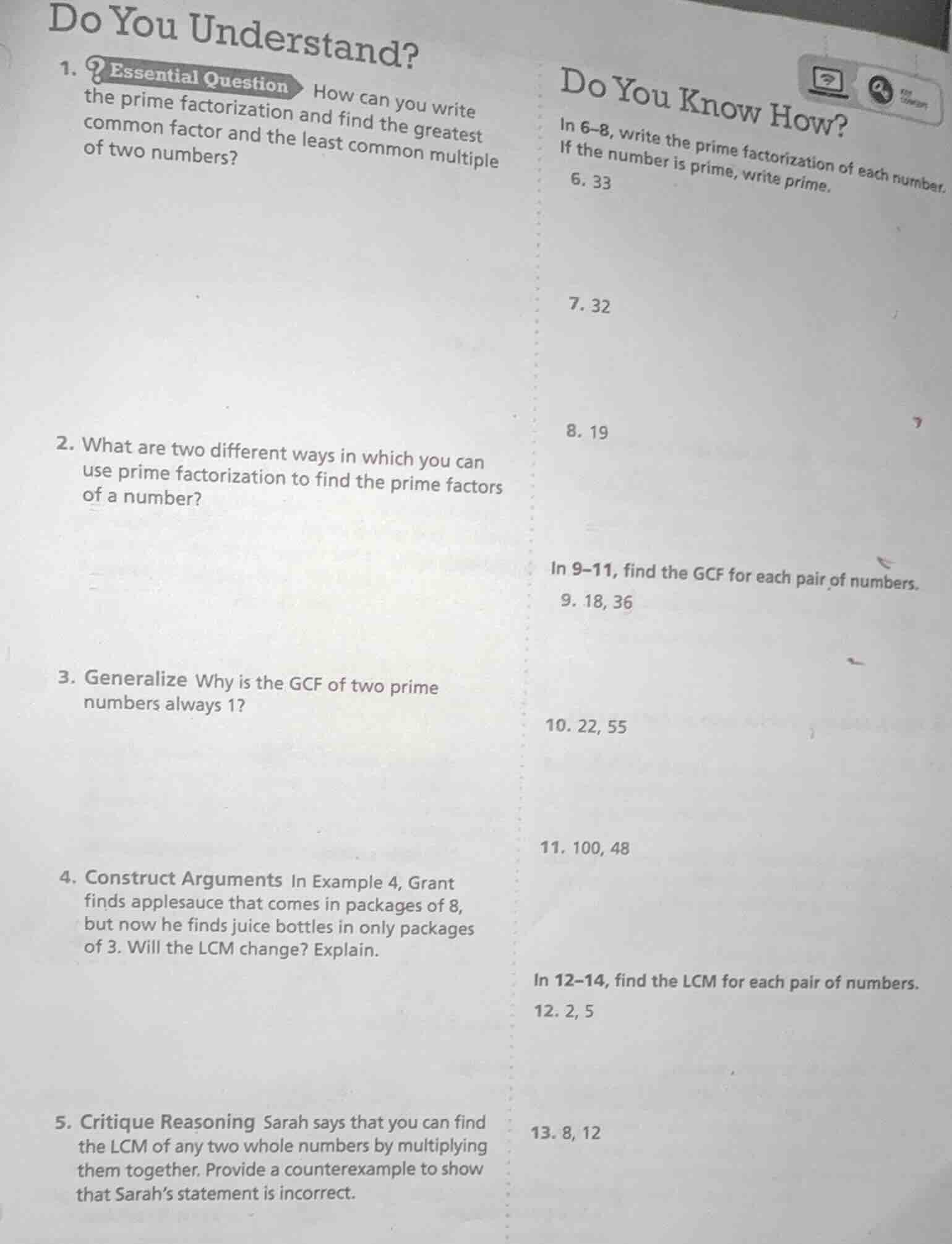
do you understand?
- essential question how can you write the prime factorization and find the greatest common factor and the least common multiple of two numbers?
- what are two different ways in which you can use prime factorization to find the prime factors of a number?
- generalize why is the gcf of two prime numbers always 1?
- construct arguments in example 4, grant finds applesauce that comes in packages of 8, but now he finds juice bottles in only packages of 3. will the lcm change? explain.
- critique reasoning sarah says that you can find the lcm of any two whole numbers by multiplying them together. provide a counterexample to show that sarah’s statement is incorrect.
do you know how?
in 6–8, write the prime factorization of each number. if the number is prime, write prime.
- 33
- 32
- 19
in 9–11, find the gcf for each pair of numbers.
- 18, 36
- 22, 55
- 100, 48
in 12–14, find the lcm for each pair of numbers.
- 2, 5
- 8, 12
- omitted as not fully visible
Let's solve question 6: Prime factorization of 33.
Step 1: Check divisibility by smallest primes
Start with the smallest prime number, 2. 33 is odd, so not divisible by 2. Next prime is 3. \( 33 \div 3 = 11 \).
Step 2: Check if quotient is prime
11 is a prime number (only divisible by 1 and itself). So the prime factors of 33 are 3 and 11.
Step 1: Divide by 2 repeatedly
32 is even, so divide by 2: \( 32 \div 2 = 16 \).
Step 2: Continue dividing by 2
\( 16 \div 2 = 8 \).
Step 3: Continue dividing by 2
\( 8 \div 2 = 4 \).
Step 4: Continue dividing by 2
\( 4 \div 2 = 2 \).
Step 5: Continue dividing by 2
\( 2 \div 2 = 1 \).
We divided by 2 five times. So the prime factorization of 32 is \( 2^5 \).
Step 1: Check divisibility by primes less than its square root
The square root of 19 is approximately 4.36. So we check primes less than 4.36: 2, 3.
19 is odd, so not divisible by 2. \( 19 \div 3 \approx 6.33 \), not an integer. So 19 has no divisors other than 1 and itself.

Snap & solve any problem in the app
Get step-by-step solutions on Sovi AI
Photo-based solutions with guided steps
Explore more problems and detailed explanations
The prime factorization of 33 is \( 3 \times 11 \).
---
Let's solve question 7: Prime factorization of 32.