QUESTION IMAGE
Question
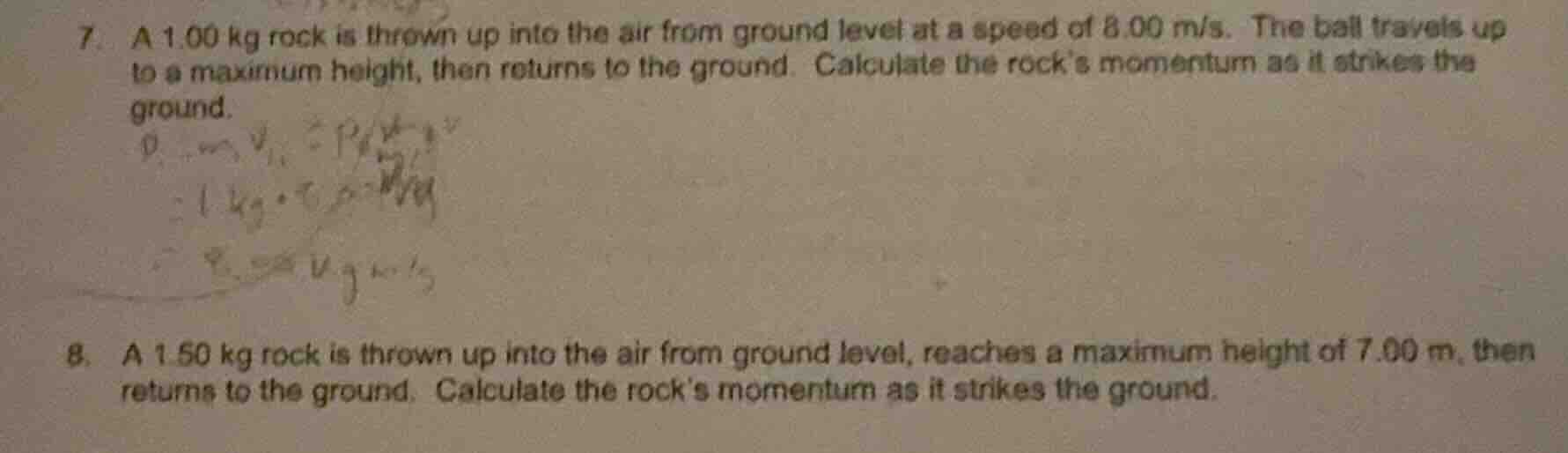
- a 1.00 kg rock is thrown up into the air from ground level at a speed of 8.00 m/s. the ball travels up to a maximum height, then returns to the ground. calculate the rocks momentum as it strikes the ground. 8. a 1.50 kg rock is thrown up into the air from ground level, reaches a maximum height of 7.00 m, then returns to the ground. calculate the rocks momentum as it strikes the ground.
Problem 7
Step1: Recall the principle of conservation of mechanical energy (or symmetry in free - fall).
When a rock is thrown vertically upwards and then falls back to the same level (ground level here), ignoring air resistance, the speed when it hits the ground will have the same magnitude as the initial speed, but the direction will be downward. The formula for momentum is \(p = mv\), where \(m\) is mass and \(v\) is velocity.
The mass of the rock \(m = 1.00\space kg\), and the speed when it hits the ground \(v= 8.00\space m/s\) (downward, but for momentum magnitude, we can use the speed).
Step2: Calculate the momentum.
Using the formula \(p=mv\), substitute \(m = 1.00\space kg\) and \(v = 8.00\space m/s\).
\(p=1.00\space kg\times8.00\space m/s = 8.00\space kg\cdot m/s\) (the direction is downward, but if we consider the magnitude, it is \(8.00\space kg\cdot m/s\) downward. If we take the sign into account (assuming upward as positive, then the velocity when hitting the ground is \(- 8.00\space m/s\), and momentum \(p = 1.00\space kg\times(- 8.00\space m/s)=- 8.00\space kg\cdot m/s\), but the magnitude is \(8.00\space kg\cdot m/s\)).
Step1: Use the principle of conservation of mechanical energy to find the speed when the rock hits the ground.
The mechanical energy at the maximum height is just gravitational potential energy \(U = mgh\), and at the ground level, it is kinetic energy \(K=\frac{1}{2}mv^{2}\). By conservation of mechanical energy (ignoring air resistance), \(mgh=\frac{1}{2}mv^{2}\). We can cancel out the mass \(m\) from both sides of the equation.
The formula for the speed \(v\) when hitting the ground is \(v=\sqrt{2gh}\), where \(g = 9.8\space m/s^{2}\) and \(h = 7.00\space m\).
Step2: Calculate the speed.
Substitute \(g = 9.8\space m/s^{2}\) and \(h=7.00\space m\) into the formula \(v=\sqrt{2gh}\).
\(v=\sqrt{2\times9.8\space m/s^{2}\times7.00\space m}=\sqrt{137.2}\space m/s\approx11.71\space m/s\) (the direction is downward).
Step3: Calculate the momentum.
The mass of the rock \(m = 1.50\space kg\), and the velocity \(v=- 11.71\space m/s\) (taking upward as positive). Using the formula \(p = mv\), we get \(p=1.50\space kg\times(- 11.71\space m/s)\approx - 17.57\space kg\cdot m/s\) (the magnitude is approximately \(17.6\space kg\cdot m/s\) downward).
We can also calculate it as follows: from \(mgh=\frac{1}{2}mv^{2}\), we know that the speed when hitting the ground is the same as the speed it would have if it were dropped from height \(h\) (or the speed with which it was thrown up in terms of energy, but here we calculated it from the height). Then momentum \(p = mv\), \(m = 1.50\space kg\), \(v=\sqrt{2gh}\).
First, calculate \(2gh=2\times9.8\times7 = 137.2\), \(v=\sqrt{137.2}\approx11.71\space m/s\). Then \(p = 1.50\times(- 11.71)\approx - 17.6\space kg\cdot m/s\) (or \(17.6\space kg\cdot m/s\) downward).

Snap & solve any problem in the app
Get step-by-step solutions on Sovi AI
Photo-based solutions with guided steps
Explore more problems and detailed explanations
The momentum of the rock as it strikes the ground is \(\boldsymbol{- 8.00\space kg\cdot m/s}\) (or \(8.00\space kg\cdot m/s\) downward).