QUESTION IMAGE
Question
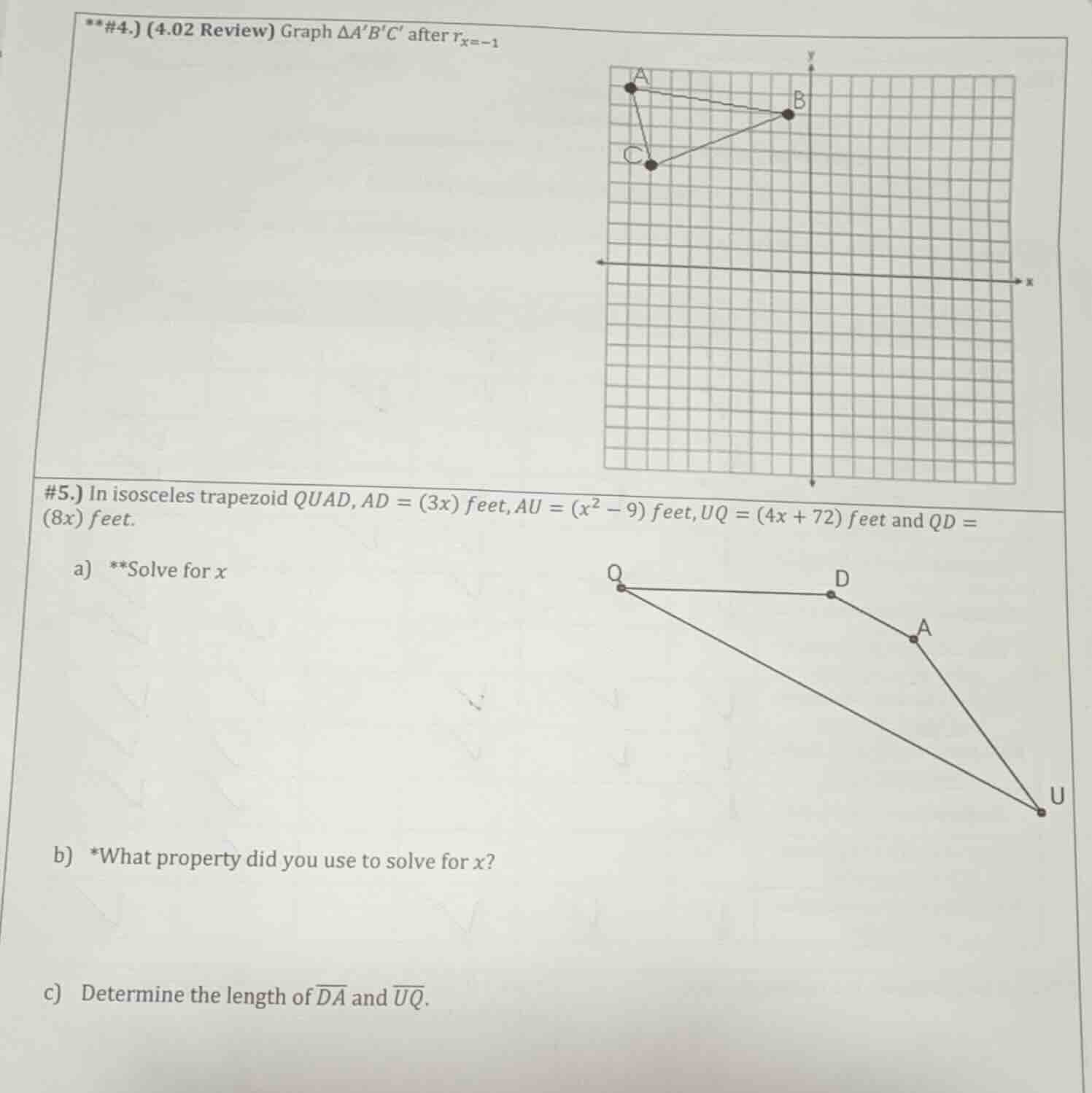
**#4.) (4.02 review) graph $\triangle abc$ after $r_{x=-1}$
#5.) in isosceles trapezoid $quad$, $ad = (3x)$ feet, $au = (x^2 - 9)$ feet, $uq = (4x + 72)$ feet and $qd = (8x)$ feet.
a) **solve for $x$
b) *what property did you use to solve for $x$
c) determine the length of $\overline{da}$ and $\overline{uq}$
Part a)
Step1: Recall isosceles trapezoid property
In an isosceles trapezoid, the non - parallel sides (legs) are equal in length. So, \(AU = QD\).
Given \(AU=(x^{2}-9)\) and \(QD = 8x\), we set up the equation:
\(x^{2}-9=8x\)
Step2: Rearrange into quadratic form
Rearrange the equation to the standard quadratic form \(ax^{2}+bx + c = 0\).
\(x^{2}-8x - 9=0\)
Step3: Factor the quadratic equation
We need to find two numbers that multiply to \(- 9\) and add up to \(-8\). The numbers are \(-9\) and \(1\).
So, \(x^{2}-8x - 9=(x - 9)(x+1)=0\)
Step4: Solve for x
Set each factor equal to zero:
\(x - 9=0\) or \(x + 1=0\)
\(x=9\) or \(x=-1\)
Since the length cannot be negative (because \(AD = 3x\), \(UQ=4x + 72\), etc., and if \(x=-1\), \(AD=-3\) which is not possible for a length), we reject \(x=-1\). So \(x = 9\).
In an isosceles trapezoid, the legs (the non - parallel sides) are congruent. This means that the lengths of the legs \(AU\) and \(QD\) are equal. We used this property to set up the equation \(x^{2}-9 = 8x\) which allowed us to solve for \(x\).
Step1: Find the length of \(\overline{DA}\)
We know that \(AD = 3x\) and \(x = 9\). Substitute \(x = 9\) into the expression for \(AD\):
\(AD=3\times9 = 27\) feet. Since \(\overline{DA}\) is the same as \(\overline{AD}\), the length of \(\overline{DA}\) is \(27\) feet.
Step2: Find the length of \(\overline{UQ}\)
We know that \(UQ=4x + 72\) and \(x = 9\). Substitute \(x = 9\) into the expression for \(UQ\):
\(UQ=4\times9+72=36 + 72=108\) feet.

Snap & solve any problem in the app
Get step-by-step solutions on Sovi AI
Photo-based solutions with guided steps
Explore more problems and detailed explanations
\(x = 9\)