QUESTION IMAGE
Question
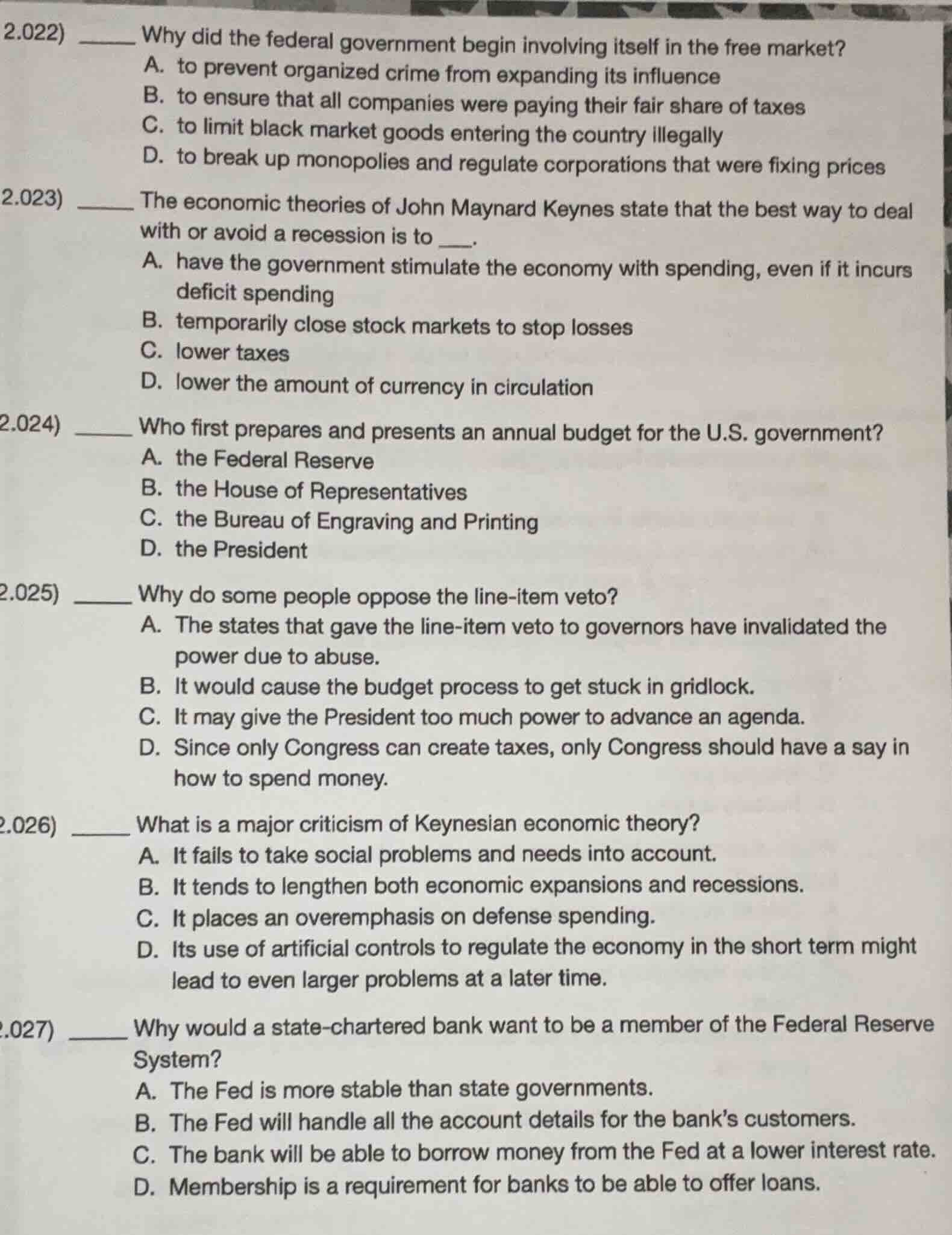
2.022) ______ why did the federal government begin involving itself in the free market?
a. to prevent organized crime from expanding its influence
b. to ensure that all companies were paying their fair share of taxes
c. to limit black market goods entering the country illegally
d. to break up monopolies and regulate corporations that were fixing prices
2.023) ____ the economic theories of john maynard keynes state that the best way to deal with or avoid a recession is to __.
a. have the government stimulate the economy with spending, even if it incurs deficit spending
b. temporarily close stock markets to stop losses
c. lower taxes
d. lower the amount of currency in circulation
2.024) ______ who first prepares and presents an annual budget for the u.s. government?
a. the federal reserve
b. the house of representatives
c. the bureau of engraving and printing
d. the president
2.025) ______ why do some people oppose the line - item veto?
a. the states that gave the line - item veto to governors have invalidated the power due to abuse.
b. it would cause the budget process to get stuck in gridlock.
c. it may give the president too much power to advance an agenda.
d. since only congress can create taxes, only congress should have a say in how to spend money.
2.026) ______ what is a major criticism of keynesian economic theory?
a. it fails to take social problems and needs into account.
b. it tends to lengthen both economic expansions and recessions.
c. it places an overemphasis on defense spending.
d. its use of artificial controls to regulate the economy in the short term might lead to even larger problems at a later time.
2.027) ______ why would a state - chartered bank want to be a member of the federal reserve system?
a. the fed is more stable than state governments.
b. the fed will handle all the account details for the bank’s customers.
c. the bank will be able to borrow money from the fed at a lower interest rate.
d. membership is a requirement for banks to be able to offer loans.
2.022: Early U.S. government market intervention focused on curbing monopolistic price-fixing and corporate overreach.
2.023: Keynesian core is deficit spending to stimulate demand during recessions.
2.024: The U.S. President is constitutionally tasked with proposing the annual budget.
2.025: Critics argue line-item veto gives excessive agenda-setting power to the President.
2.026: A key critique of Keynesianism is that short-term artificial controls can create larger future economic issues.
2.027: State-chartered Fed members gain access to lower interest rate borrowing from the Fed.

Snap & solve any problem in the app
Get step-by-step solutions on Sovi AI
Photo-based solutions with guided steps
Explore more problems and detailed explanations
2.022: D. to break up monopolies and regulate corporations that were fixing prices
2.023: A. have the government stimulate the economy with spending, even if it incurs deficit spending
2.024: D. the President
2.025: C. It may give the President too much power to advance an agenda.
2.026: D. Its use of artificial controls to regulate the economy in the short term might lead to even larger problems at a later time.
2.027: C. The bank will be able to borrow money from the Fed at a lower interest rate.