QUESTION IMAGE
Question
e) 9.0h + hbr3
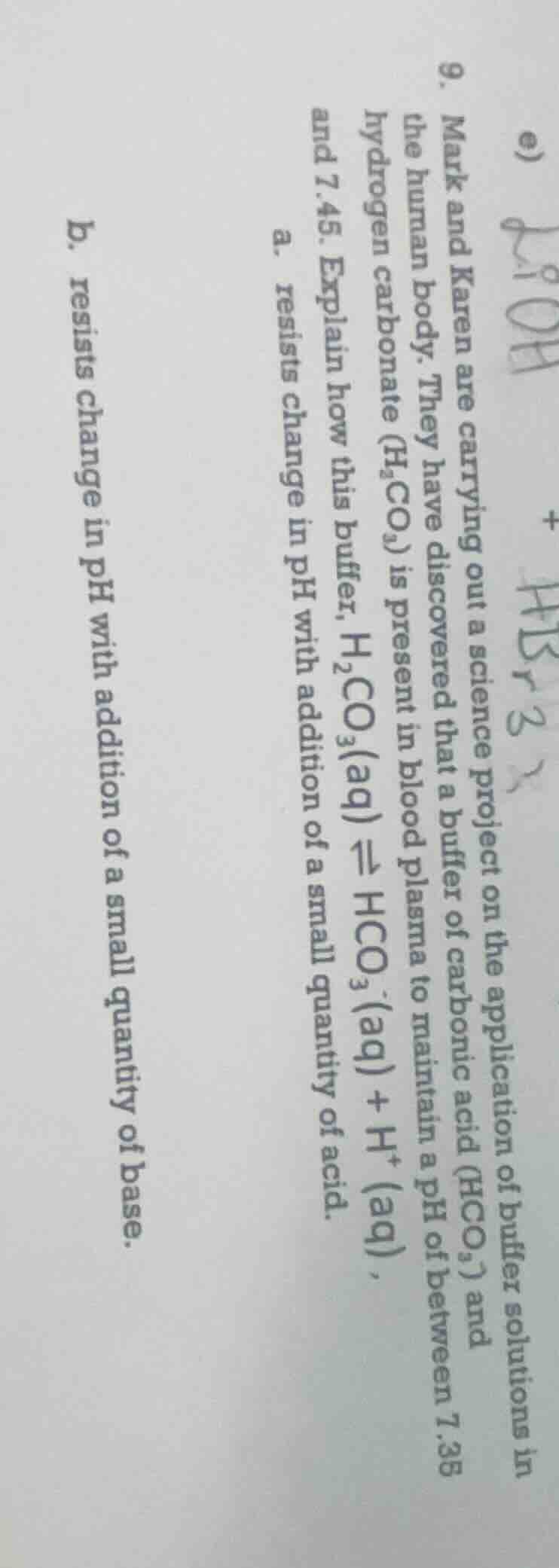
- mark and karen are carrying out a science project on the application of buffer solutions in the human body. they have discovered that a buffer of carbonic acid (h₂co₃) and hydrogen carbonate (h₂co₃) is present in blood plasma to maintain a ph of between 7.35 and 7.45. explain how this buffer, h₂co₃(aq) ⇌ hco₃⁻(aq) + h⁺(aq),
a. resists change in ph with addition of a small quantity of acid.
b. resists change in ph with addition of a small quantity of base.
Part a
Step 1: Identify buffer components
The buffer consists of weak acid $\ce{H2CO3}$ and its conjugate base $\ce{HCO3^-}$.
Step 2: Reaction with added acid
When a small amount of acid (e.g., $\ce{H+}$ from a strong acid) is added, the conjugate base $\ce{HCO3^-}$ reacts with the added $\ce{H+}$: $\ce{HCO3^-(aq) + H+(aq) -> H2CO3(aq)}$.
Step 3: Explain pH resistance
By consuming the added $\ce{H+}$, the concentration of $\ce{H+}$ in the solution does not increase significantly, thus resisting a large drop in pH. The equilibrium $\ce{H2CO3(aq) <=> HCO3^-(aq) + H+(aq)}$ shifts left to counteract the added $\ce{H+}$.
Step 1: Identify buffer components
Again, the buffer has $\ce{H2CO3}$ (weak acid) and $\ce{HCO3^-}$ (conjugate base).
Step 2: Reaction with added base
When a small amount of base (e.g., $\ce{OH-}$ from a strong base) is added, the weak acid $\ce{H2CO3}$ reacts with the added $\ce{OH-}$: $\ce{H2CO3(aq) + OH-(aq) -> HCO3^-(aq) + H2O(l)}$.
Step 3: Explain pH resistance
By consuming the added $\ce{OH-}$, the concentration of $\ce{OH-}$ does not increase significantly, so the pH does not rise much. The equilibrium $\ce{H2CO3(aq) <=> HCO3^-(aq) + H+(aq)}$ shifts right to replace the $\ce{H+}$ consumed by $\ce{OH-}$, maintaining pH.

Snap & solve any problem in the app
Get step-by-step solutions on Sovi AI
Photo-based solutions with guided steps
Explore more problems and detailed explanations
When acid is added, $\ce{HCO3^-}$ reacts with added $\ce{H+}$ to form $\ce{H2CO3}$, preventing a large pH drop. The buffer equilibrium shifts left to consume excess $\ce{H+}$.