QUESTION IMAGE
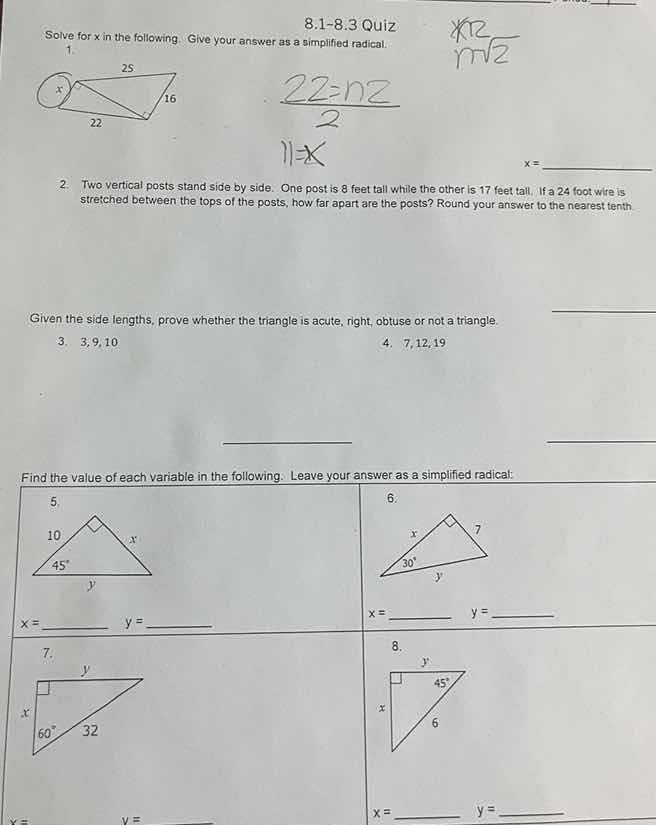
Question
8.1-8.3 quiz
solve for x in the following. give your answer as a simplified radical.
1.
- two vertical posts stand side by side. one post is 8 feet tall while the other is 17 feet tall. if a 24 foot wire is stretched between the tops of the posts, how far apart are the posts? round your answer to the nearest tenth.
given the side lengths, prove whether the triangle is acute, right, obtuse or not a triangle.
- 3, 9, 10
- 7, 12, 19
find the value of each variable in the following. leave your answer as a simplified radical:
5.
6.
7.
8.
Problem 1: Solve for \( x \) (Right Triangle, Pythagorean Theorem)
Step 1: Identify the right triangle
The triangle with sides 16, 22, and the diagonal, and the other triangle with diagonal, 25, and \( x \). First, find the diagonal (let's call it \( d \)) using the right triangle with legs 16 and 22.
\[
d^2 = 16^2 + 22^2
\]
Step 2: Calculate \( d^2 \)
\[
16^2 = 256, \quad 22^2 = 484 \\
d^2 = 256 + 484 = 740
\]
Step 3: Now, for the triangle with hypotenuse 25 and leg \( d \) (wait, no—wait, the first triangle: wait, the figure is a quadrilateral with a diagonal, splitting it into two right triangles? Wait, the first triangle has sides \( x \), 22, and the diagonal, and the other has diagonal, 16, 25? Wait, no, maybe I misread. Wait, the first problem: the quadrilateral has sides \( x \), 25, 16, 22, with a diagonal. So the two triangles: one with legs 16 and 22, hypotenuse \( d \); the other with legs \( x \) and 22, hypotenuse 25? Wait, no, 25 is a side. Wait, maybe it's a right triangle? Wait, no, the first figure: a triangle with sides \( x \), 22, and hypotenuse 25? No, 16 is another side. Wait, maybe the diagonal is common. Let's re-express:
Wait, the two triangles: Triangle 1: legs 16 and 22, hypotenuse \( d \). Triangle 2: legs \( x \) and \( d \), hypotenuse 25? No, 25 is a side. Wait, maybe the first triangle is 16, 22, \( d \); the second is \( x \), 22, 25? No, 25 is a side. Wait, I think I made a mistake. Wait, the problem says "Solve for \( x \) in the following. Give your answer as a simplified radical." The figure: a quadrilateral with a diagonal, so two right triangles. So Triangle 1: sides 16, 22, \( d \) (right triangle). Triangle 2: sides \( x \), 22, 25? No, 25 is a side. Wait, no—wait, 25 is the hypotenuse of the second triangle, with one leg \( d \) (from first triangle) and the other leg \( x \)? No, 22 is a common side. Wait, maybe the first triangle is 16, 22, \( d \) (right), and the second is \( x \), 22, 25 (right)? No, 25 would be hypotenuse. Wait, let's check: if \( x \), 22, 25 are sides of a right triangle, with 25 hypotenuse, then \( x^2 + 22^2 = 25^2 \)? No, 22² + x² = 25²? Wait, 25² = 625, 22² = 484, so x² = 625 - 484 = 141? No, that can't be, because the other triangle has 16, 22, \( d \), so \( d^2 = 16² + 22² = 256 + 484 = 740 \), which is more than 25²=625, so that's impossible. Therefore, the correct approach: the two triangles are both right triangles, with the diagonal as a common leg. So Triangle 1: legs 16 and 22, hypotenuse \( d \). Triangle 2: legs \( x \) and \( d \), hypotenuse 25? No, 25 is a side. Wait, I think I messed up the figure. Wait, maybe the first triangle is \( x \), 22, and hypotenuse 25, and the other triangle is 16, 22, and hypotenuse \( d \), but that doesn't make sense. Wait, no—wait, the problem is: the quadrilateral has sides \( x \), 25, 16, 22, with a diagonal. So the two triangles: one with sides 16, 22, \( d \) (right triangle), the other with sides \( x \), \( d \), 25 (right triangle). So \( d^2 = 16² + 22² = 740 \), and then \( x^2 + d^2 = 25² \)? But 25²=625, which is less than 740, so that's impossible. Therefore, the correct figure must be: the two triangles are: one with legs 16 and \( x \), hypotenuse \( d \); the other with legs 22 and \( d \), hypotenuse 25? No, this is confusing. Wait, maybe the first problem is a right triangle with legs 16 and 22, and the other triangle is a right triangle with leg 22 and hypotenuse 25, and the other leg \( x \). Wait, let's try that. So for the triangle with hypotenuse 25 and leg 22: \( x^2 + 22^2 = 25^2 \). Then \( x^2 = 25^2 - 22^2 = 625 - 484 = 141 \), so \( x = \sqrt{1…
Step 1: Identify the right triangle
The difference in height is \( 17 - 8 = 9 \) ft (vertical leg), the wire is the hypotenuse (24 ft), and the horizontal leg is the distance \( d \) between the posts.
Step 2: Apply Pythagorean theorem
\[
d^2 + 9^2 = 24^2
\]
Step 3: Calculate \( d^2 \)
\[
9^2 = 81, \quad 24^2 = 576 \\
d^2 = 576 - 81 = 495 \\
d = \sqrt{495} = \sqrt{9 \times 55} = 3\sqrt{55} \approx 22.2
\]
Wait, no—wait, the vertical difference is \( 17 - 8 = 9 \) ft, so the right triangle has legs \( d \) (distance between posts) and 9 ft, hypotenuse 24 ft. So:
\[
d^2 + 9^2 = 24^2 \\
d^2 = 24^2 - 9^2 = 576 - 81 = 495 \\
d = \sqrt{495} \approx 22.2
\]
Step 1: Check triangle inequality
\( 3 + 9 > 10 \) (12 > 10), \( 3 + 10 > 9 \) (13 > 9), \( 9 + 10 > 3 \) (19 > 3). So it's a triangle.
Step 2: Classify by angles (using Pythagorean theorem: \( c^2 \) vs \( a^2 + b^2 \))
Let \( c = 10 \) (longest side), \( a = 3 \), \( b = 9 \).
\[
a^2 + b^2 = 3^2 + 9^2 = 9 + 81 = 90 \\
c^2 = 10^2 = 100
\]
Since \( c^2 > a^2 + b^2 \) (100 > 90), the triangle is obtuse.

Snap & solve any problem in the app
Get step-by-step solutions on Sovi AI
Photo-based solutions with guided steps
Explore more problems and detailed explanations
\( \boldsymbol{\sqrt{141}} \)