QUESTION IMAGE
Question
4 × 10⁻⁵ − 1.1 × 10⁻⁸ =
the area of texas is about 2.69 × 10⁵ square miles, and the area of delaware is about 2.5 × 10³ square miles.
about how many times larger is the area of texas than the area of delaware?
tuesday
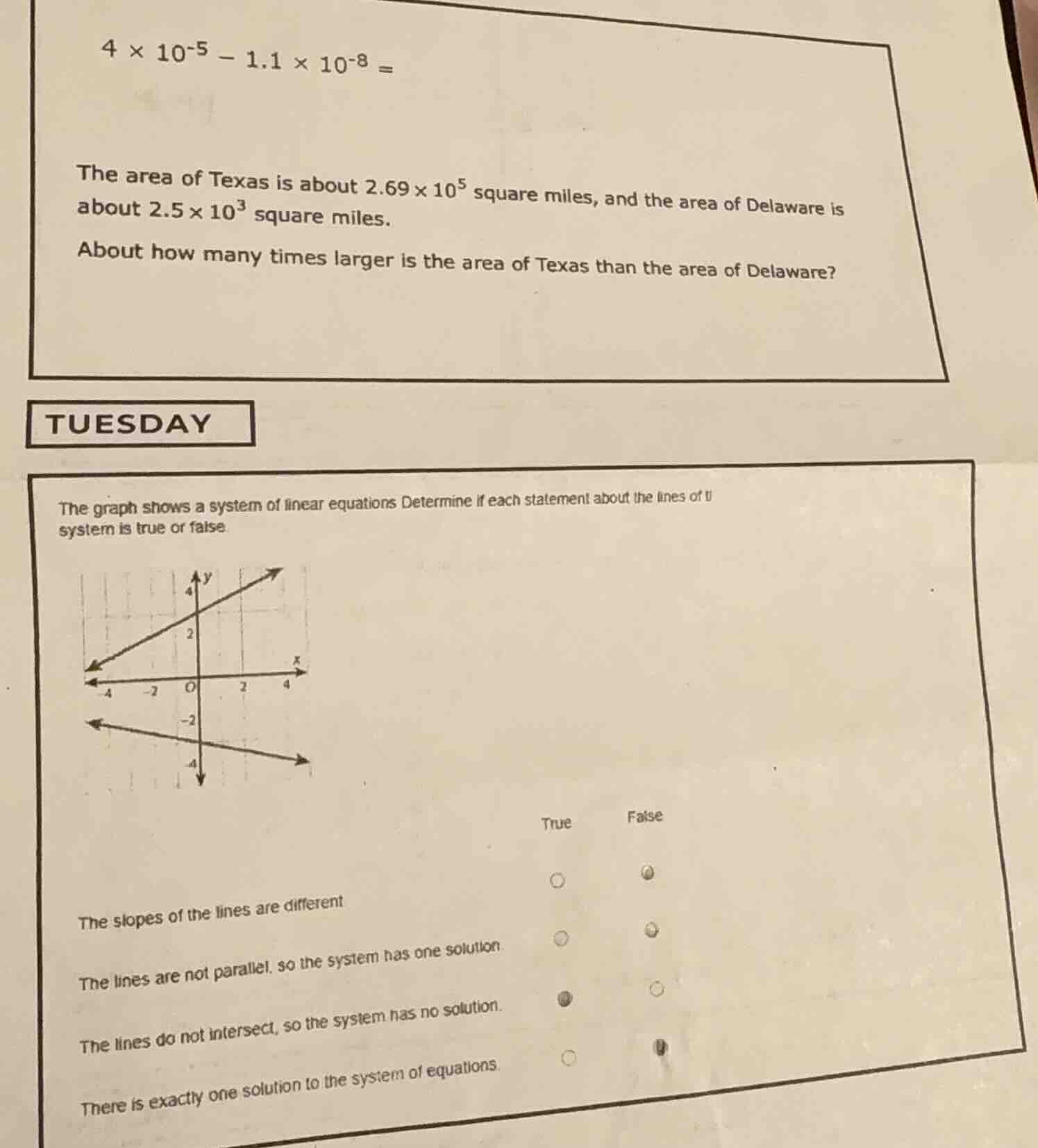
the graph shows a system of linear equations determine if each statement about the lines of the system is true or false.
the slopes of the lines are different
true
false
the lines are not parallel, so the system has one solution.
true
false
the lines do not intersect, so the system has no solution.
true
false
there is exactly one solution to the system of equations.
true
false
First Problem: \( 4 \times 10^{-5} - 1.1 \times 10^{-8} \)
Step1: Rewrite in same exponent
Rewrite \( 4 \times 10^{-5} \) as \( 4000 \times 10^{-8} \) (since \( 10^{-5}=10000\times10^{-8} \)? Wait, no: \( 10^{-5} = 10^{3} \times 10^{-8} \), so \( 4 \times 10^{-5} = 4 \times 10^{3} \times 10^{-8}=4000\times 10^{-8} \))
\( 4 \times 10^{-5} = 4000 \times 10^{-8} \)
Step2: Subtract the coefficients
Now subtract \( 1.1 \times 10^{-8} \) from \( 4000 \times 10^{-8} \):
\( (4000 - 1.1) \times 10^{-8} \approx 3998.9 \times 10^{-8} \)
Step3: Rewrite in scientific notation
\( 3998.9 \times 10^{-8} \approx 3.9989 \times 10^{3} \times 10^{-8}=3.9989\times 10^{-5} \approx 4\times 10^{-5} \) (since 1.1 is much smaller than 4000, the result is approximately \( 4 \times 10^{-5} \))
Step1: Recall the formula for ratio
To find how many times larger the area of Texas is than Delaware, we divide the area of Texas by the area of Delaware.
Let \( A_{TX} = 2.69 \times 10^{5} \) and \( A_{DE} = 2.5 \times 10^{3} \)
The ratio \( r=\frac{A_{TX}}{A_{DE}}=\frac{2.69 \times 10^{5}}{2.5 \times 10^{3}} \)
Step2: Divide the coefficients and subtract exponents
Divide the coefficients: \( \frac{2.69}{2.5} \approx 1.076 \)
Subtract the exponents of 10: \( 10^{5 - 3}=10^{2} \)
Step3: Multiply the results
\( r\approx 1.076\times 10^{2}=107.6 \approx 108 \) (or more accurately, \( \frac{2.69}{2.5}=1.076 \), so \( 1.076\times 100 = 107.6 \), approximately 108 or 1.076×10²)
To determine the slope, we can use the formula \( m = \frac{y_2 - y_1}{x_2 - x_1} \). Looking at the graph, one line is increasing (positive slope) and the other is decreasing (negative slope). So their slopes are different. So this statement is True.

Snap & solve any problem in the app
Get step-by-step solutions on Sovi AI
Photo-based solutions with guided steps
Explore more problems and detailed explanations
\( \approx 3.9989\times 10^{-5} \) (or approximately \( 4\times 10^{-5} \))