QUESTION IMAGE
Question
- \\(\
\\)\
- \\(\
\\)\
- \\(\
\\)\
- \\(\
\\)\
- \\(\
\\)\
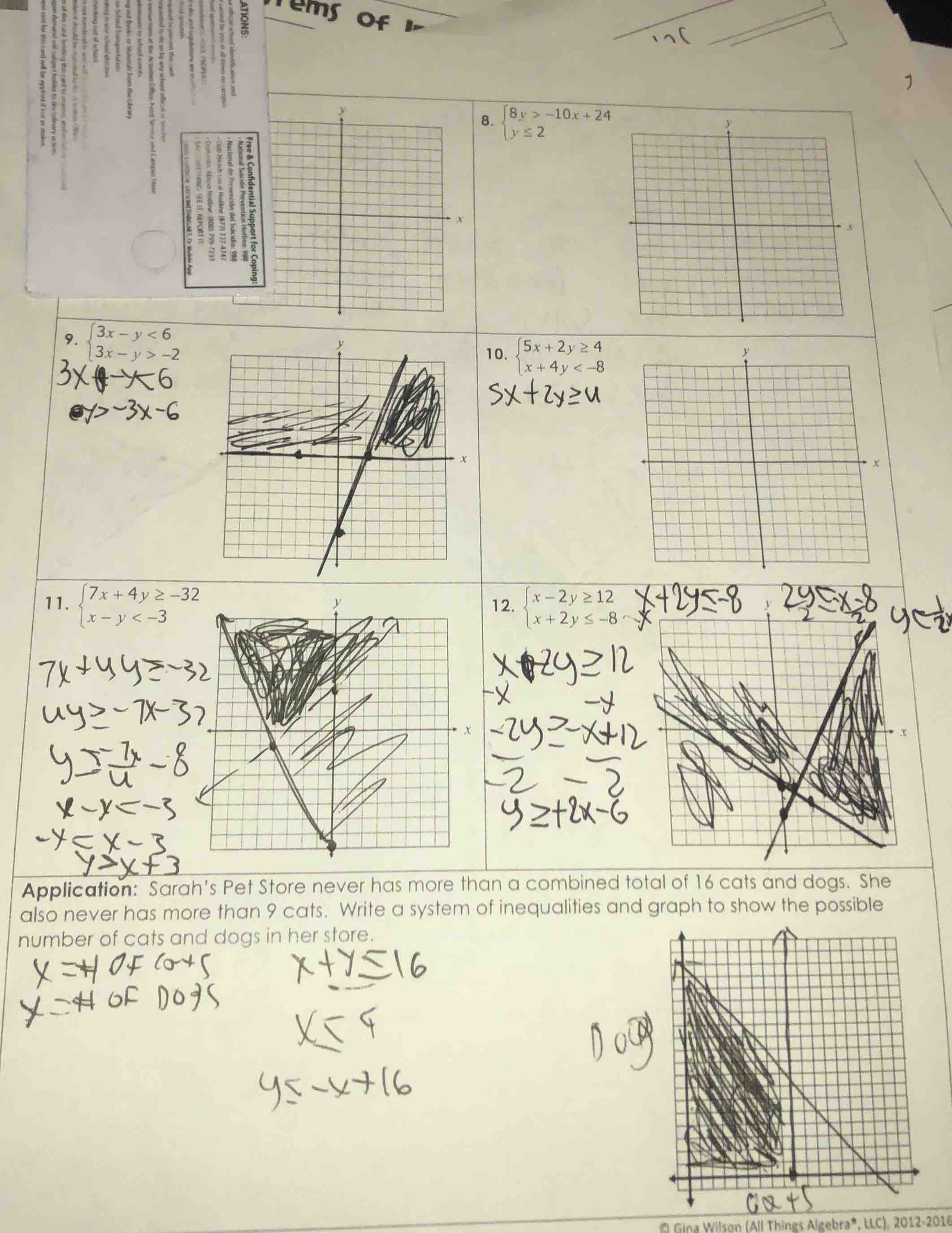
application: sarahs pet store never has more than a combined total of 16 cats and dogs. she also never has more than 9 cats. write a system of inequalities and graph to show the possible number of cats and dogs in her store.
Application Problem (Sarah's Pet Store)
Step1: Define Variables
Let \( x \) be the number of cats and \( y \) be the number of dogs. Both \( x \) and \( y \) must be non - negative integers (since we can't have a negative number of animals), so \( x\geq0 \) and \( y\geq0 \).
Step2: Formulate the first inequality (Combined total)
The combined total of cats and dogs is never more than 16. So, the sum of the number of cats (\( x \)) and the number of dogs (\( y \)) is less than or equal to 16. Mathematically, this is \( x + y\leq16 \).
Step3: Formulate the second inequality (Number of cats)
Sarah never has more than 9 cats. So, the number of cats \( x \) is less than or equal to 9. Mathematically, this is \( x\leq9 \).
Step4: Consider non - negativity
Since the number of cats and dogs can't be negative, we also have \( y\geq0 \) and \( x\geq0 \). But when graphing, the region defined by \( x + y\leq16 \), \( x\leq9 \), \( x\geq0 \) and \( y\geq0 \) will show the possible number of cats and dogs.
To graph \( x + y\leq16 \), we first graph the line \( x + y = 16 \) (which has a \( y\) - intercept of 16 and an \( x\) - intercept of 16). The inequality \( x + y\leq16 \) represents the region below and including this line.
To graph \( x\leq9 \), we graph the vertical line \( x = 9 \) and the region to the left of and including this line.
The region of intersection of \( x + y\leq16 \), \( x\leq9 \), \( x\geq0 \) and \( y\geq0 \) (where \( x\) and \( y\) are non - negative integers) will give the possible number of cats and dogs. For example, if \( x = 0 \), then \( y\) can range from 0 to 16; if \( x = 9 \), then \( y\) can range from 0 to \( 16 - 9=7 \).

Snap & solve any problem in the app
Get step-by-step solutions on Sovi AI
Photo-based solutions with guided steps
Explore more problems and detailed explanations
The system of inequalities is \(
\) (where \( x \) is the number of cats and \( y \) is the number of dogs). The graph is the region bounded by the lines \( x + y = 16 \) (below the line), \( x = 9 \) (to the left of the line), \( x = 0 \) (to the right of the line) and \( y = 0 \) (above the line), with \( x,y\in\mathbb{Z}_{\geq0}\).