QUESTION IMAGE
Question
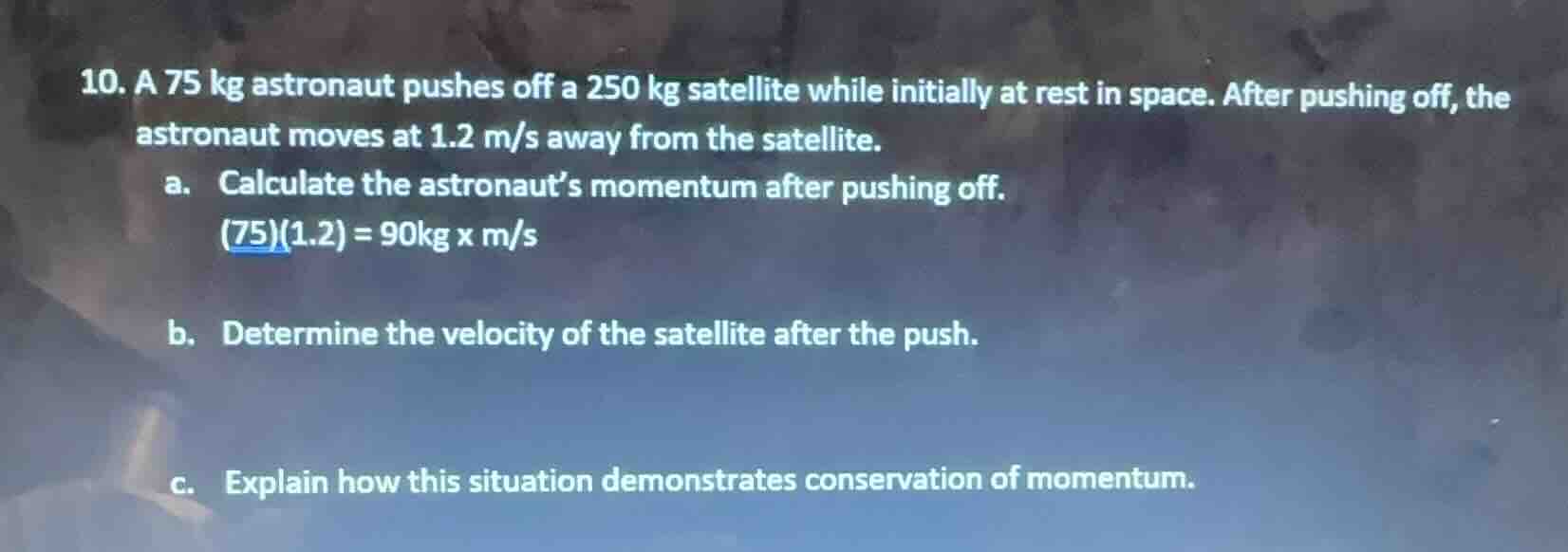
- a 75 kg astronaut pushes off a 250 kg satellite while initially at rest in space. after pushing off, the astronaut moves at 1.2 m/s away from the satellite.
a. calculate the astronaut’s momentum after pushing off.
(75)(1.2) = 90kg x m/s
b. determine the velocity of the satellite after the push.
c. explain how this situation demonstrates conservation of momentum.
Part a
Step1: Recall momentum formula
Momentum \( p \) is given by \( p = mv \), where \( m \) is mass and \( v \) is velocity.
Step2: Substitute values
For the astronaut, \( m = 75\space kg \) and \( v = 1.2\space m/s \). So, \( p = 75\times1.2 \).
Step3: Calculate
\( 75\times1.2 = 90\space kg\cdot m/s \).
Step1: Conservation of momentum
Initial total momentum is \( 0 \) (at rest). So, final momentum of astronaut plus final momentum of satellite is \( 0 \). Let \( m_a = 75\space kg \), \( v_a = 1.2\space m/s \), \( m_s = 250\space kg \), \( v_s \) be satellite's velocity. Then \( m_a v_a + m_s v_s = 0 \).
Step2: Solve for \( v_s \)
Rearrange: \( v_s = -\frac{m_a v_a}{m_s} \). Substitute \( m_a = 75 \), \( v_a = 1.2 \), \( m_s = 250 \).
Step3: Calculate
\( v_s = -\frac{75\times1.2}{250} = -\frac{90}{250} = -0.36\space m/s \). The negative sign indicates direction opposite to astronaut.
- Initial total momentum: System (astronaut + satellite) is at rest, so initial momentum \( p_{initial} = 0 \).
- Final total momentum: \( p_{astronaut} + p_{satellite} = 75\times1.2 + 250\times(-0.36) = 90 - 90 = 0 \).
- Since \( p_{initial} = p_{final} = 0 \), momentum is conserved (no external forces in space, so internal forces conserve total momentum).

Snap & solve any problem in the app
Get step-by-step solutions on Sovi AI
Photo-based solutions with guided steps
Explore more problems and detailed explanations
The astronaut’s momentum after pushing off is \( 90\space kg\cdot m/s \).