QUESTION IMAGE
Question
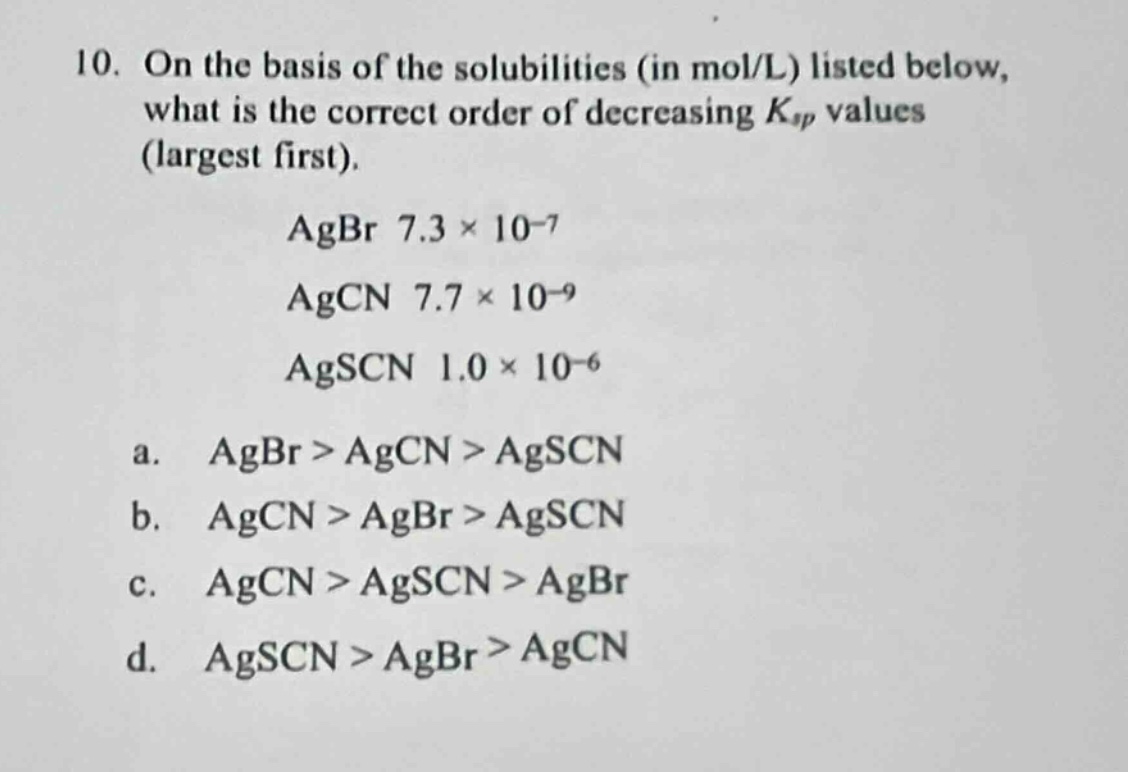
- on the basis of the solubilities (in mol/l) listed below, what is the correct order of decreasing $k_{sp}$ values (largest first).
agbr $7.3 \times 10^{-7}$
agcn $7.7 \times 10^{-9}$
agscn $1.0 \times 10^{-6}$
a. $\ce{agbr} > \ce{agcn} > \ce{agscn}$
b. $\ce{agcn} > \ce{agbr} > \ce{agscn}$
c. $\ce{agcn} > \ce{agscn} > \ce{agbr}$
d. $\ce{agscn} > \ce{agbr} > \ce{agcn}$
Step1: Recall \( K_{sp} \) formula for 1:1 salts
For salts with formula \( AB \) (1:1 ratio, like \( AgBr \), \( AgCN \), \( AgSCN \)), \( K_{sp} = [A^+][B^-] \). If solubility is \( s \) (mol/L), then \( [A^+] = s \), \( [B^-] = s \), so \( K_{sp} = s^2 \)? Wait, no—wait, for \( AgBr \), dissociation is \( AgBr(s)
ightleftharpoons Ag^+(aq) + Br^-(aq) \). So \( [Ag^+] = s \), \( [Br^-] = s \), so \( K_{sp} = s \times s = s^2 \)? Wait, no, the solubility given is \( s \) (mol/L), so for 1:1 salt, \( K_{sp} = s^2 \)? Wait, no, wait: if solubility is \( s \), then \( [Ag^+] = s \), \( [Br^-] = s \), so \( K_{sp} = s \times s = s^2 \). Wait, but let's check the given solubilities:
For \( AgBr \), solubility \( s = 7.3 \times 10^{-7} \) mol/L. Then \( K_{sp} = s^2 = (7.3 \times 10^{-7})^2 = 5.329 \times 10^{-13} \)? Wait, no, wait—wait, maybe I made a mistake. Wait, no: actually, for \( AgBr \), the solubility is \( s \), so \( [Ag^+] = s \), \( [Br^-] = s \), so \( K_{sp} = s \times s = s^2 \). But wait, let's check the other salts:
\( AgCN \): solubility \( s = 7.7 \times 10^{-9} \) mol/L. Then \( K_{sp} = s^2 = (7.7 \times 10^{-9})^2 = 5.929 \times 10^{-17} \)?
\( AgSCN \): solubility \( s = 1.0 \times 10^{-6} \) mol/L. Then \( K_{sp} = s^2 = (1.0 \times 10^{-6})^2 = 1.0 \times 10^{-12} \)?
Wait, that can't be right. Wait, no, maybe the solubility given is the molar solubility, and for 1:1 salts, \( K_{sp} = s^2 \). Wait, but let's recalculate:
\( AgSCN \): \( s = 1.0 \times 10^{-6} \), so \( K_{sp} = (1.0 \times 10^{-6})^2 = 1.0 \times 10^{-12} \)
\( AgBr \): \( s = 7.3 \times 10^{-7} \), so \( K_{sp} = (7.3 \times 10^{-7})^2 = 5.329 \times 10^{-13} \)
\( AgCN \): \( s = 7.7 \times 10^{-9} \), so \( K_{sp} = (7.7 \times 10^{-9})^2 = 5.929 \times 10^{-17} \)
Wait, but then the \( K_{sp} \) values would be:
\( AgSCN \): \( 1.0 \times 10^{-12} \)
\( AgBr \): \( 5.329 \times 10^{-13} \)
\( AgCN \): \( 5.929 \times 10^{-17} \)
So then the order of \( K_{sp} \) (largest first) would be \( AgSCN > AgBr > AgCN \), because \( 1.0 \times 10^{-12} > 5.329 \times 10^{-13} > 5.929 \times 10^{-17} \).
Wait, let's verify:
\( 1.0 \times 10^{-12} \) (AgSCN) is larger than \( 5.329 \times 10^{-13} \) (AgBr) because \( 1.0 \times 10^{-12} = 10 \times 10^{-13} \), which is larger than \( 5.329 \times 10^{-13} \). Then \( 5.329 \times 10^{-13} \) (AgBr) is larger than \( 5.929 \times 10^{-17} \) (AgCN) because \( 10^{-13} \) is larger than \( 10^{-17} \).
So the order of decreasing \( K_{sp} \) is \( AgSCN > AgBr > AgCN \), which is option d.
Step2: Calculate \( K_{sp} \) for each salt
- For \( AgBr \): \( s = 7.3 \times 10^{-7} \) mol/L. \( K_{sp} = s \times s = (7.3 \times 10^{-7})^2 = 5.329 \times 10^{-13} \)
- For \( AgCN \): \( s = 7.7 \times 10^{-9} \) mol/L. \( K_{sp} = (7.7 \times 10^{-9})^2 = 5.929 \times 10^{-17} \)
- For \( AgSCN \): \( s = 1.0 \times 10^{-6} \) mol/L. \( K_{sp} = (1.0 \times 10^{-6})^2 = 1.0 \times 10^{-12} \)
Step3: Compare \( K_{sp} \) values
- \( AgSCN \): \( 1.0 \times 10^{-12} \)
- \( AgBr \): \( 5.329 \times 10^{-13} \) (which is \( 0.5329 \times 10^{-12} \))
- \( AgCN \): \( 5.929 \times 10^{-17} \) (which is \( 0.0005929 \times 10^{-12} \))
So the order from largest to smallest \( K_{sp} \) is \( AgSCN > AgBr > AgCN \).

Snap & solve any problem in the app
Get step-by-step solutions on Sovi AI
Photo-based solutions with guided steps
Explore more problems and detailed explanations
d. \( \text{AgSCN} > \text{AgBr} > \text{AgCN} \)