QUESTION IMAGE
Question
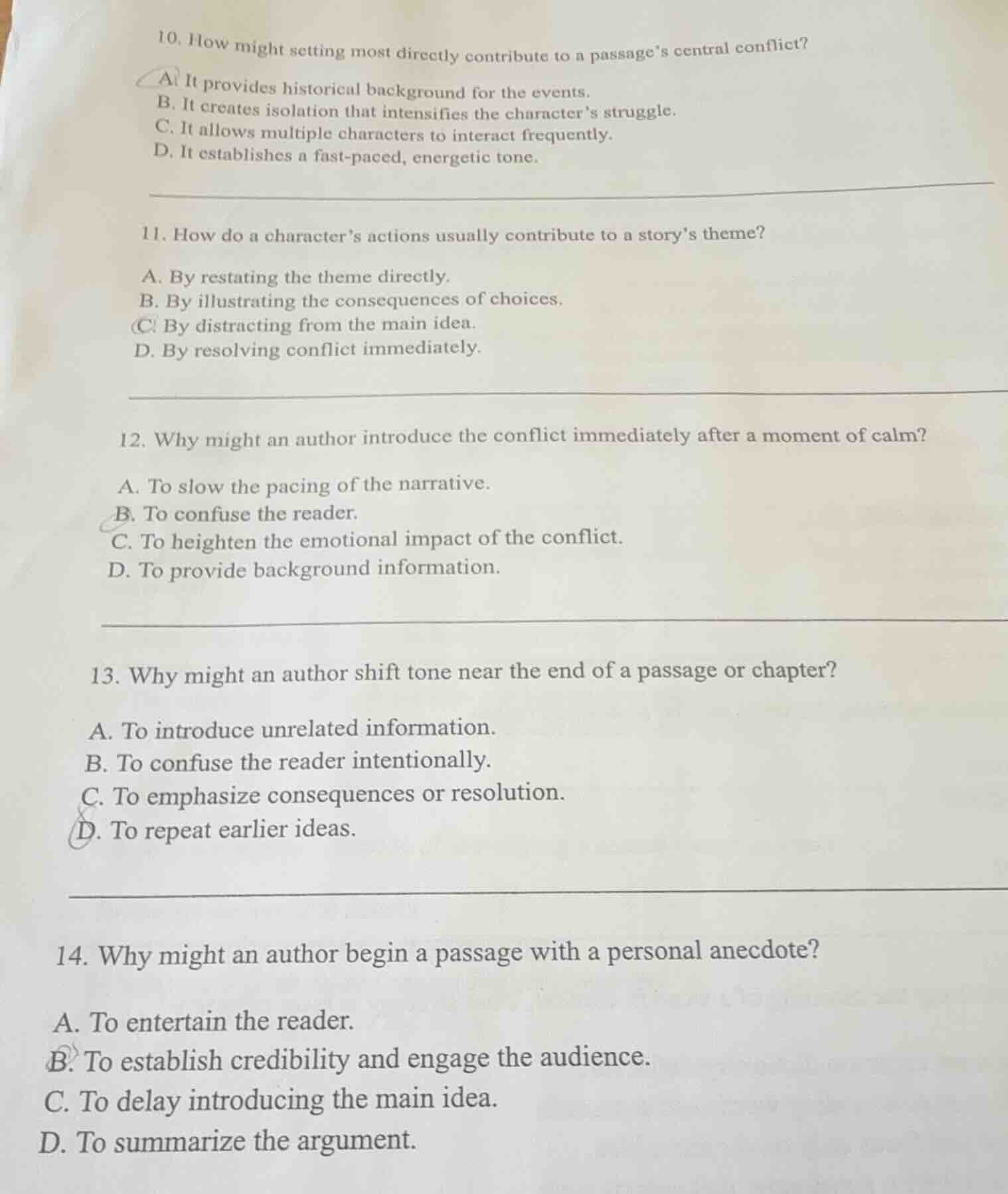
- how might setting most directly contribute to a passage’s central conflict?
a) it provides historical background for the events.
b. it creates isolation that intensifies the character’s struggle.
c. it allows multiple characters to interact frequently.
d. it establishes a fast - paced, energetic tone.
- how do a character’s actions usually contribute to a story’s theme?
a. by restating the theme directly.
b. by illustrating the consequences of choices.
c. by distracting from the main idea.
d. by resolving conflict immediately.
- why might an author introduce the conflict immediately after a moment of calm?
a. to slow the pacing of the narrative.
b. to confuse the reader.
c. to heighten the emotional impact of the conflict.
d. to provide background information.
- why might an author shift tone near the end of a passage or chapter?
a. to introduce unrelated information.
b. to confuse the reader intentionally.
c. to emphasize consequences or resolution.
d. to repeat earlier ideas.
- why might an author begin a passage with a personal anecdote?
a. to entertain the reader.
b. to establish credibility and engage the audience.
c. to delay introducing the main idea.
d. to summarize the argument.
- Setting directly fuels central conflict by creating isolating conditions that make a character's struggle harder and more urgent, rather than just providing background, enabling interactions, or setting tone.
- A character's actions show the outcomes of their decisions, which directly demonstrates the story's underlying theme, rather than restating it, distracting from it, or resolving conflict right away.
- A calm moment builds contrast, making the subsequent conflict feel more intense and emotionally impactful for the reader, rather than slowing pacing, confusing readers, or providing background.
- A late tone shift draws attention to key story elements like the results of events or the end of a conflict, rather than adding unrelated info, confusing readers, or repeating old ideas.
- Opening with a personal anecdote makes the author relatable, builds trust with the audience, and hooks them into the passage, rather than just entertaining, delaying the main idea, or summarizing the argument.

Snap & solve any problem in the app
Get step-by-step solutions on Sovi AI
Photo-based solutions with guided steps
Explore more problems and detailed explanations
- B. It creates isolation that intensifies the character's struggle.
- B. By illustrating the consequences of choices.
- C. To heighten the emotional impact of the conflict.
- C. To emphasize consequences or resolution.
- B. To establish credibility and engage the audience.