QUESTION IMAGE
Question
- 10 points
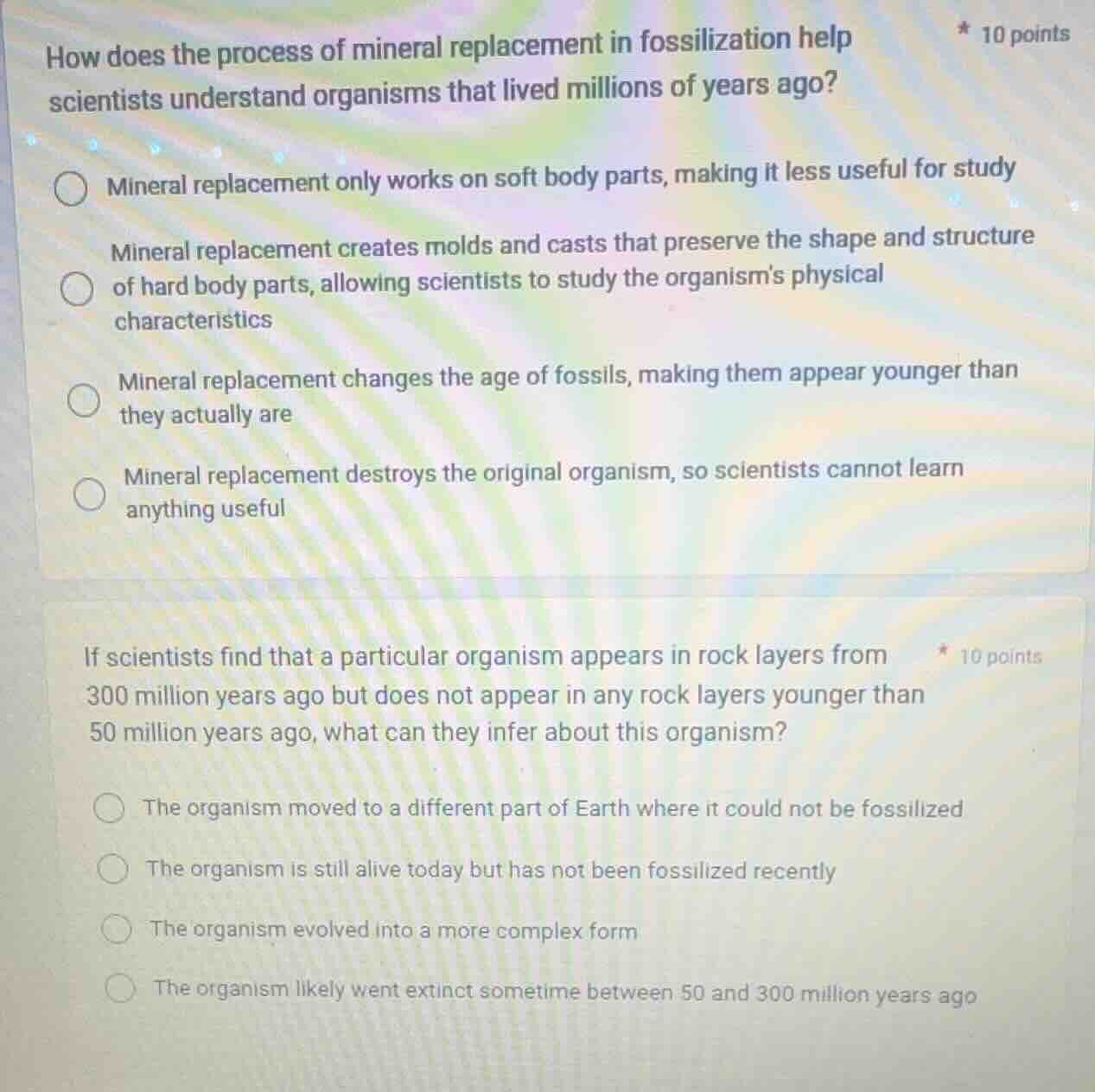
how does the process of mineral replacement in fossilization help scientists understand organisms that lived millions of years ago?
○ mineral replacement only works on soft body parts, making it less useful for study
○ mineral replacement creates molds and casts that preserve the shape and structure of hard body parts, allowing scientists to study the organisms physical characteristics
○ mineral replacement changes the age of fossils, making them appear younger than they actually are
○ mineral replacement destroys the original organism, so scientists cannot learn anything useful
- 10 points
if scientists find that a particular organism appears in rock layers from 300 million years ago but does not appear in any rock layers younger than 50 million years ago, what can they infer about this organism?
○ the organism moved to a different part of earth where it could not be fossilized
○ the organism is still alive today but has not been fossilized recently
○ the organism evolved into a more complex form
○ the organism likely went extinct sometime between 50 and 300 million years ago
For the first question: Mineral replacement in fossilization preserves hard body parts as molds/casts, retaining physical structures for study. Other options are incorrect: it acts on hard parts, does not alter fossil age, and preserves rather than destroys useful evidence.
For the second question: The absence of the organism's fossils in layers younger than 50 million years, after appearing 300 million years ago, indicates it likely went extinct between those times. The other options are less supported; there is no evidence for migration without fossilization, continued existence without fossils, or evolution to a new form.

Snap & solve any problem in the app
Get step-by-step solutions on Sovi AI
Photo-based solutions with guided steps
Explore more problems and detailed explanations
- Mineral replacement creates molds and casts that preserve the shape and structure of hard body parts, allowing scientists to study the organism's physical characteristics
- The organism likely went extinct sometime between 50 and 300 million years ago