QUESTION IMAGE
Question
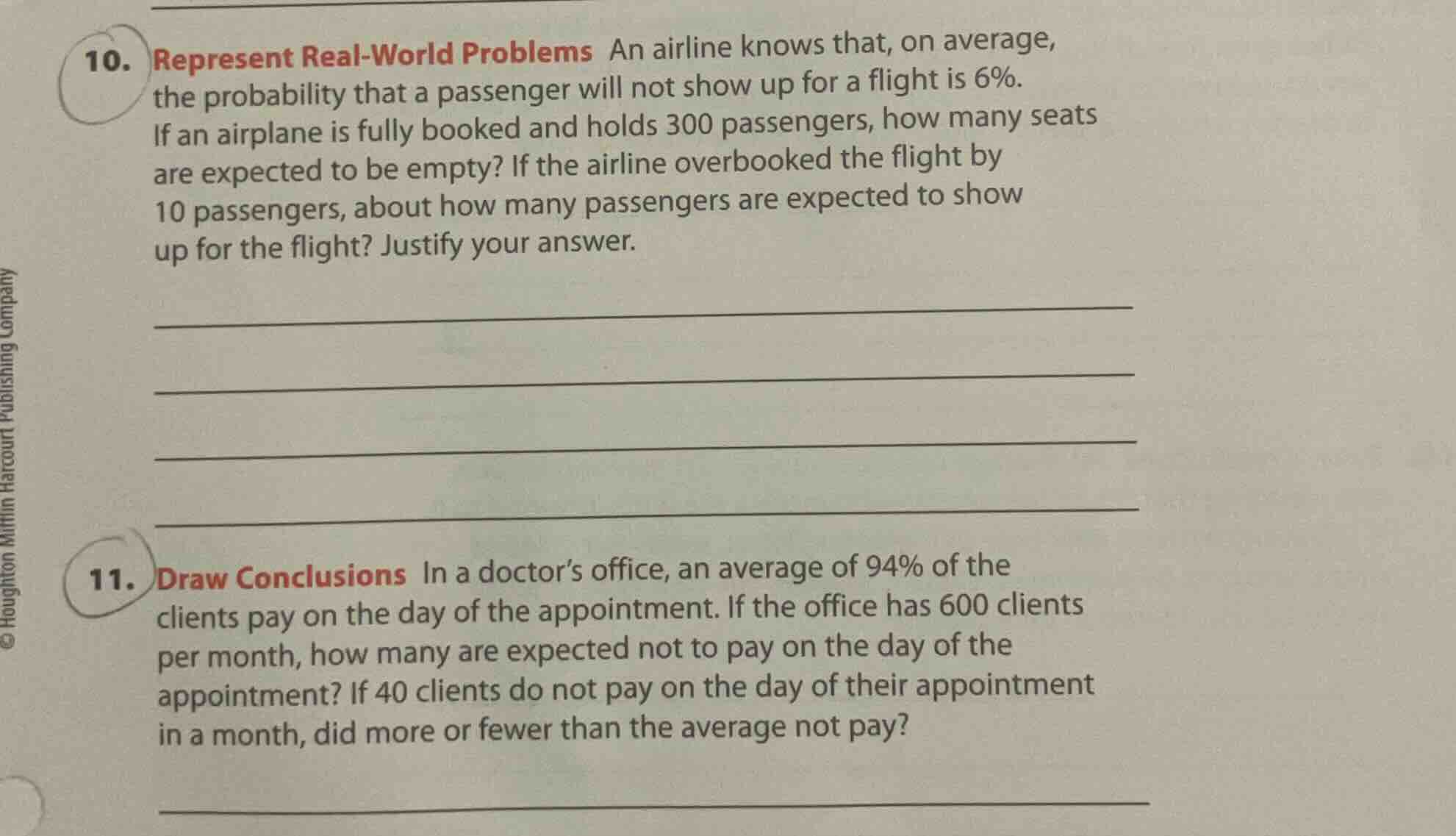
- represent real - world problems an airline knows that, on average, the probability that a passenger will not show up for a flight is 6%. if an airplane is fully booked and holds 300 passengers, how many seats are expected to be empty? if the airline overbooked the flight by 10 passengers, about how many passengers are expected to show up for the flight? justify your answer.
- draw conclusions in a doctor’s office, an average of 94% of the clients pay on the day of the appointment. if the office has 600 clients per month, how many are expected not to pay on the day of the appointment? if 40 clients do not pay on the day of their appointment in a month, did more or fewer than the average not pay?
Problem 10
Step 1: Calculate empty seats (fully booked)
The probability of a passenger not showing up is 6% or 0.06. For 300 passengers, the expected number of empty seats is the probability of no - show times the number of passengers.
So, we calculate $300\times0.06$.
$300\times0.06 = 18$
Step 2: Calculate total booked (overbooked)
If the flight is overbooked by 10 passengers, the total number of booked passengers is $300 + 10=310$.
Step 3: Calculate expected passengers to show up
The probability of a passenger showing up is $1 - 0.06 = 0.94$. So the expected number of passengers to show up is the total number of booked passengers times the probability of showing up.
We calculate $310\times0.94$.
$310\times0.94=(300 + 10)\times0.94=300\times0.94+10\times0.94 = 282+9.4 = 291.4\approx291$ (or we can also think of it as total booked minus expected no - shows: $310-310\times0.06 = 310\times(1 - 0.06)=310\times0.94 = 291.4\approx291$)
Step 1: Calculate expected non - payers
The percentage of clients who do not pay on the day of the appointment is $100\% - 94\%=6\%$ or 0.06. For 600 clients, the expected number of clients who do not pay on the day of the appointment is $600\times0.06$.
$600\times0.06 = 36$
Step 2: Compare with 40
We have the expected number of non - payers as 36 and the actual number of non - payers in a month is 40. Since $40>36$, more than the average did not pay.

Snap & solve any problem in the app
Get step-by-step solutions on Sovi AI
Photo-based solutions with guided steps
Explore more problems and detailed explanations
- When fully booked (300 passengers), the expected number of empty seats is 18.
- When overbooked by 10 passengers (310 total booked), the expected number of passengers to show up is approximately 291.