QUESTION IMAGE
Question
- someone said that light bent around a corner to reach an object. is this possible? * 1 point
a. no, light travels in straight lines only.
b. yes, light travels like a river, wherever there is an open path.
c. maybe; light travels in unpredictable ways.
d. yes, if the light is bright enough, then it can change direction to go around corners.
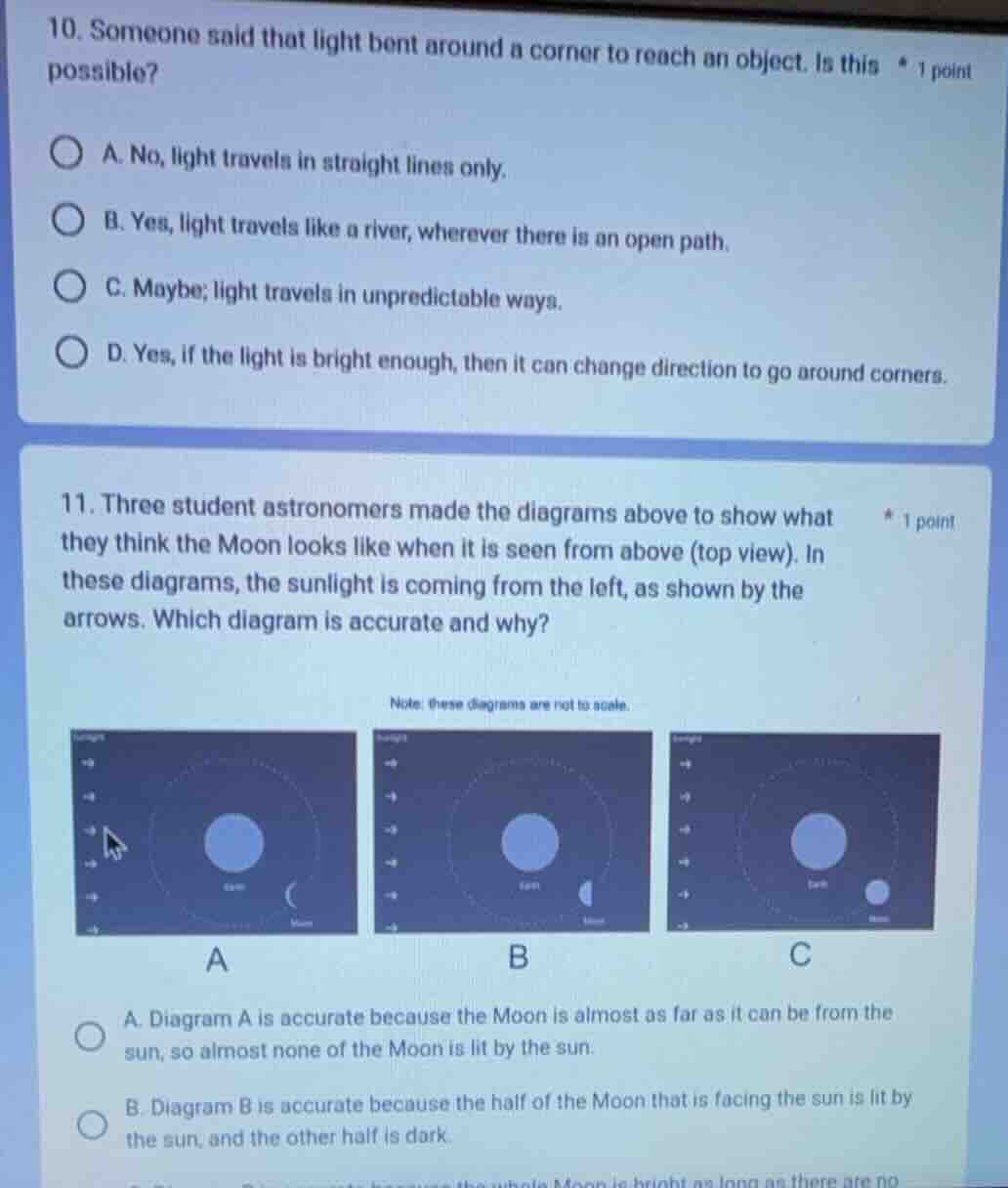
- three student astronomers made the diagrams above to show what they think the moon looks like when it is seen from above (top view). in these diagrams, the sunlight is coming from the left, as shown by the arrows. which diagram is accurate and why? * 1 point
note: these diagrams are not to scale.
a. diagram a is accurate because the moon is almost as far as it can be from the sun, so almost none of the moon is lit by the sun.
b. diagram b is accurate because the half of the moon that is facing the sun is lit by the sun, and the other half is dark.
For question 10: While light typically travels in straight lines in a uniform medium, phenomena like diffraction allow light to bend around obstacles (corners) to a degree. However, option B incorrectly analogizes it to a river. The most accurate reasoning is that light can exhibit wave behavior to bend around corners, but among the given options, the common misconception is that light only travels straight, but the correct scientific answer here is that it can bend via diffraction, but none of the options perfectly capture this. Wait, no—re-evaluating: Option A is incorrect because light can diffract. Option B's reasoning is wrong, but the "yes" is correct? No, better to correct: Actually, light can bend around corners through diffraction, so the answer is yes, but the best option here is B? No, no—wait, no, the options: Option A is wrong because light does bend (diffraction). Option B's reasoning is flawed, but it's the only "yes" that is technically correct in outcome. Wait no, let's re-assess: The question is if light can bend around a corner to reach an object. Diffraction allows this, so the answer is yes. Option B's reasoning is not accurate, but among the options, it's the only yes that is not based on brightness (D is wrong, brightness doesn't make light bend). Option C is wrong, light's behavior is predictable. So the correct option is B, but the reasoning is off, but it's the only correct yes.
For question 11: The Moon is lit on the half facing the Sun, regardless of its position relative to Earth. When viewed from above, the portion of the Moon facing the left (sun direction) must be illuminated. Diagram B shows the half of the Moon facing the Sun lit, which matches the rule that the Sun illuminates the hemisphere of the Moon facing it.

Snap & solve any problem in the app
Get step-by-step solutions on Sovi AI
Photo-based solutions with guided steps
Explore more problems and detailed explanations
- B. Yes, light travels like a river, wherever there is an open path.
- B. Diagram B is accurate because the half of the Moon that is facing the sun is lit by the sun, and the other half is dark.