QUESTION IMAGE
Question
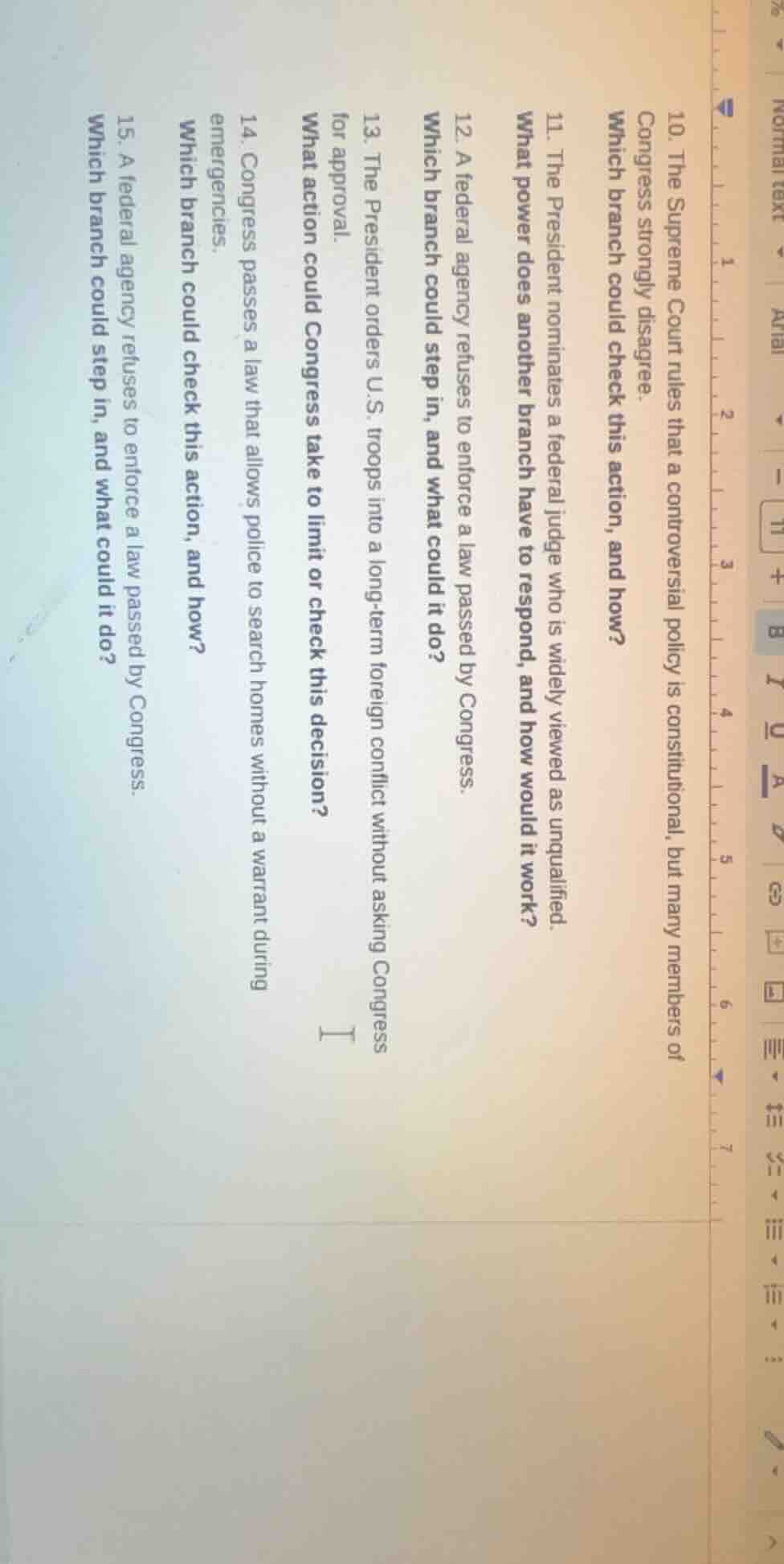
- the supreme court rules that a controversial policy is constitutional, but many members of congress strongly disagree. which branch could check this action, and how?
- the president nominates a federal judge who is widely viewed as unqualified. what power does another branch have to respond, and how would it work?
- a federal agency refuses to enforce a law passed by congress. which branch could step in, and what could it do?
- the president orders u.s. troops into a long - term foreign conflict without asking congress for approval. what action could congress take to limit or check this decision?
- congress passes a law that allows police to search homes without a warrant during emergencies. which branch could check this action, and how?
- a federal agency refuses to enforce a law passed by congress. which branch could step in, and what could it do?
Brief Explanations
- Congress can check the Supreme Court's ruling by proposing a constitutional amendment, which would override the Court's interpretation if ratified by 3/4 of U.S. states.
- The Senate (legislative branch) has the power to reject the nomination. It holds confirmation hearings and votes; a majority vote against the nominee blocks their appointment.
- The legislative branch (Congress) can step in. It can hold oversight hearings, cut the agency's funding, or pass new legislation to compel enforcement.
- Congress can check this decision by using its power of the purse to cut funding for the troop deployment, or by passing a resolution to demand troop withdrawal (in some cases, with a veto-override if the President objects).
- The judicial branch (Supreme Court) can check this law. It can review the law in a legal challenge and declare it unconstitutional if it violates the Fourth Amendment's protection against unreasonable searches.
- The executive branch (President) can issue an executive order to direct enforcement, or the judicial branch can order the agency to enforce the law after a lawsuit is filed to compel compliance. Congress can also use oversight or funding cuts to pressure the agency.

Snap & solve any problem in the app
Get step-by-step solutions on Sovi AI
Photo-based solutions with guided steps
Explore more problems and detailed explanations
- The Legislative Branch (Congress) can check this by proposing and working to ratify a constitutional amendment that would counter the Court's ruling.
- The Legislative Branch (Senate) can respond by rejecting the nomination; it holds confirmation hearings and votes, requiring a majority to approve the nominee, so a negative vote blocks the appointment.
- The Legislative Branch (Congress) can step in: it can conduct oversight hearings, reduce the agency's budget, or pass legislation to mandate enforcement.
- Congress (Legislative Branch) can limit this decision by cutting funding for the troop deployment or passing a resolution demanding troop withdrawal (with a 2/3 vote in both chambers to override a potential presidential veto).
- The Judicial Branch (Supreme Court) can check this action by reviewing the law in a case and declaring it unconstitutional if it violates the Fourth Amendment.
- The Executive Branch (President) can step in by issuing an executive order to enforce the law, or the Judicial Branch can order the agency to comply via a court ruling after a legal challenge. Congress can also use oversight or funding cuts to force enforcement.