QUESTION IMAGE
Question
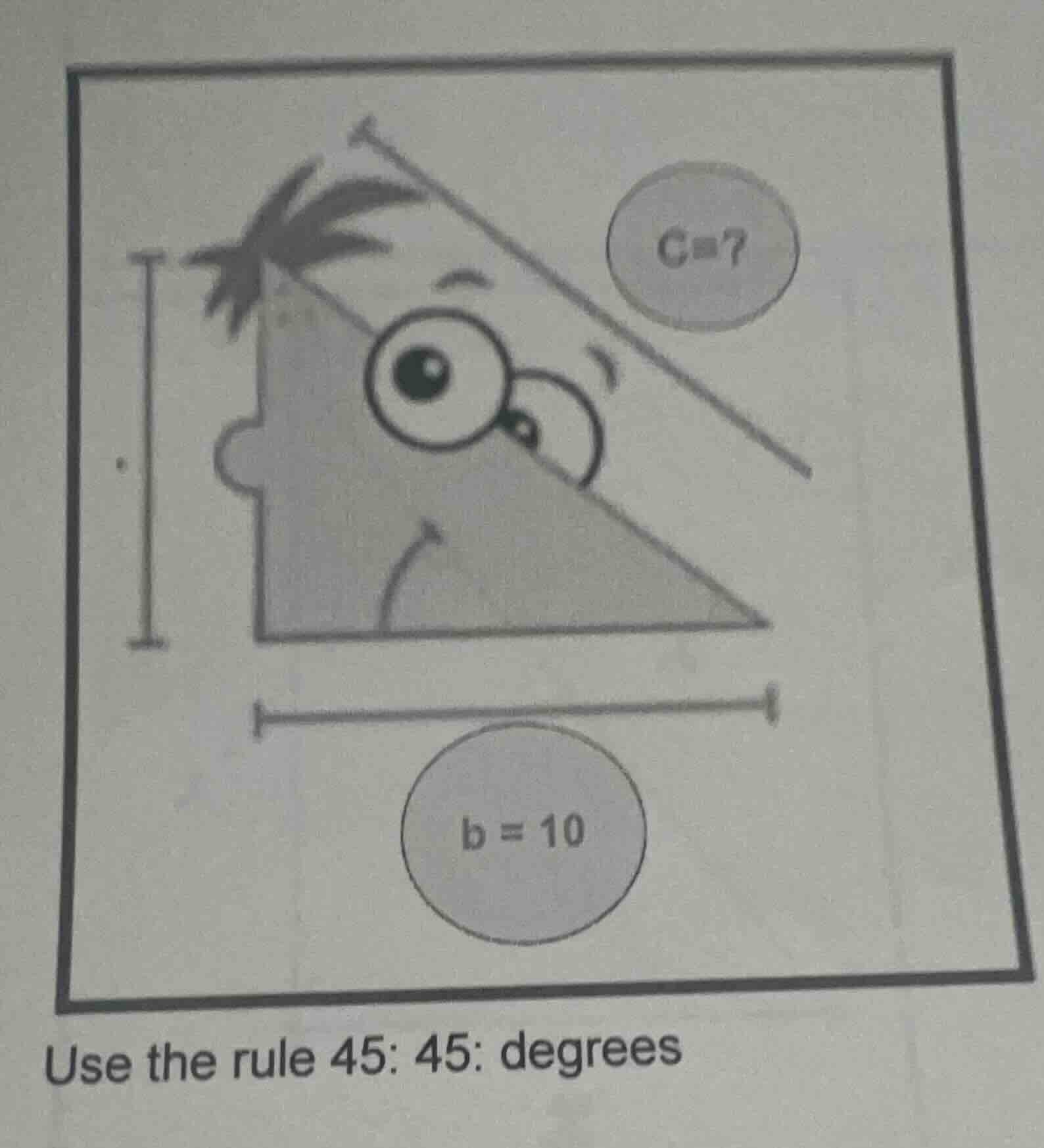
c=7
b = 10
use the rule 45: 45: degrees
Step1: Identify triangle type
The triangle has angles 45°, 45°, and 90° (since \(180 - 45 - 45 = 90\)), so it's an isosceles right triangle. In such a triangle, the legs (the two equal sides) are equal, and the hypotenuse \(c\) is related to a leg \(a\) (or \(b\)) by \(c = a\sqrt{2}\) (or \(c = b\sqrt{2}\)). Wait, but here we might have a typo or misinterpretation? Wait, the problem says "Use the rule 45: 45: degrees" (probably 45-45-90 triangle). Wait, but in the diagram, \(b = 10\) (maybe a leg), and \(c = 7\)? No, maybe the labels are different. Wait, maybe the triangle has legs \(a\) and \(b\), and hypotenuse \(c\). In a 45-45-90 triangle, legs are equal, so if one leg is \(b = 10\), then the other leg \(a = 10\), and hypotenuse \(c = 10\sqrt{2}\approx14.14\). But the diagram has \(c = 7\)? Wait, maybe the labels are reversed. Wait, maybe the given \(c = 7\) is a leg? Wait, no, the notation: in a right triangle, hypotenuse is opposite the right angle. Let's re-express: in a 45-45-90 triangle, let the legs be \(x\), then hypotenuse \(h = x\sqrt{2}\). So if a leg is \(x\), hypotenuse is \(x\sqrt{2}\); if hypotenuse is \(h\), then leg \(x = \frac{h}{\sqrt{2}}=\frac{h\sqrt{2}}{2}\).
Wait, maybe the problem is to find a side. Let's assume that \(b = 10\) is a leg (since in 45-45-90, legs are equal), so the other leg is also 10, and hypotenuse is \(10\sqrt{2}\approx14.14\). But the diagram has \(c = 7\) – maybe that's a mistake, or maybe we need to find a leg when hypotenuse is 7? Wait, no, the problem says "Use the rule 45: 45: degrees" – so 45-45-90 triangle. Let's clarify:
In a 45-45-90 triangle:
- Angles: 45°, 45°, 90°
- Sides: legs (opposite 45°) are equal, hypotenuse (opposite 90°) is leg \(\times\sqrt{2}\)
So if we have a leg \(x\), hypotenuse \(h = x\sqrt{2}\)
If we have hypotenuse \(h\), leg \(x = \frac{h}{\sqrt{2}}=\frac{h\sqrt{2}}{2}\)
Wait, maybe the problem is to find a side. Let's suppose that \(b = 10\) is a leg, so the other leg is 10, hypotenuse is \(10\sqrt{2}\approx14.14\). But the diagram has \(c = 7\) – maybe the labels are wrong, or maybe we need to find a leg when hypotenuse is 7? Then leg would be \(\frac{7\sqrt{2}}{2}\approx4.95\). But the given \(b = 10\) – maybe the problem is mislabeled. Alternatively, maybe the triangle is labeled with \(b = 10\) as a leg, and we need to find hypotenuse. Then hypotenuse \(c = 10\sqrt{2}\approx14.14\).
Wait, maybe the original problem is to find the hypotenuse when a leg is 10. So:
Step1: Recall 45-45-90 triangle ratios
In a 45-45-90 triangle, the ratio of leg : leg : hypotenuse is \(1 : 1 : \sqrt{2}\). So if one leg (let's say \(b\)) is 10, then the other leg is also 10, and hypotenuse \(c = 10 \times \sqrt{2}\).
Step2: Calculate the hypotenuse
\(c = 10\sqrt{2} \approx 14.14\) (or exact form \(10\sqrt{2}\)).
But the diagram has \(c = 7\) – maybe that's a typo, and \(b = 10\) is a leg, so hypotenuse is \(10\sqrt{2}\).
Alternatively, if \(c = 7\) is the hypotenuse, then leg \(b = \frac{7}{\sqrt{2}}=\frac{7\sqrt{2}}{2}\approx4.95\), but the given \(b = 10\) doesn't match. So likely, the problem is to find hypotenuse when leg is 10, so:
Step1: Identify triangle type
It's a 45-45-90 right triangle, so legs are equal, hypotenuse \(= \text{leg} \times \sqrt{2}\).
Step2: Apply the ratio
Given leg \(b = 10\), hypotenuse \(c = 10 \times \sqrt{2}\).
Step3: Calculate the value
\(10\sqrt{2} \approx 14.14\) (or exact form \(10\sqrt{2}\)).

Snap & solve any problem in the app
Get step-by-step solutions on Sovi AI
Photo-based solutions with guided steps
Explore more problems and detailed explanations
If finding hypotenuse with leg \(b = 10\), the hypotenuse is \(10\sqrt{2}\) (or approximately \(14.14\)). If there's a mislabel and \(c = 7\) is a leg, then the other leg is 7 and hypotenuse is \(7\sqrt{2}\approx9.9\), but given \(b = 10\), the first scenario is more likely. So the answer is \(10\sqrt{2}\) (or \(\approx14.14\)).