QUESTION IMAGE
Question
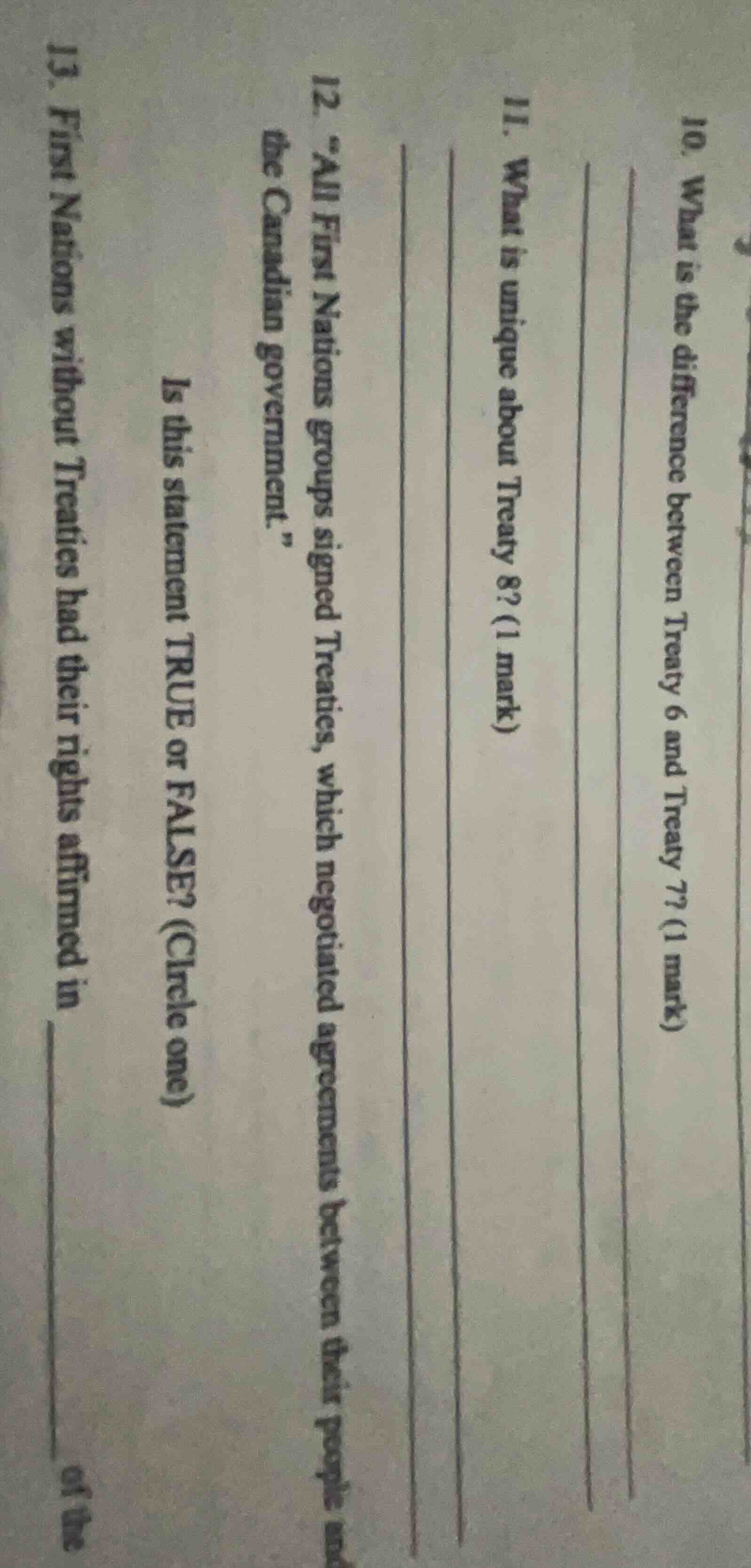
- what is the difference between treaty 6 and treaty 7? (1 mark)
- what is unique about treaty 8? (1 mark)
- \all first nations groups signed treaties, which negotiated agreements between their people and the canadian government.\
is this statement true or false? (circle one)
- first nations without treaties had their rights affirmed in
Brief Explanations
- Treaty 6 included a medical care clause (for a pandemic at the time) and covered a more agricultural-focused region in the Prairies, while Treaty 7 covered a smaller, more southern Prairies area focused on supporting the Canadian Pacific Railway, with no equivalent medical clause.
- Treaty 8 was unique because it was a comprehensive "adhesion" treaty that covered a massive, remote northern territory, and it explicitly included rights to hunt, trap, and fish on unoccupied Crown land, alongside the usual land surrender terms, to sustain the First Nations' traditional subsistence lifestyle.
- Not all First Nations groups signed treaties with the Canadian government; many groups (especially in British Columbia, parts of the North, and elsewhere) never entered into these negotiated agreements.
- First Nations without treaties had their rights affirmed in Section 35 of the Constitution Act, 1982, which recognizes and affirms the existing Aboriginal and treaty rights of Aboriginal peoples in Canada.

Snap & solve any problem in the app
Get step-by-step solutions on Sovi AI
Photo-based solutions with guided steps
Explore more problems and detailed explanations
- Treaty 6 included a medical assistance provision (for a smallpox outbreak) and covered a larger, agricultural Prairie region, while Treaty 7 covered a smaller southern Prairie area tied to the Canadian Pacific Railway, with no such medical clause.
- Treaty 8 is unique as it covers an enormous remote northern territory, explicitly guarantees First Nations rights to hunt, trap, and fish on unoccupied Crown land to maintain their traditional subsistence way of life, and had extensive adhesion additions over time.
- FALSE
- Section 35, Constitution Act, 1982