QUESTION IMAGE
Question
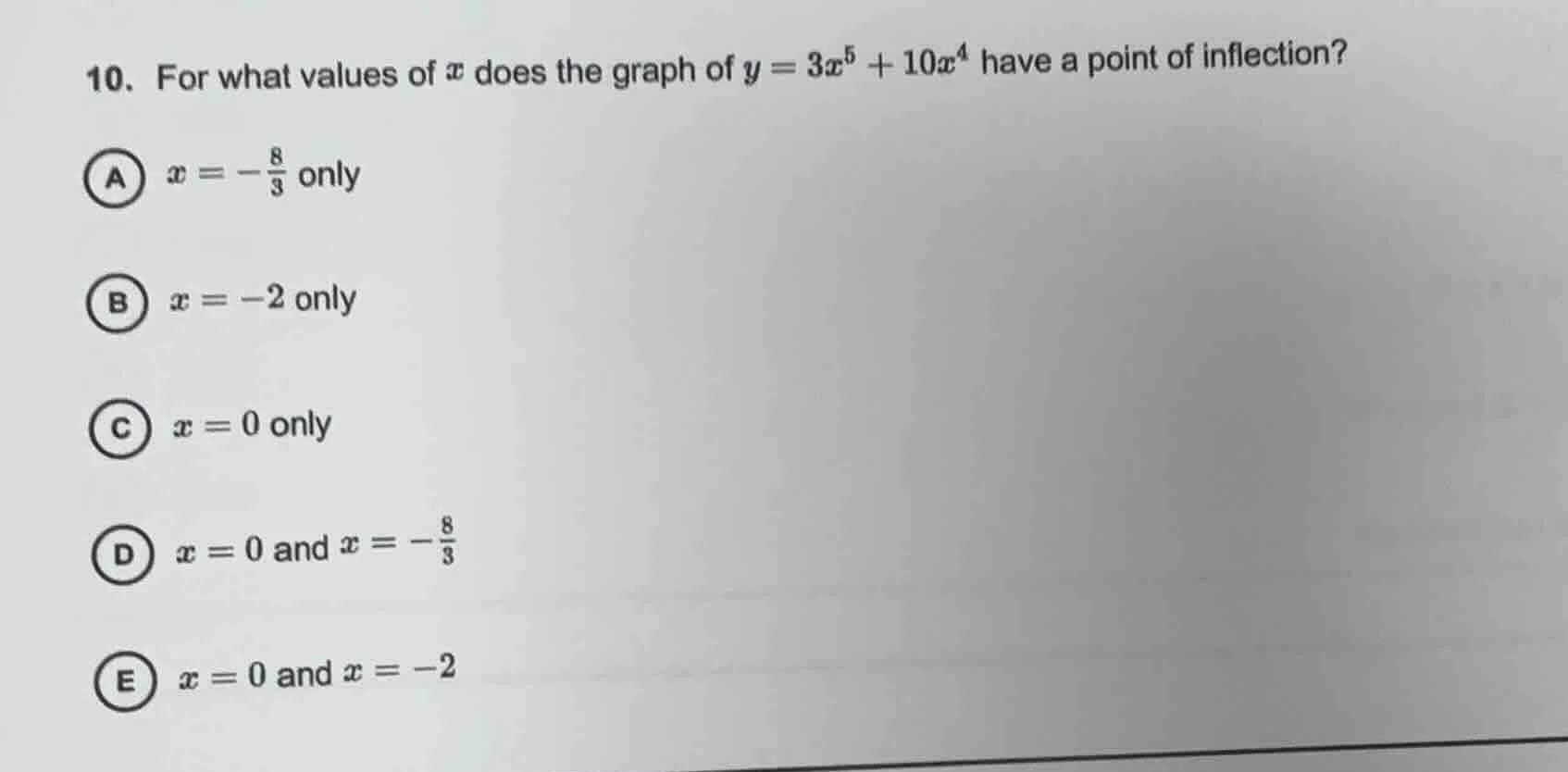
- for what values of $x$ does the graph of $y = 3x^5 + 10x^4$ have a point of inflection?
a $x = -\frac{8}{3}$ only
b $x = -2$ only
c $x = 0$ only
d $x = 0$ and $x = -\frac{8}{3}$
e $x = 0$ and $x = -2$
Step1: Find first derivative
$y' = \frac{d}{dx}(3x^5 + 10x^4) = 15x^4 + 40x^3$
Step2: Find second derivative
$y'' = \frac{d}{dx}(15x^4 + 40x^3) = 60x^3 + 120x^2$
Step3: Solve $y''=0$ for $x$
$60x^3 + 120x^2 = 0$
$60x^2(x + 2) = 0$
Solutions: $x=0$ and $x=-2$
Step4: Test concavity change
- For $x < -2$ (e.g., $x=-3$): $y'' = 60(-3)^3 + 120(-3)^2 = -540 + 1080 = 540 > 0$ (concave up)
- For $-2 < x < 0$ (e.g., $x=-1$): $y'' = 60(-1)^3 + 120(-1)^2 = -60 + 120 = 60 > 0$? No, correction: $y'' = 60(-1)^3 + 120(-1)^2 = -60 + 120 = 60$? No, wait: $60(-1)^3 = -60$, $120(-1)^2=120$, sum is $60$? No, wait no: $60x^3 +120x^2$ at $x=-2$ is 0. At $x=-3$: $60*(-27)+120*(9)= -1620+1080=-540 <0$ (concave down). At $x=-1$: $60*(-1)+120*(1)=60>0$ (concave up). So concavity changes at $x=-2$.
- For $x>0$ (e.g., $x=1$): $y''=60+120=180>0$ (concave up). No concavity change at $x=0$.

Snap & solve any problem in the app
Get step-by-step solutions on Sovi AI
Photo-based solutions with guided steps
Explore more problems and detailed explanations
B. $x = -2$ only