QUESTION IMAGE
Question
- what is the wave speed of every form of energy on the em spectrum?
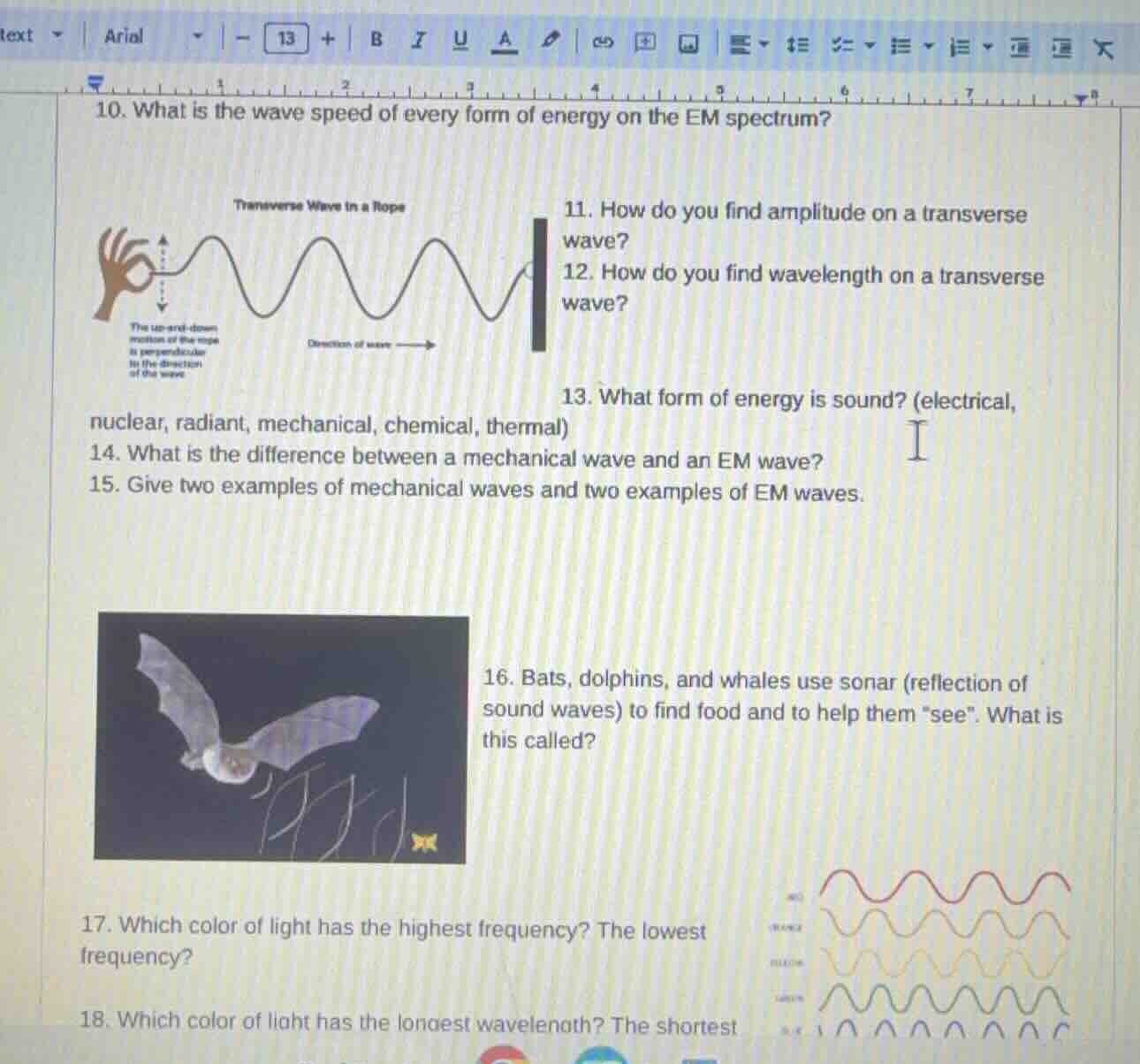
transverse wave in a rope
the up-and-down motion of the rope is perpendicular to the direction of the wave
direction of wave ----->
- how do you find amplitude on a transverse wave?
- how do you find wavelength on a transverse wave?
- what form of energy is sound? (electrical, nuclear, radiant, mechanical, chemical, thermal)
- what is the difference between a mechanical wave and an em wave?
- give two examples of mechanical waves and two examples of em waves.
- bats, dolphins, and whales use sonar (reflection of sound waves) to find food and to help them \see\. what is this called?
- which color of light has the highest frequency? the lowest frequency?
- which color of light has the longest wavelength? the shortest
Question 10
Electromagnetic (EM) waves all travel at the speed of light in a vacuum. The speed of light \( c \) is a constant, approximately \( 3.0 \times 10^8 \, \text{m/s} \) in a vacuum. All forms of electromagnetic energy (like radio waves, visible light, X - rays, etc.) on the EM spectrum travel at this speed in a vacuum.
For a transverse wave, the amplitude is the maximum displacement of a point on the wave from its rest (equilibrium) position. To find the amplitude, you measure the vertical distance (in the case of a transverse wave like the one on a rope or a light wave) from the mid - line (equilibrium position) of the wave to the peak (highest point) or the trough (lowest point) of the wave.
For a transverse wave, the wavelength is the distance between two consecutive identical points on the wave. This can be the distance between two consecutive peaks, two consecutive troughs, or two consecutive points that are in the same phase (e.g., two consecutive points where the wave is at the same position in its cycle). To measure it, you can use a ruler or a measuring tool to find the distance between, for example, one peak and the next adjacent peak on the transverse wave.

Snap & solve any problem in the app
Get step-by-step solutions on Sovi AI
Photo-based solutions with guided steps
Explore more problems and detailed explanations
The wave speed of every form of energy on the EM spectrum (in a vacuum) is \( 3.0\times10^{8}\, \text{m/s} \) (the speed of light).