QUESTION IMAGE
Question
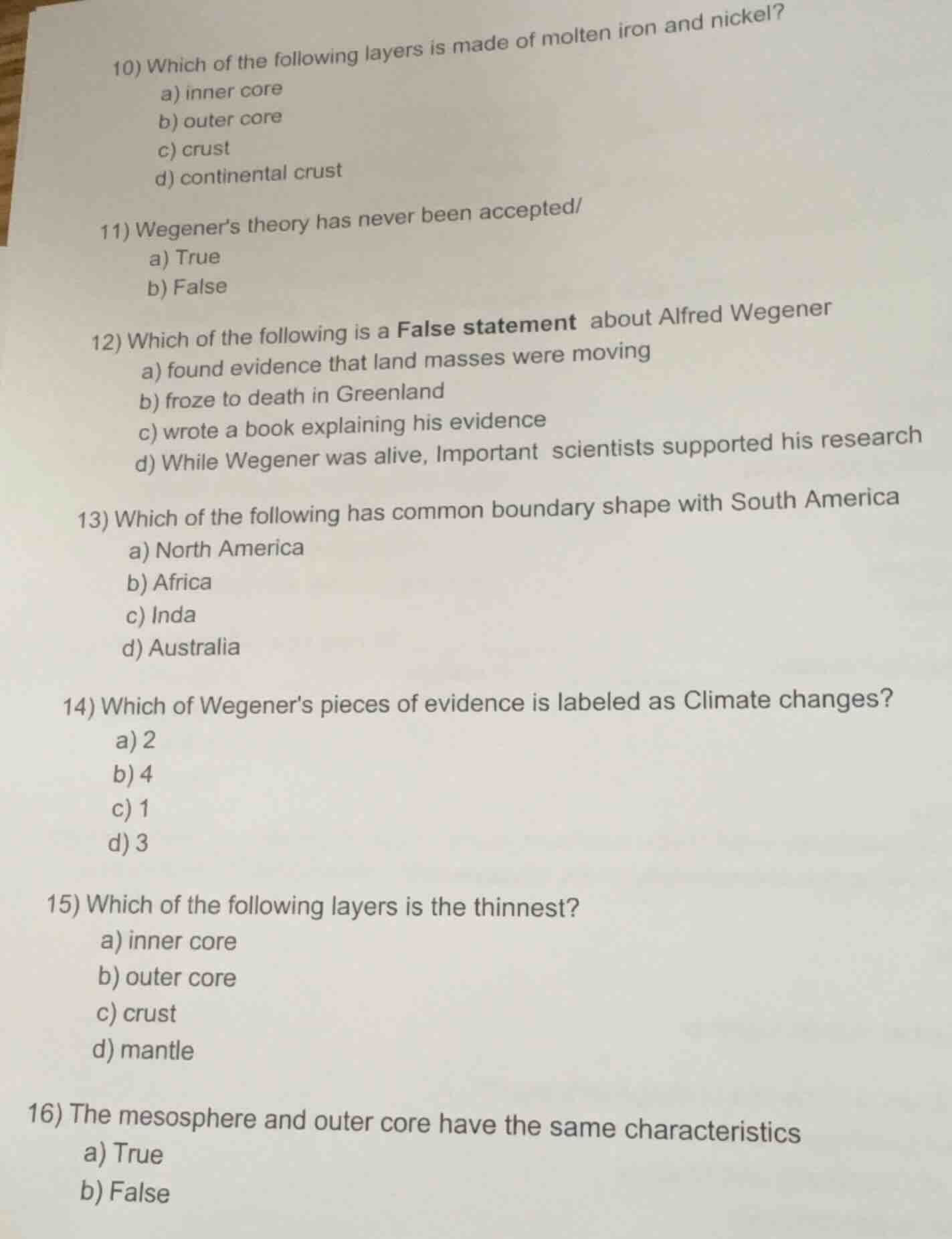
- which of the following layers is made of molten iron and nickel?
a) inner core
b) outer core
c) crust
d) continental crust
- wegener’s theory has never been accepted/
a) true
b) false
- which of the following is a false statement about alfred wegener
a) found evidence that land masses were moving
b) froze to death in greenland
c) wrote a book explaining his evidence
d) while wegener was alive, important scientists supported his research
- which of the following has common boundary shape with south america
a) north america
b) africa
c) inda
d) australia
- which of wegeners pieces of evidence is labeled as climate changes?
a) 2
b) 4
c) 1
d) 3
- which of the following layers is the thinnest?
a) inner core
b) outer core
c) crust
d) mantle
- the mesosphere and outer core have the same characteristics
a) true
b) false
Brief Explanations
- Earth's outer core is a liquid layer composed of molten iron and nickel, while the inner core is solid, crust is rocky, and continental crust is a subset of the crust.
- Wegener's continental drift theory was initially rejected but later formed the basis for plate tectonics, so it was eventually accepted.
- Wegener's theory was widely rejected by the scientific community during his lifetime; he did find evidence for moving landmasses, died in Greenland, and published his work.
- The eastern coast of South America and western coast of Africa have complementary boundary shapes, supporting continental drift.
- Wegener's climate change evidence includes glacial deposits in warm regions (labeled as piece 2 in standard evidence sets).
- The crust is the outermost and thinnest layer of the Earth, much thinner than the mantle, outer core, and inner core.
- The mesosphere (a solid layer in the mantle) is solid, while the outer core is liquid, so they have different characteristics.

Snap & solve any problem in the app
Get step-by-step solutions on Sovi AI
Photo-based solutions with guided steps
Explore more problems and detailed explanations
- b) outer core
- b) False
- d) While Wegener was alive, Important scientists supported his research
- b) Africa
- a) 2
- c) crust
- b) False