QUESTION IMAGE
Question
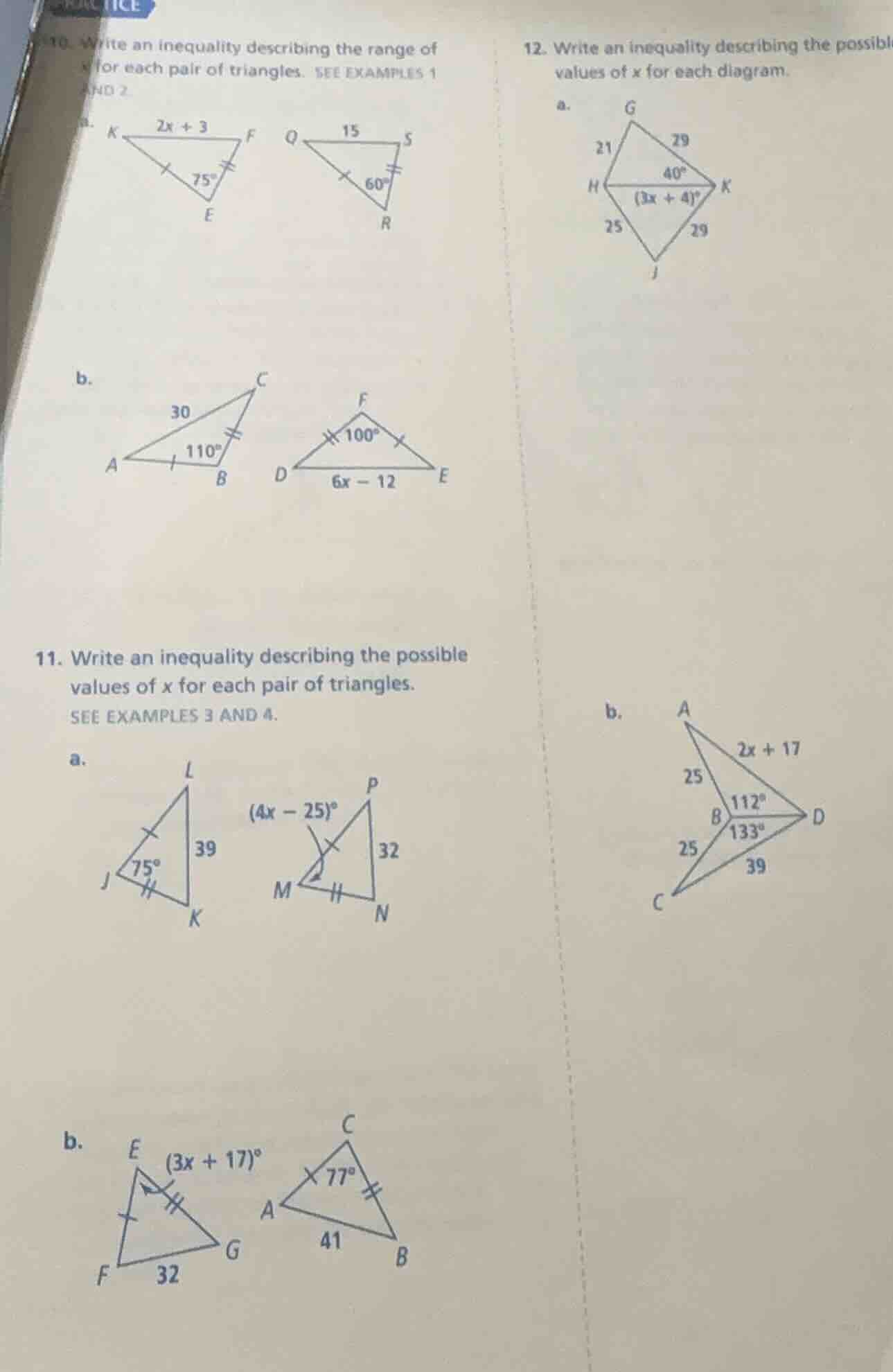
- write an inequality describing the range of x for each pair of triangles. see examples 1 and 2.
a. triangle kfe with side kf = 2x + 3, angle at e is 75°, and triangle qsr with side qs = 15, angle at r is 60°
b. triangle abc with side ac = 30, angle at b is 110°, and triangle dfe with side de = 6x - 12, angle at f is 100°
- write an inequality describing the possible values of x for each pair of triangles. see examples 3 and 4.
a. triangle jkl with angle at j is 75°, side kl = 39, and triangle mnp with angle at m is (4x - 25)°, side pn = 32
b. triangle efg with side fg = 32, angle at e is (3x + 17)°, and triangle abc with side ab = 41, angle at a is 77°
- write an inequality describing the possible values of x for each diagram.
a. quadrilateral ghkj with sides gh = 21, gk = 29, hj = 25, jk = 29, angle at k is 40°, angle at h is (3x + 4)°
b. quadrilateral abdc with sides ab = 25, ad = 2x + 17, cb = 25, cd = 39, angle at b is 112°, angle at d is 133°
Problem 10a
Step1: Apply Hinge Theorem converse
Triangles have 2 equal sides; larger angle faces longer side.
$2x + 3 > 15$
Step2: Solve inequality for x
Isolate x by subtracting 3, divide by 2.
$2x > 12 \implies x > 6$
Step3: Ensure side length positive
Side cannot be negative.
$2x + 3 > 0 \implies x > -1.5$
Step4: Combine valid inequalities
Use the stricter positive condition.
$x > 6$
---
Problem 10b
Step1: Apply Hinge Theorem converse
Triangles have 2 equal sides; larger angle faces longer side.
$30 > 6x - 12$
Step2: Solve inequality for x
Isolate x by adding 12, divide by 6.
$42 > 6x \implies x < 7$
Step3: Ensure side length positive
Side cannot be negative.
$6x - 12 > 0 \implies x > 2$
Step4: Combine valid inequalities
Merge the two conditions.
$2 < x < 7$
---
Problem 11a
Step1: Apply Hinge Theorem
Triangles have 2 equal sides; longer side faces larger angle.
$4x - 25 < 75$
Step2: Solve inequality for x
Isolate x by adding 25, divide by 4.
$4x < 100 \implies x < 25$
Step3: Ensure angle positive
Angle cannot be negative.
$4x - 25 > 0 \implies x > 6.25$
Step4: Combine valid inequalities
Merge the two conditions.
$6.25 < x < 25$
---
Problem 11b
Step1: Apply Hinge Theorem
Triangles have 2 equal sides; longer side faces larger angle.
$3x + 17 > 77$
Step2: Solve inequality for x
Isolate x by subtracting 17, divide by 3.
$3x > 60 \implies x > 20$
Step3: Ensure angle positive
Angle cannot be negative.
$3x + 17 > 0 \implies x > -5.67$
Step4: Combine valid inequalities
Use the stricter positive condition.
$x > 20$
---
Problem 12a
Step1: Apply Hinge Theorem
Triangles share 2 equal sides; longer side faces larger angle.
$3x + 4 > 40$
Step2: Solve inequality for x
Isolate x by subtracting 4, divide by 3.
$3x > 36 \implies x > 12$
Step3: Ensure angle positive
Angle cannot be negative.
$3x + 4 > 0 \implies x > -\frac{4}{3}$
Step4: Combine valid inequalities
Use the stricter positive condition.
$x > 12$
---
Problem 12b
Step1: Apply Hinge Theorem converse
Triangles have 2 equal sides; smaller angle faces shorter side.
$2x + 17 < 39$
Step2: Solve inequality for x
Isolate x by subtracting 17, divide by 2.
$2x < 22 \implies x < 11$
Step3: Ensure side length positive
Side cannot be negative.
$2x + 17 > 0 \implies x > -8.5$
Step4: Combine valid inequalities
Merge the two conditions.
$-8.5 < x < 11$

Snap & solve any problem in the app
Get step-by-step solutions on Sovi AI
Photo-based solutions with guided steps
Explore more problems and detailed explanations
10a. $x > 6$
10b. $2 < x < 7$
11a. $6.25 < x < 25$
11b. $x > 20$
12a. $x > 12$
12b. $-8.5 < x < 11$