QUESTION IMAGE
Question
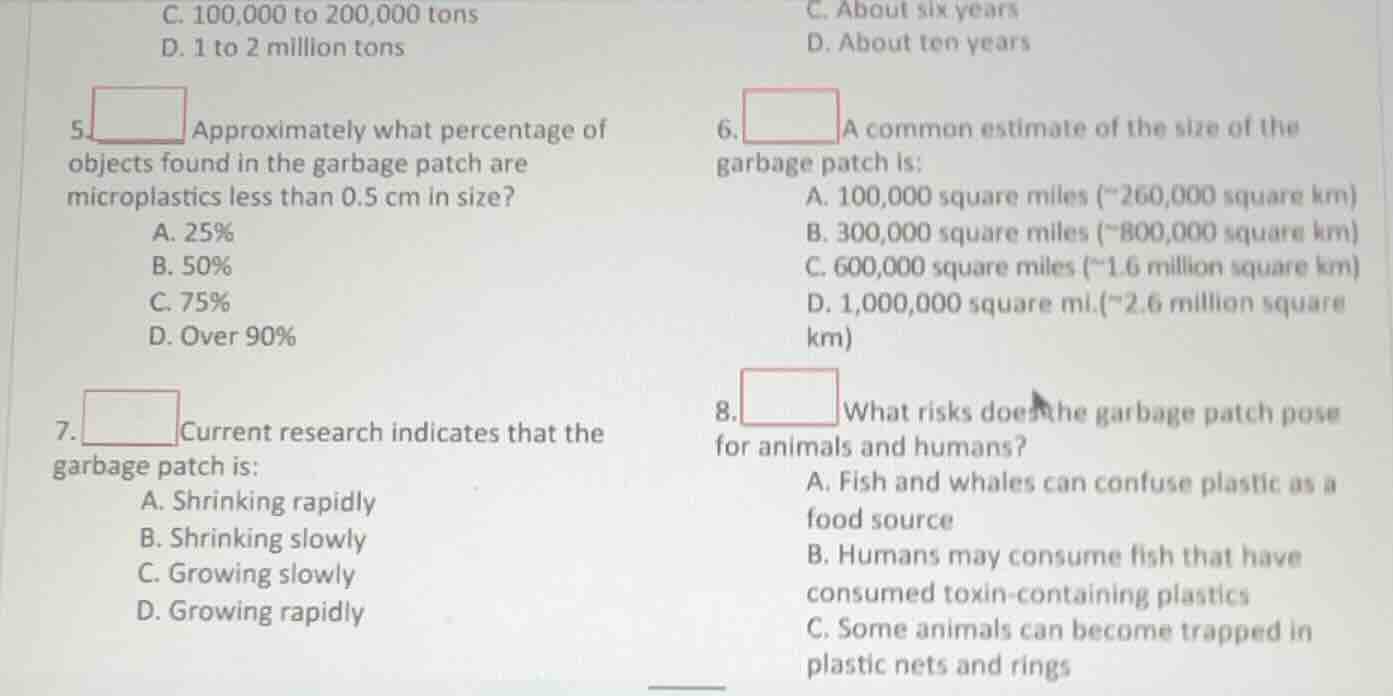
c. 100,000 to 200,000 tons d. 1 to 2 million tons 5. approximately what percentage of objects found in the garbage patch are microplastics less than 0.5 cm in size? a. 25% b. 50% c. 75% d. over 90% 6. a common estimate of the size of the garbage patch is: a. 100,000 square miles (~260,000 square km) b. 300,000 square miles (~800,000 square km) c. 600,000 square miles (~1.6 million square km) d. 1,000,000 square mi.(~2.6 million square km) 7. current research indicates that the garbage patch is: a. shrinking rapidly b. shrinking slowly c. growing slowly d. growing rapidly 8. what risks does the garbage patch pose for animals and humans? a. fish and whales can confuse plastic as a food source b. humans may consume fish that have consumed toxin - containing plastics c. some animals can become trapped in plastic nets and rings
- Scientific studies on ocean garbage patches show that the vast majority of debris are tiny microplastics, with over 90% being less than 0.5 cm.
- Widely cited estimates place the size of the Great Pacific Garbage Patch at around 1.6 million square kilometers, which converts to ~600,000 square miles.
- Current research consistently shows that ocean garbage patches are growing rapidly due to ongoing plastic pollution input.
- Ocean garbage patches pose multiple risks: animals mistake plastic for food, humans can ingest plastics/toxins by eating contaminated fish, and animals get trapped in larger plastic debris.

Snap & solve any problem in the app
Get step-by-step solutions on Sovi AI
Photo-based solutions with guided steps
Explore more problems and detailed explanations
- D. Over 90%
- C. 600,000 square miles (~1.6 million square km)
- D. Growing rapidly
- A. Fish and whales can confuse plastic as a food source; B. Humans may consume fish that have consumed toxin-containing plastics; C. Some animals can become trapped in plastic nets and rings