QUESTION IMAGE
Question
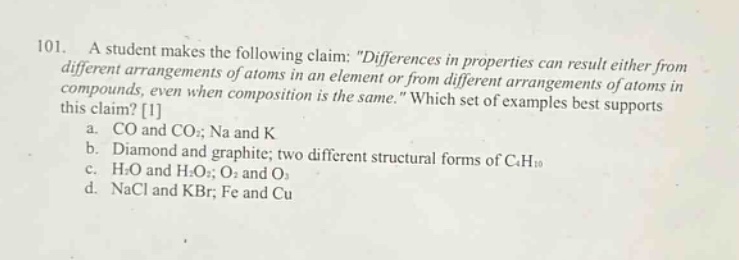
- a student makes the following claim: \differences in properties can result either from different arrangements of atoms in an element or from different arrangements of atoms in compounds, even when composition is the same.\ which set of examples best supports this claim? 1
a. co and co₂; na and k
b. diamond and graphite; two different structural forms of c₄h₁₀
c. h₂o and h₂o₂; o₂ and o₃
d. nacl and kbr; fe and cu
Brief Explanations
To support the claim, we need examples of: 1) an element with different atomic arrangements (allotropes) and 2) a compound with the same composition but different atomic arrangements (isomers or different structures).
- Option a: \( \text{CO} \) and \( \text{CO}_2 \) have different compositions (not same composition for compounds), and \( \text{Na} \) and \( \text{K} \) are different elements (not different arrangements of same element). Eliminate.
- Option b: Diamond and graphite are allotropes of carbon (different arrangements of atoms in the same element). Two different structural forms of \( \text{C}_4\text{H}_{10} \) (butane and isobutane) are isomers (same composition, different atomic arrangements in a compound). This matches both parts of the claim.
- Option c: \( \text{H}_2\text{O} \) and \( \text{H}_2\text{O}_2 \) have different compositions (not same composition for compounds). \( \text{O}_2 \) and \( \text{O}_3 \) are allotropes (good for element part, but compound part fails). Eliminate.
- Option d: \( \text{NaCl} \) and \( \text{KBr} \) have different compositions (different elements). \( \text{Fe} \) and \( \text{Cu} \) are different elements. Eliminate.

Snap & solve any problem in the app
Get step-by-step solutions on Sovi AI
Photo-based solutions with guided steps
Explore more problems and detailed explanations
b. Diamond and graphite; two different structural forms of \( \text{C}_4\text{H}_{10} \)