QUESTION IMAGE
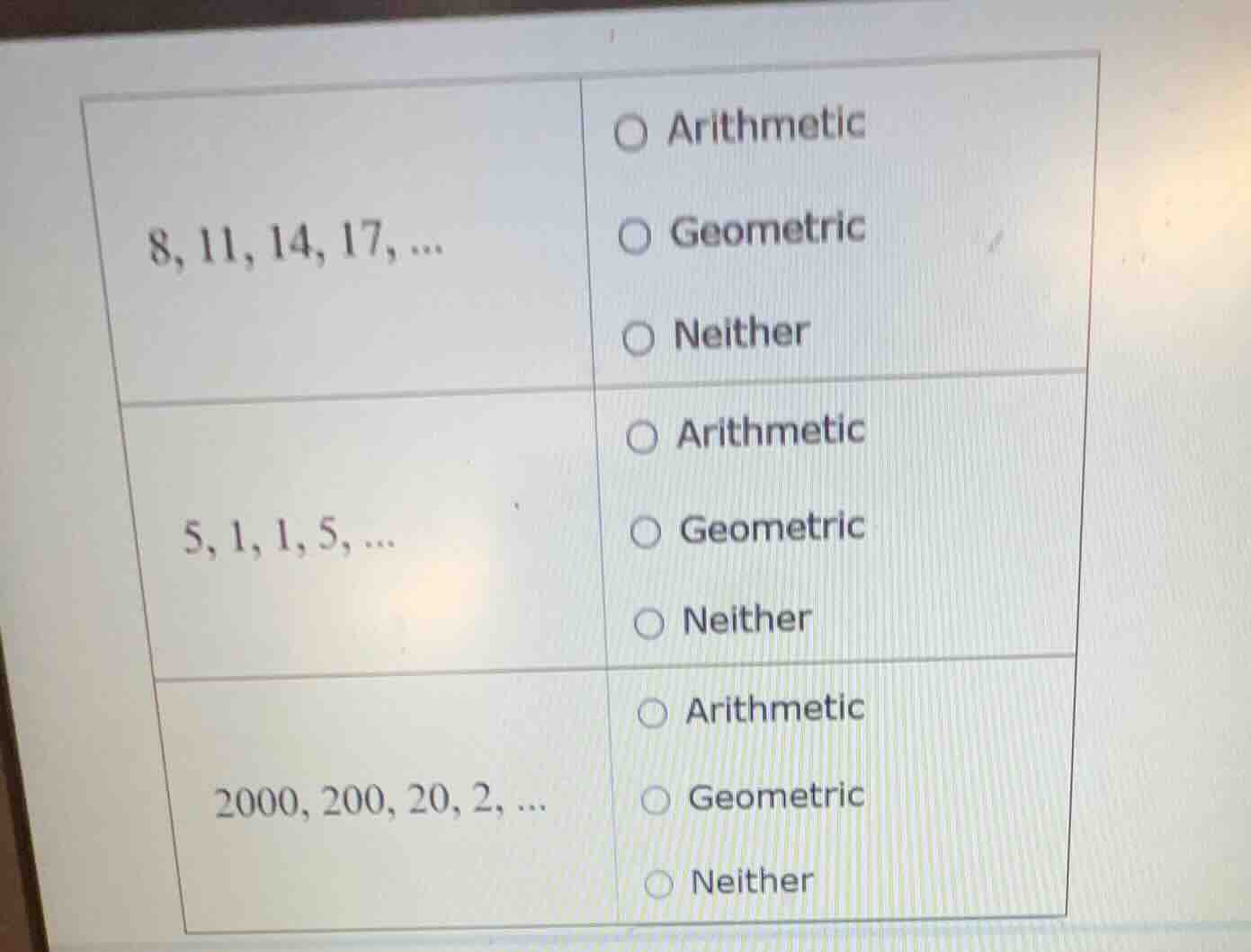
Question
8, 11, 14, 17, ...
○ arithmetic
○ geometric
○ neither
5, 1, 1, 5, ...
○ arithmetic
○ geometric
○ neither
2000, 200, 20, 2, ...
○ arithmetic
○ geometric
○ neither
First Sequence: \( 8, 11, 14, 17, \dots \)
Step1: Check for Arithmetic Sequence
An arithmetic sequence has a common difference \( d \) between consecutive terms. Calculate the differences: \( 11 - 8 = 3 \), \( 14 - 11 = 3 \), \( 17 - 14 = 3 \). The common difference \( d = 3 \) is constant.
Step2: Check for Geometric Sequence
A geometric sequence has a common ratio \( r \) between consecutive terms. Calculate the ratios: \( \frac{11}{8} = 1.375 \), \( \frac{14}{11} \approx 1.2727 \), \( \frac{17}{14} \approx 1.2143 \). The ratios are not constant. So it is arithmetic.
Second Sequence: \( 5, 1, 1, 5, \dots \)
Step1: Check for Arithmetic Sequence
Calculate the differences: \( 1 - 5 = -4 \), \( 1 - 1 = 0 \), \( 5 - 1 = 4 \). The differences are not constant.
Step2: Check for Geometric Sequence
Calculate the ratios: \( \frac{1}{5} = 0.2 \), \( \frac{1}{1} = 1 \), \( \frac{5}{1} = 5 \). The ratios are not constant. So it is neither.
Third Sequence: \( 2000, 200, 20, 2, \dots \)
Step1: Check for Arithmetic Sequence
Calculate the differences: \( 200 - 2000 = -1800 \), \( 20 - 200 = -180 \), \( 2 - 20 = -18 \). The differences are not constant.
Step2: Check for Geometric Sequence
Calculate the ratios: \( \frac{200}{2000} = 0.1 \), \( \frac{20}{200} = 0.1 \), \( \frac{2}{20} = 0.1 \). The common ratio \( r = 0.1 \) is constant. So it is geometric.

Snap & solve any problem in the app
Get step-by-step solutions on Sovi AI
Photo-based solutions with guided steps
Explore more problems and detailed explanations
- For \( 8, 11, 14, 17, \dots \): Arithmetic
- For \( 5, 1, 1, 5, \dots \): Neither
- For \( 2000, 200, 20, 2, \dots \): Geometric